
Last Updated on 19/08/2026
Introduction
Among patients using modafinil, one of the most frequently encountered clinical concerns is the gradual reduction in therapeutic efficacy over time. This phenomenon, known as tolerance, represents a genuine physiological adaptation rather than a failure of the medication or a psychological issue. The experience of diminishing returns (where a dose that once provided robust wakefulness and cognitive enhancement becomes noticeably less effective) is well-documented in clinical practice and reflects complex neurobiological and pharmacokinetic changes.
Modafinil tolerance develops through multiple interconnected mechanisms. At the neurobiological level, chronic exposure leads to dopamine transporter downregulation, reduced receptor sensitivity and compensatory changes in glutamate and GABA systems. Pharmacokinetically, the liver’s CYP450 enzyme system undergoes induction, accelerating drug clearance and shortening its duration of action. Understanding these mechanisms is essential for clinicians and patients alike, as it enables evidence-based strategies for prevention and management.
Analysis of modafinil tolerance, examining its underlying mechanisms, identifying risk factors and offering practical, evidence-based approaches to maintain therapeutic efficacy while minimizing the risks of dose escalation and adverse effects.
Defining Tolerance
Tolerance is a physiological phenomenon characterized by a diminished response to a fixed dose of a medication over time, necessitating dose escalation to achieve the original effect. In the context of modafinil, this manifests as reduced wakefulness-promoting effects, diminished cognitive enhancement, shortened duration of action and a perceived need for higher doses.
It is important to distinguish true pharmacodynamic tolerance from other phenomena that may produce similar clinical presentations. Pharmacodynamic tolerance involves reduced receptor sensitivity or downstream signaling, representing the primary mechanism in modafinil use through DAT downregulation and receptor desensitization. Pharmacokinetic tolerance, in contrast, involves increased drug metabolism or clearance through CYP enzyme induction, which accelerates drug elimination. Behavioral tolerance represents learned adaptation to drug effects, essentially psychological habituation to cognitive enhancement. Pseudo-tolerance refers to perceived reduced efficacy due to non-drug factors such as sleep deprivation, stress or nutritional deficiencies.
The clinical significance of tolerance extends beyond diminished efficacy. When patients experience reduced effects, they may be tempted to increase their dose without medical supervision, raising the risk of side effects including anxiety, insomnia and cardiovascular effects. Additionally, the perception of needing higher doses can contribute to psychological dependence, while patients may continue taking a medication that no longer provides meaningful benefit, wasting both financial and medical resources.
Neurobiological Mechanisms of Tolerance
The development of tolerance to modafinil is primarily driven by neuroadaptive changes in the dopamine system. The dopamine transporter (DAT) represents a critical target for modafinil wakefulness-promoting effects and chronic exposure leads to compensatory changes that reduce the drug’s efficacy. DAT downregulation results in decreased numbers of transporter molecules available for modafinil to inhibit, leading to reduced dopamine elevation. Concurrently, D2 receptor desensitization diminishes postsynaptic dopamine receptor sensitivity, resulting in reduced dopamine signaling despite increased extracellular dopamine. Autoreceptor upregulation enhances inhibitory feedback mechanisms, reducing dopamine release, while neurotransmitter depletion reduces dopamine synthesis and storage capacity.
Beyond the dopamine system, modafinil’s influence on glutamatergic and GABAergic pathways undergoes compensatory changes that further contribute to tolerance. Prolonged stimulation can lead to reduced AMPA receptor sensitivity, altered NMDA receptor function and changes in glutamate transporter expression. Compensatory GABAergic upregulation may counteract modafinil’s excitatory effects, contributing to reduced wakefulness promotion and diminished cognitive enhancement.
The orexin and histamine systems, which modafinil indirectly activates to promote wakefulness, also undergo adaptations. Reduced orexin neuron firing diminishes wakefulness signals, while H1 receptor downregulation reduces cortical arousal and decreased orexin receptor density weakens downstream signaling. These interconnected neuroadaptive changes collectively contribute to the reduced efficacy observed with chronic modafinil use.
Pharmacokinetic Mechanisms of Tolerance
Pharmacokinetic tolerance develops through changes in drug metabolism and clearance. Modafinil is metabolized primarily by CYP3A4 and CYP2C19 enzymes in the liver, and chronic use can induce these enzymes, accelerating drug clearance and reducing its duration of action.
The induction of CYP3A4 activity leads to faster clearance and reduced drug levels, while CYP2C19 shows variable induction that may also accelerate clearance. Phase II enzymes may undergo induction as well, enhancing elimination. Individual genetic variation in CYP enzyme activity significantly influences tolerance risk. Poor metabolizers may develop tolerance more slowly due to slower clearance, while ultra-rapid metabolizers experience faster clearance that may accelerate tolerance development. Intermediate metabolizers face moderate risk.
Transport proteins also play a role in tolerance development. ABCB1 (P-glycoprotein) transports modafinil out of the brain and chronic exposure may upregulate this transporter, reducing brain penetration. Blood-brain barrier changes may also alter drug penetration, resulting in diminished central nervous system exposure and reduced efficacy.
Risk Factors for Tolerance Development
| Risk Factor Category | Specific Factors | Mechanism |
|---|---|---|
| Genetic Factors | CYP enzyme variants, COMT polymorphisms, DAT gene variants | Altered metabolism, dopamine signaling |
| Dosing Patterns | Daily use, high doses, long-term continuous use | Accelerated receptor adaptation |
| Sleep Status | Chronic sleep deprivation, poor sleep hygiene | Increased homeostatic sleep drive |
| Lifestyle Factors | Poor nutrition, lack of exercise, high stress | Altered neurotransmitter function |
| Concomitant Medications | Other stimulants, caffeine, nicotine | Additive effects on receptor adaptation |
Tolerance does not develop uniformly across all individuals. Genetic factors play a significant role, with variations in CYP enzymes, COMT polymorphisms, and DAT gene variants influencing both metabolism and dopamine signaling. Dosing patterns are equally important: daily use, high doses, and long-term continuous use all accelerate receptor adaptation. Sleep status significantly affects tolerance risk, as chronic sleep deprivation and poor sleep hygiene increase homeostatic sleep drive, potentially counteracting modafinil’s effects.
Lifestyle factors, including poor nutrition, lack of exercise, and high stress levels, can alter neurotransmitter function and accelerate tolerance development. Concomitant medications, particularly other stimulants like amphetamines, caffeine and nicotine, can have additive effects on receptor adaptation through shared dopamine pathways.
Clinical Indicators of Tolerance
| Indicator | Description | Clinical Significance |
|---|---|---|
| Reduced Wakefulness | Feeling less alert despite taking the same dose | Classic pharmacodynamic tolerance |
| Diminished Cognitive Enhancement | Decreased focus, memory, or problem-solving ability | Reduced therapeutic efficacy |
| Increased Fatigue or Brain Fog | Experiencing tiredness despite modafinil use | Tolerance to wakefulness effects |
| Shortened Duration of Effects | Modafinil wears off faster than usual | Pharmacokinetic tolerance (enzyme induction) |
| Need for Higher Doses | Compulsion to increase dosage for similar results | High risk for side effects and dependence |
Recognizing early signs of tolerance is essential to prevent dependence and ineffective usage. Patients experiencing reduced wakefulness may feel less alert despite taking the same dose, representing classic pharmacodynamic tolerance. Diminished cognitive enhancement manifests as decreased focus, memory or problem-solving ability, indicating reduced therapeutic efficacy. Increased fatigue or brain fog suggests tolerance to wakefulness effects, while a shortened duration of effects points to pharmacokinetic tolerance through enzyme induction.
The most concerning indicator is the need for higher doses, where patients feel compelled to increase dosage for similar results. This pattern significantly raises the risk of side effects and psychological dependence.
Clinical suspicion should arise when patients report reduced efficacy after at least 2-4 weeks of continuous use, when side effects diminish while therapeutic effects also decrease, when dose escalation fails to restore previous effectiveness or when dose escalation leads to side effects without proportional benefit.
Prevention Strategies
| Strategy | Implementation | Evidence Level |
|---|---|---|
| Intermittent Dosing | 2-3 times per week, not daily | Clinical consensus |
| Scheduled Breaks | 1-2 weeks off every 1-2 months | Limited but positive |
| Lowest Effective Dose | Use minimal dose that provides benefit | Strong clinical evidence |
| As-Needed Use | Use only when necessary, not routinely | Supported by clinical guidelines |
| Dose Reduction | Reduce dose as soon as efficacy decreases | Prevents further adaptation |
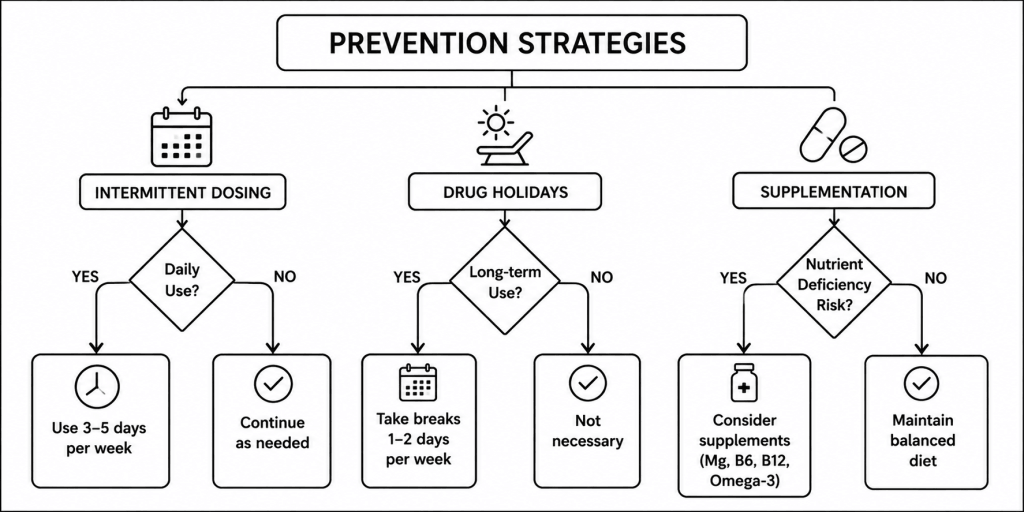
Medication cycling is one of the most effective strategies for preventing or slowing tolerance development. Intermittent dosing, using modafinil 2-3 times per week rather than daily, allows receptor recovery periods between exposures. Scheduled breaks of 1-2 weeks every 1-2 months provide longer recovery periods. Using the lowest effective dose minimizes receptor stimulation, while as-needed use prevents unnecessary receptor adaptation. Dose reduction as soon as efficacy decreases helps prevent further adaptation.
Supplementation strategies can support neurotransmitter function and potentially slow tolerance development. L-Tyrosine, a dopamine precursor, may help replenish dopamine stores at doses of 500-2000 mg/day. N-Acetylcysteine (NAC), which modulates glutamate and provides antioxidant support, may be beneficial at 600-1200 mg/day. Magnesium, an NMDA receptor blocker, may help at 200-400 mg/day. Other supplements like vitamin C, B-complex vitamins, and uridine may offer additional support, though evidence is more limited.
Lifestyle interventions play a crucial role in tolerance prevention. Optimal sleep hygiene reduces homeostatic sleep pressure, enhancing wakefulness response. Regular exercise enhances dopamine receptor sensitivity, slowing tolerance development. Stress management reduces cortisol-mediated receptor changes, preserving receptor function. Balanced nutrition provides neurotransmitter precursors, supporting dopamine function. Intermittent fasting may enhance dopamine sensitivity, potentially slowing tolerance development.
Clinical Management of Tolerance
When tolerance develops, a systematic clinical approach is essential. The first step involves assessing and confirming that reduced efficacy is not due to pseudo-tolerance factors. Sleep deprivation should be evaluated through assessment of sleep quality and duration. Nutritional deficiencies require dietary review and consideration of supplement use. Psychological factors, including stress and mood changes, should be evaluated. Drug interactions should be reviewed by assessing concomitant medications.
Once true tolerance is confirmed, prevention strategies should be implemented. This involves initiating medication cycling if not already in place, optimizing sleep hygiene, reviewing supplement use and considering lifestyle modifications.
If tolerance persists despite these measures, dose adjustment may be considered. Tapering down to the lowest effective dose is preferred over increasing the dose. If dose increase is necessary, it should be done cautiously under medical supervision with careful monitoring for side effects.
If tolerance is significant and management strategies fail to restore efficacy, evaluating alternative medications should be considered. Options include switching to a different wakefulness-promoting agent, combining with non-pharmacologic interventions or using alternative nootropics with different mechanisms
Conclusion
Modafinil tolerance is a clinically significant phenomenon resulting from neurobiological adaptations (receptor downregulation, DAT changes and neurotransmitter system shifts) combined with pharmacokinetic changes in drug metabolism. Understanding these mechanisms is essential for maintaining therapeutic efficacy and preventing dose escalation that may lead to adverse effects.
The most effective strategies for managing tolerance are preventive: intermittent dosing, scheduled breaks, lifestyle optimization and early recognition of tolerance indicators. By implementing these evidence-based approaches, patients can maintain modafinil’s benefits while minimizing the risks of dose escalation and adverse effects.
For patients and clinicians alike, informed and proactive management of modafinil tolerance is the key to sustainable, safe and effective use. A collaborative approach between patient and healthcare provider, with open communication about efficacy and concerns, ensures the best possible therapeutic outcomes.
FAQ
What is modafinil tolerance and how quickly does it develop?
Modafinil tolerance is a diminished response to the same dose over time, typically developing over weeks to months of continuous use. Some individuals notice changes within a few weeks, while others maintain effectiveness for longer periods. The rate varies based on dosage, frequency and individual genetic factors.
Can modafinil tolerance be prevented?
Yes. Cycling usage (2-3 times per week), taking drug holidays (1-2 weeks off every 1-2 months), using the lowest effective dose, optimizing sleep, maintaining good nutrition and considering supportive supplements can all help prevent or slow tolerance development.
Is modafinil tolerance permanent?
No. Tolerance to modafinil is generally reversible. When the medication is discontinued or reduced, receptor sensitivity and enzyme activity return toward baseline. A drug holiday of 1-2 weeks can often restore sensitivity, though longer breaks may be needed for some individuals.
Does tolerance increase addiction risk?
Not directly. However, the compulsion to escalate doses to regain lost effects can contribute to psychological dependence. This is why dose escalation without medical supervision is discouraged. Patients should discuss any dose adjustments with their healthcare provider.
Can I combine modafinil with other nootropics to avoid tolerance?
Combining modafinil with other nootropics may be helpful for some individuals but carries risks. Different agents may have additive effects or interact unpredictably. Always use medications and supplements under medical supervision to avoid interactions.
‼️ Disclaimer: The information provided in this article about modafinil is intended for informational purposes only and is not a substitute for professional medical consultation or recommendations. The author of the article are not responsible for any errors, omissions, or actions based on the information provided.
References:
- TGA eBS – Product and Consumer Medicine Information Licence. Archived from the original on 2024
- 64 FR 4050 – Schedules of Controlled Substances: Placement of Modafinil Into Schedule IV. Federal register. Department of Justice. 2024
- Modafinil Monograph for Professionals. Drugs.com. American Society of Health-System Pharmacists. 2023
- FDA-sourced list of all drugs with black box warnings. nctr-crs.fda.gov. 2023
- Modafinil Product information. Health Canada. 2022
- Sousa A, Dinis-Oliveira RJ. Pharmacokinetic and pharmacodynamic of the cognitive enhancer modafinil: Relevant clinical and forensic aspects. 2020
- Hersey M, Tanda G. Modafinil, an atypical CNS stimulant?. Pharmacological Advances in Central Nervous System Stimulants. 2024
- Robertson P, Hellriegel ET. Clinical pharmacokinetic profile of modafinil. Clinical Pharmacokinetics. 2003
- Yaroslav Winter, Christina Lang, Ulf Kallweit, David Apel, Vinzenz Fleischer, Erik Ellwardt, Sergiu Groppa. Pitolisant-supported bridging during drug holidays to deal with tolerance to modafinil in patients with narcolepsy. Sleep Med. https://pubmed.ncbi.nlm.nih.gov/37839272/. 2023
- Dr. Biswajit Sinha, MS Nataraja, Harshavardhan G. The Effect of Modafinil on +Gz Tolerance in Healthy Male Aircrew. Indian Journal of Aerospace Medicine. https://www.researchgate.net/publication/384968890_The_Effect_of_Modafinil_on_Gz_Tolerance_in_Healthy_Male_Aircrew. 2018