
Last Updated on 20/08/2026
Introduction: Beyond the “Smart Drug” Label
Modafinil represents one of the most extensively studied and clinically versatile pharmaceuticals developed in the last three decades. Yet public understanding often lags behind the science. It is neither a traditional stimulant nor a mythical “Limitless pill.” Modafinil is a eugeroic, a distinct pharmacological class defined by selective, sustained wakefulness promotion with minimal peripheral sympathomimetic activation and exceptionally low abuse liability.
How modafinil works, how its effects manifest across different user populations and how it compares to other cognitive enhancers. The discussion extends beyond isolated “productivity hacks” to provide comprehensive information on pharmacodynamics, pharmacokinetics, real-world effectiveness and evidence-based strategies for optimizing the drug’s effects. For the clinician, modafinil offers a safe, effective and non-addictive option for managing disorders of excessive sleepiness and in select cases, adjunctive treatment of cognitive dysfunction.
Pharmacodynamics: The Multi-Neurotransmitter Mechanism
Understanding modafinil requires abandoning the stimulant paradigm. Its mechanism is multi-pathway, region-specific and fundamentally different from amphetamines. At the dopamine transporter (DAT), modafinil binds and inhibits dopamine reuptake, but achieves only approximately 50% DAT occupancy at therapeutic doses (200-400 mg). Unlike cocaine or amphetamine, it does not reverse the vesicular monoamine transporter (VMAT2). This results in extracellular dopamine that rises slowly and modestly, reaching pro-cognitive levels without euphoria or addiction-triggering spikes. The clinical consequence is enhanced motivation, working memory and executive function without “rush” or compulsive redosing behavior.
Beyond dopamine, modafinil directly activates orexin neurons in the lateral hypothalamus, stabilizing wakefulness and stimulates histamine release from the tuberomammillary nucleus. Histamine is the brain’s primary wakefulness neurotransmitter and this mechanism explains modafinil efficacy in narcolepsy (orexin deficiency) and its clean, non-jittery alertness. The clinical consequence is sustained vigilance without anxiety or tremor.
Modafinil also modulates glutamate and GABA systems, increasing extracellular glutamate in the prefrontal cortex and hippocampus while reducing GABAergic inhibitory tone. This shifts cortical networks toward an optimized excitatory state, facilitating long-term potentiation and synaptic plasticity. The clinical consequence is improved cognitive flexibility, faster learning and enhanced complex problem-solving. Additionally, modafinil weakly inhibits the norepinephrine transporter, increasing cortical norepinephrine and contributing to attention enhancement and the subjective feeling of “readiness.”
Subjective and Objective Effect Profile
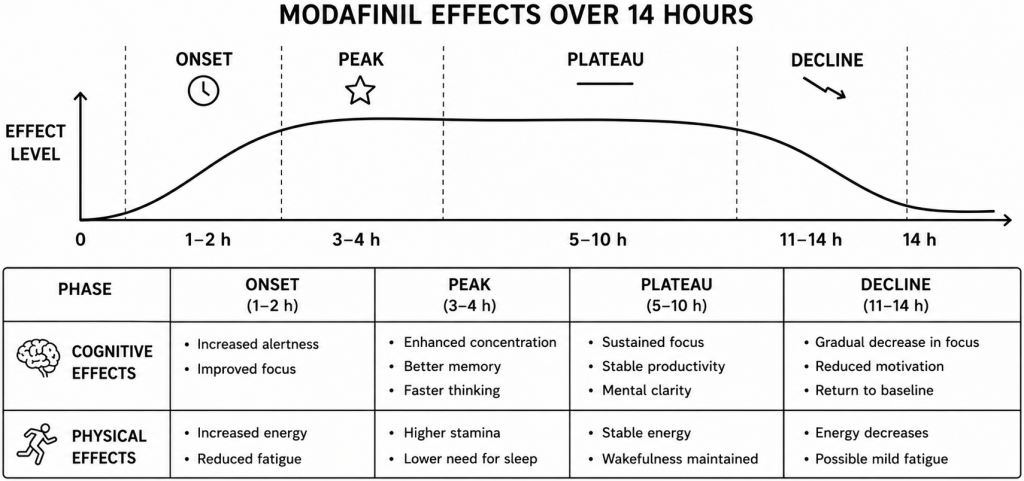
| Effect Domain | Onset (0-2 hrs) | Peak (2-6 hrs) | Plateau (6-10 hrs) | Decline (10-14 hrs) |
|---|---|---|---|---|
| Wakefulness | Subtle lifting of fatigue | Complete abolition of sleepiness | Stable alertness maintained | Gradual return of normal fatigue signaling |
| Motivation | “Task initiation” impulse emerges | Procrastination eliminated | Sustained effort without boredom | Motivation declines with task completion |
| Focus/Attention | Mild difficulty concentrating | “Laser focus” sustained attention | Deep work possible for hours | Attention wanes, multitasking harder |
| Cognition | No immediate change | Enhanced working memory, faster recall | Complex problem-solving maintained | Cognitive flexibility preserved but slowing |
| Mood | Neutral or mild well-being | Stable, calm focus. No euphoria | No significant mood elevation or depression | No crash, neutral return to baseline |
| Physical | No sensation | Possible mild headache or dry mouth | Decreased appetite | Mild fatigue if sleep-deprived |
Modafinil’s effects are state-dependent and dose-dependent. The experience of a sleep-deprived resident differs significantly from a well-rested executive. A critical clinical note is that euphoria is absent. If a user reports euphoria, clinicians should consider extremely high supra-therapeutic doses, adulterated products, misattribution, co-ingestion with other substances or an individual with no prior stimulant exposure misinterpreting alertness as euphoria.
Comparative Pharmacology
| Parameter | Modafinil | Caffeine | Amphetamine (Adderall) | Methylphenidate (Ritalin) |
|---|---|---|---|---|
| Mechanism (Primary) | DAT inhibition, orexin activation | Adenosine receptor antagonist | DAT/NET reversal (VMAT2 release) | DAT/NET inhibition |
| DAT Occupancy (Therapeutic) | ~50% | 0% | >80% | >60% |
| Euphoria/”High” | None | None | Moderate-High | Low-Moderate |
| Abuse Liability (DEA) | Schedule IV (Low) | Not Scheduled | Schedule II (High) | Schedule II (High) |
| Duration of Action | 12-15 hours | 3-5 hours | 4-6h (IR); 10-12h (XR) | 3-4h (IR); 8-12h (XR) |
| Peripheral Side Effects | Mild (HA, dry mouth) | Jitteriness, tachycardia, GI distress | Significant: tachycardia, hypertension, tremor, appetite suppression | Similar to amphetamine, often less severe |
| Tolerance Development | Slow, mild | Moderate, rapid | Rapid, significant | Moderate-rapid |
| Crash/Withdrawal | Mild rebound sleepiness | Headache, fatigue | Severe fatigue, anhedonia, hypersomnia | Moderate fatigue, dysphoria |
| Best Clinical Indication | Narcolepsy, SWSD, OSA residual EDS | General fatigue | ADHD, narcolepsy | ADHD |
Modafinil should be chosen when sustained, clean wakefulness is needed, when the patient has stimulant sensitivity, when abuse risk is a concern or when a long duration of action is required. Amphetamines or methylphenidate should be chosen when potent, rapid symptom control for severe ADHD is required or when the patient has not responded to modafinil.
Clinical Efficacy Evidence
For FDA-approved indications, robust evidence supports modafinil’s use. In narcolepsy, multiple randomized controlled trials demonstrate significant reduction in excessive daytime sleepiness, with Epworth Sleepiness Scale score reductions of 4-6 points. Modafinil is considered first-line therapy. In obstructive sleep apnea, it is approved for residual sleepiness despite optimal CPAP therapy, treating the symptom rather than the apnea itself. In shift work sleep disorder, modafinil is superior to placebo in maintaining nighttime alertness and cognitive performance at a dose of 200 mg taken one hour before the shift.
Off-label applications show moderate-quality evidence. Across multiple meta-analyses in adult ADHD, modafinil demonstrates efficacy superior to placebo but inferior to amphetamines, positioning it as a useful second-line option for non-responders or those who cannot tolerate stimulants. As an adjunct in major depressive disorder, it effectively addresses residual fatigue and sleepiness following partial response to SSRIs or SNRIs, although it does not alleviate core mood symptoms. The evidence for fatigue in multiple sclerosis remains mixed, yet some patients experience marked improvement, justifying a therapeutic trial in refractory cases. Among sleep-deprived healthy adults, robust data support gains in vigilance, executive function and working memory, whereas benefits in well-rested individuals are subtle and highly task-dependent.
Practical Optimization
| Phase | Dose | Timing | Goal |
|---|---|---|---|
| Day 1 | 50 mg (1/4 pill) | 7:00-8:00 AM | Assess tolerance, CYP2D6/CYP3A4 metabolism rate |
| Day 2 | 100 mg (1/2 pill) | 7:00-8:00 AM | Establish baseline therapeutic response |
| Day 3+ | 100-200 mg | 7:00-8:00 AM | Maintenance dose; titrate to effect |
The critical rule is never to take modafinil after 12:00 PM. The half-life of 12-15 hours means late dosing guarantees insomnia.
Tolerance management protocols are essential for long-term efficacy. The standard intermittent protocol of 2-3 times per week (Monday, Wednesday, Friday) maintains efficacy for most users long-term. A cyclical approach of 3 weeks on followed by 1 week off works well for chronic, high-demand periods such as exams or project deadlines. Mini-holidays of 2-4 consecutive days off every 2-3 weeks help reset DAT sensitivity. Dose reduction, returning to 50-100 mg after a period of 200 mg daily use, re-sensitizes without full cessation.
Side effects can be effectively managed. Headache, often due to dehydration or muscle tension, responds to hydration of 500 mL water with the dose followed by 250 mL per hour plus electrolytes. Dry mouth, from a mild anticholinergic-like effect, responds to sugar-free gum and frequent sips of water. Insomnia is prevented by a hard stop: no dosing after 10:00 AM. Anxiety and jitteriness, caused by excessive dose or caffeine synergy, respond to dose reduction to 50 mg and elimination of caffeine on dosing days. Appetite suppression, mediated by DAT, is managed with phone reminders to eat small, frequent meals.
Safety, Contraindications, and High-Risk Populations
| Condition | Risk | Action |
|---|---|---|
| Uncontrolled Hypertension | Exacerbation, cardiovascular event | Contraindicated until BP controlled |
| Cardiac Arrhythmia / LVH | Increased cardiac workload | Generally contraindicated, cardiology consult |
| Pregnancy / Breastfeeding | Teratogenicity risk (animal data); excretion in milk | Avoid |
| History of Psychosis / Mania | May precipitate psychotic/manic episode | Contraindicated (except rare specialist cases) |
| Severe Hepatic Impairment (Child-Pugh C) | Reduced metabolism, accumulation | Dose reduction by 50% or avoid |
| Hormonal Contraceptives | Reduced efficacy (CYP3A4 induction) | Mandatory non-hormonal backup method |
Modafinil is generally safe for healthy adults aged 18-65 with normal cardiac, hepatic and renal function and for long-term use under medical supervision in narcolepsy patients. However, several contraindications and cautions exist. Uncontrolled hypertension is a contraindication until blood pressure is controlled. Cardiac arrhythmia or left ventricular hypertrophy generally contraindicate use. Pregnancy and breastfeeding should avoid modafinil due to teratogenicity risk in animal data and excretion in milk. A history of psychosis or mania is a contraindication except in rare specialist cases. Severe hepatic impairment requires dose reduction by 50% or avoidance. Hormonal contraceptives require mandatory non-hormonal backup methods due to CYP3A4 induction.
Conclusion
Modafinil is not a “stimulant lite.” It is a distinct pharmacological entity with a mechanism of action combining selective DAT inhibition, orexin activation, and glutamate/GABA modulation that produces a therapeutic profile unmatched by any other agent. For the clinician, it offers a safe, effective and non-addictive option for managing disorders of excessive sleepiness and in select cases, adjunctive treatment of cognitive dysfunction.
For the informed, responsible user, modafinil offers a powerful tool for cognitive optimization provided it is used with respect for its potency, adherence to evidence-based protocols and a clear understanding that it enhances capacity but does not replace discipline, sleep or nutrition. When used correctly, modafinil does not make users “smarter.” It allows access to the intelligence and skills already possessed, without the barrier of fatigue. That is its true value.
FAQ
Does modafinil show up on a drug test?
Yes. Standard military, aviation and some workplace drug screens include modafinil (Schedule IV). A valid prescription is required to justify a positive result. Users should be aware of their employer’s testing policies.
Can I drink coffee with modafinil?
Not recommended, especially for new users. Synergistic stimulation significantly increases anxiety, jitteriness and tachycardia. If caffeine is desired, limit to 1 small cup and monitor response carefully. Many users find they need less caffeine while taking modafinil.
Why don’t I feel “high” or euphoric?
This is normal and expected. Modafinil is not a euphoriant. The absence of a “high” is evidence of its low abuse potential. The goal is enhanced function, not altered perception. Patients should be counseled that this is a sign of appropriate therapeutic effect.
Does modafinil cause hair loss?
No. There is no established causal link between modafinil and alopecia. This myth originates from unverified anecdotal reports, it is not supported by pharmacovigilance data or clinical trials. Patients should be reassured on this point.
‼️ Disclaimer: The information provided in this article about modafinil is intended for informational purposes only and is not a substitute for professional medical consultation or recommendations. The author of the article are not responsible for any errors, omissions, or actions based on the information provided.
References:
- Mayoclinic – «Modafinil (Oral Route)». https://www.mayoclinic.org/drugs-supplements/modafinil-oral-route/side-effects/drg-20064870 . 2023
- Prommer E. Modafinil: is it ready for prime time? J Opioid Manag. 2006
- Volkow ND, Fowler JS, Logan J, Alexoff D, Zhu W, Telang F, et al. Effects of modafinil on dopamine and dopamine transporters in the male human brain: clinical implications. JAMA. 2009
- Simon P, Hémet C, Ramassamy C, Costentin J. Non-amphetaminic mechanism of stimulant locomotor effect of modafinil in mice. Eur Neuropsychopharmacol. 1995
- Kumar R. Approved and investigational uses of modafinil: an evidence-based review. Drugs. 2008
- Lyon, R. C. Stability profiles of drug products extended beyond labeled expiration dates. Available at: https://www.ncbi.nlm.nih.gov/pubmed/16721796 . 2006
- Alacam, H. Modafinil dependence: A case with attention-deficit/hyperactivity disorder. Available at: https://www.ncbi.nlm.nih.gov/pmc/articles/PMC5912487/ . 2018
- Stuhec, M.Efficacy, acceptability, and tolerability of lisdexamfetamine, mix amphetamine salts, methylphenidate, and modafinil in the treatment of attention-deficit hyperactivity disorder in adults. Available at: https://www.ncbi.nlm.nih.gov/pubmed/30117329 . 2018
- Scammell, T. E. Narcolepsy. https://www.nejm.org/doi/full/10.1056/NEJMra1500587? 2015
- Use expired medicines. https://www.fda.gov/drugs/resourcesforyou/specialfeatures/ucm481139.htm . 2016
- Paul Gerrard, Robert Malcolm. Mechanisms of modafinil: A review of current research. Neuropsychiatr Dis Treat. https://pmc.ncbi.nlm.nih.gov/articles/PMC2654794/. 2007
- Melinda Hersey, Gianluigi Tanda. Modafinil, an atypical CNS stimulant? Adv Pharmacol. https://pmc.ncbi.nlm.nih.gov/articles/PMC12004278/. 2025