Last Updated on 03/09/2026
The Myth of Synergy
The patient had read online that modafinil and cannabis complement each other perfectly: the former ensures intense focus, while the latter unlocks creative potential. For several weeks, he experienced an incredible surge of energy and productivity. But one day, when he sat down to write an important report, he found himself simply staring at a blank screen, fragmented thoughts were racing chaotically through his mind, impossible to piece together. His heart was pounding wildly, his palms were sweating and the creative spark he had once proudly boasted about had given way to intense anxiety.
Such cases are not uncommon. The internet is full of testimonials about this combination, yet clinical practice suggests otherwise. There is no synergy here, on the contrary, there is pharmacological antagonism: modafinil drives the brain toward wakefulness, while cannabis plunges it into a state of cognitive fog. The result is unpredictable and often unpleasant, ranging from a rapid heartbeat to memory lapses. I have treated patients who faced these issues and I can say with confidence: the risks far outweigh any hypothetical benefits. There is no reliable scientific evidence to confirm that these substances work more effectively in tandem. In reality, they simply work against each other.
Pharmacological Antagonism
True pharmacological synergy occurs when two drugs interact to produce an effect greater than the sum of their individual effects. Modafinil and cannabis do not meet this criterion. Their mechanisms oppose each other, creating a net effect that is unpredictable and potentially dangerous.
| Neurobiological Target | Modafinil Effect | Cannabis (THC) Effect | Predicted Interaction |
|---|---|---|---|
| Dopamine | Increases extracellular dopamine via DAT inhibition | Increases dopamine release in nucleus accumbens, but disrupts prefrontal dopamine signaling | Complex, non-linear. May increase reward salience but impair executive function |
| Acetylcholine | Enhances cholinergic transmission in cortex (pro-cognitive) | Impairs cholinergic function, linked to memory deficits | Antagonistic. Modafinil cognitive benefits may be negated by THC-induced memory impairment |
| Glutamate | Increases cortical glutamate (enhances excitation, LTP) | Disrupts glutamate signaling, particularly in hippocampus (impairs memory consolidation) | Antagonistic. Likely net negative effect on learning and memory |
| GABA | May reduce GABAergic tone (promotes excitation) | Increases GABA release in some regions (promotes inhibition, sedation) | Opposing. Net effect on arousal is unpredictable |
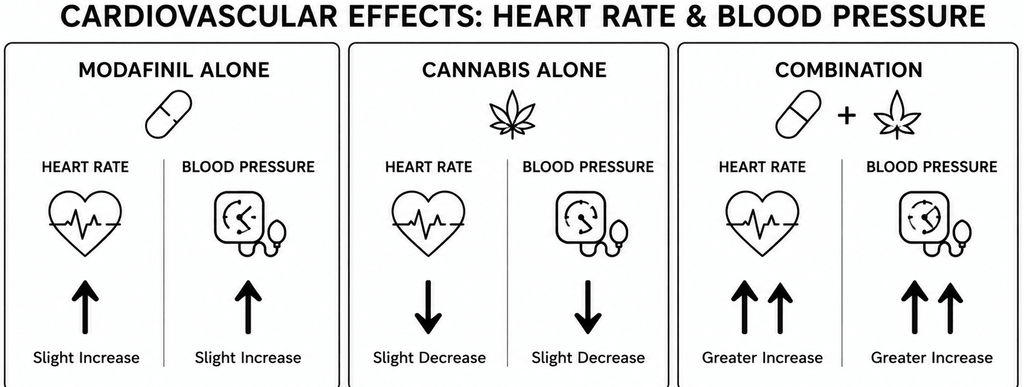
| Cardiovascular | Mild-moderate increase in HR and BP | Increases HR (tachycardia), can cause orthostatic hypotension | Additive/Synergistic risk. Combined use may cause significant tachycardia and blood pressure fluctuations |
The term “synergy” is frequently misused in online discussions. Pharmacology demands precision. The available evidence points toward opposing or nullifying interactions, not synergy.
The Scientific Literature
The Single Relevant Study
The most direct evidence comes from a 2011 study published in Pharmacology, Biochemistry and Behavior: “The safety of modafinil in combination with oral Δ9-tetrahydrocannabinol in humans.”
| Study Parameter | Details |
|---|---|
| Design | Double-blind, placebo-controlled, within-subject |
| Participants | Healthy adults with history of cannabis use |
| Intervention | Modafinil (200 mg, 400 mg) or placebo, followed by oral THC (0 mg, 7.5 mg, 15 mg) |
| Outcomes | Subjective drug effects, cognitive performance, cardiovascular measures |
The findings were telling. Modafinil did not significantly alter the subjective “high” or rewarding effects of THC. It failed to reverse THC-induced memory impairment. In some measures, cognitive performance was worse. The combination produced additive increases in heart rate, particularly at higher doses.
The authors concluded: “These results do not support the use of modafinil to counteract the acute effects of THC.”
Absence of Other Evidence
To date, not a single study has proven that this blend enhances mental performance or productivity. It lacks any recognized medical utility and critically, its safety profile over extended use has never been established.
The scientific literature does not support the anecdotal claims of beneficial “synergy.”
Analysis of Unsubstantiated Claims
Online forums and anecdotal reports frequently cite specific benefits. Each claim demands scrutiny.
“Modafinil cancels the lethargy, cannabis provides the creativity.”
Users report feeling focused yet relaxed. Creativity, however, is not a single entity. THC impairs executive function and memory, cognitive domains essential for complex creative work. Modafinil may enhance focus, but if memory is impaired, the content of that focus is degraded.
“Great for pain management: energy from modafinil, relief from cannabis.”
While plausible as a strategy, this is not synergy. It is simply using two drugs for two different symptoms. The cardiovascular and cognitive risks remain. The combination of a potent wakefulness agent and a psychoactive substance with known cognitive-impairing effects is, from a pharmacological standpoint, unwise.
“CBD-rich strains balance modafinil-induced anxiety.”
This is the most biologically plausible claim. CBD is a negative allosteric modulator of the CB1 receptor and may mitigate some of THC’s anxiogenic effects. However, no studies have tested this specifically with modafinil. CBD may reduce anxiety, but it does not eliminate cardiovascular risk or potential cognitive impairment.
“Enhanced creative flow state.”
“Flow” is a complex psychological state. There is no evidence that this combination reliably induces it. The impairment of working memory by THC argues against it. The available evidence suggests a complex, unpredictable and potentially dangerous interaction.
Clinical reality demands honesty. Anecdotal reports are hypothesis-generating, not evidence-establishing. They are subject to massive confirmation bias and placebo effects.
Documented and Theoretical Risks
Cardiovascular Strain
| Parameter | Modafinil Alone | Cannabis (THC) Alone | Combination (Predicted) |
|---|---|---|---|
| Heart Rate (HR) | Mild increase (5-10 bpm) | Moderate increase (20-50 bpm), dose-dependent | Additive increase. Potential for significant tachycardia, palpitations |
| Blood Pressure (BP) | Mild increase | Variable, can cause orthostatic hypotension | Unpredictable. Risk of BP fluctuations, dizziness, syncope |
| Risk for Vulnerable Individuals | Caution in those with hypertension, arrhythmia | Caution in those with CAD, arrhythmia | Contraindicated. Those with any cardiovascular history should avoid |
The additive cardiovascular effects represent the most immediate and measurable risk. Tachycardia, palpitations and blood pressure fluctuations can occur.
Cognitive Impairment
THC reliably impairs working memory. Modafinil’s pro-cognitive effects are unlikely to fully reverse this impairment. The net effect is likely neutral to negative on complex cognitive tasks. Decision-making, planning and impulse control may be impaired, especially with higher THC doses or in inexperienced users.
Psychiatric Risks
Modafinil can induce anxiety, THC, especially high-THC strains, is a well-known anxiogen. The combination may precipitate panic attacks in susceptible individuals. Both substances, in vulnerable individuals, have been linked to psychotic symptoms. Cannabis is a known risk factor for psychosis onset. Combination may increase risk.
The potential for psychological dependence exists. Regular combined use may reinforce psychological dependence on both substances.
Clinical Guidance
Absolute Contraindications
The following individuals should never combine modafinil and cannabis:
- Those with a history of cardiovascular disease (hypertension, arrhythmia, CAD)
- Those with a personal or strong family history of psychosis
- Those with anxiety disorders or panic disorder
- Pregnant or breastfeeding women
- Individuals taking other medications metabolized by CYP3A4 (hormonal contraceptives, certain statins, anticoagulants)
Extreme Caution (If Considering Use)
If, after reviewing all risks, an individual still considers combined use, the following precautions are mandatory:
| Parameter | Recommendation |
|---|---|
| Medical Consultation | Discuss with a physician knowledgeable in both substances. Do not self-prescribe |
| Start Low, Go Slow | Use minimal doses of both substances. For cannabis, choose CBD-dominant strains with very low THC (<0.3%) |
| Timing | Take Modafinil early morning. If using cannabis, use only in the evening, after all cognitive work is complete |
| Avoid Driving/Operating Machinery | For at least 12 hours after combined use. Impairment is unpredictable |
| Monitor Closely | Track heart rate, blood pressure, anxiety levels and cognitive function. Discontinue if any adverse effects emerge |
| Never Combine with Alcohol | Alcohol adds further CNS depression, cardiovascular risk and hepatotoxicity |
The Verdict
Labeling this combination “synergy” is not merely inaccurate, it is a dangerous misconception. Patients who bought into this idea ultimately experienced panic attacks, rapid heart rate and alarming sensations. Scientific evidence supports neither increased creativity nor improved mental acuity, on the contrary, studies point to significant cardiac strain, memory impairment and an elevated risk of psychiatric disorders. Modafinil was developed to specifically target fatigue, whereas cannabis (and THC in particular) scatters attention and distorts the perception of time. The theoretical benefits people chase are based solely on anecdotal accounts rather than reliable data. There is not a single documented case where this combination yielded genuine benefits without negative consequences. For individuals prescribed modafinil for medical reasons, self-administering cannabis poses risks to cognitive health and safety that frequently lead to disastrous outcomes. The risks involved are not merely hypothetical warnings but very real health issues: severe palpitations, memory lapses and anxiety.
FAQ
Can Modafinil and cannabis be used together safely?
Generally, no. While some individuals may report no acute adverse effects, the combination carries documented risks (tachycardia, cognitive impairment) and theoretical risks (psychosis, dependency). There is no established “safe” protocol.
Does Modafinil cancel out the “high” from cannabis?
The only study to examine this (Sugarman, 2011) found that modafinil did not significantly alter the subjective rewarding effects of THC. It does not act as a “sobering” agent.
Can this combination help with ADHD?
No. Modafinil is used off-label for ADHD in some adults. Adding cannabis, which impairs executive function and memory, is counterproductive. There is no evidence to support this combination for ADHD.
Will CBD protect me from the risks?
Partially, but not completely. CBD may mitigate some of THC’s anxiogenic effects, but it does not eliminate cardiovascular risk or potential cognitive impairment. High-CBD, low-THC products are less risky than high-THC strains, but the combination with modafinil remains unstudied.
Conclusion
This analysis has examined the pharmacological mechanisms, reviewed the scientific evidence, and detailed the clinical risks of combining modafinil and cannabis. The evidence base is thin and does not support beneficial claims. The risks are real and potentially serious. Responsible clinical practice demands caution, transparency, and a firm stance against unproven combinations.
Reviewed By: Dr. Dave Lewis, MD, PhD, Clinical Pharmacologist, Board Certified in Psychiatry and Neuropharmacology
References:
- The safety of modafinil in combination with oral ∆9-tetrahydrocannabinol in humans DE Sugarman, J Poling, M Sofuoglu. Pharmacology, biochemistry, and behavior, 2011.
- Effect of AEF0117 on Subjective Effects of Cannabis in CUD Subjects. https://clinicaltrials.gov/show/NCT03717272, 2018.
- Effectiveness Study of Dronabinol and BRENDA for the Treatment of Cannabis Withdrawal. https://clinicaltrials.gov/show/NCT00480441, 2007.
- A Study Investigating the Bioavailability of CBD and THC in an Emulsion Product in a Healthy Population. https://clinicaltrials.gov/show/NCT04601207, 2020.
- THC + CBD and Memory Study. https://clinicaltrials.gov/show/NCT04855526, 2021.
- Safety and Effects on Responses to Stress and Pain of Natural Medical Marijuana Products. https://clinicaltrials.gov/ct2/show/NCT04226690, 2020.
- Modafinil for cognitive neuroenhancement in healthy non-sleep-deprived subjects: a systematic review is published in European Neuropsychopharmacology. 2016.
- Dawn E Sugarman, James Poling, Mehmet Sofuoglu. The safety of modafinil in combination with oral Δ9-tetrahydrocannabinol in humans. Pharmacol Biochem Behav. 2013.
- Ahmet Ozturk, Erdem Deveci. Drug Abuse of Modafinil by a Cannabis User. Bulletin of Clinical Psychopharmacology. 2014.
- Sofija V. Canavan, Erica L. Forselius, Andrew J. Bessette, Peter T. Morgan. Preliminary evidence for normalization of risk taking by modafinil in chronic cocaine users. 2014.