
Last Updated on 10/08/2026
Introduction: The Hidden Epidemic of Shift Work Sleep Disorder
Shift Work Sleep Disorder (SWSD) represents one of the most underdiagnosed and undertreated conditions in occupational medicine. It affects approximately 10% to 40% of shift workers, according to the American Academy of Sleep Medicine, yet the vast majority remain untreated. The consequences extend far beyond personal discomfort: impaired alertness in these critical roles directly impacts public safety.
The transformative potential of appropriately prescribed wakefulness-promoting agents. Modafinil, specifically, has emerged as a cornerstone therapy for this condition. However, its safe and effective use requires nuanced understanding of its pharmacology, appropriate patient selection, and comprehensive management strategies.
Understanding Shift Work Sleep Disorder
The Clinical Definition
According to the International Classification of Sleep Disorders, Third Edition (ICSD-3), Shift Work Sleep Disorder is diagnosed when a patient meets three essential criteria:
- Circadian Misalignment: The work schedule overlaps with the typical sleep period, creating persistent conflict between the internal biological clock and external work demands.
- Symptom Manifestation: Patients experience either excessive sleepiness during intended waking hours (particularly during night shifts) or difficulty maintaining sleep during daylight hours, or both.
- Functional Impairment: These symptoms produce clinically significant distress or impairment in occupational, social or other important areas of functioning, which must persist for at least three months.
Important Distinction: SWSD should not be confused with simple fatigue. While fatigue results from inadequate sleep quantity, SWSD involves fundamental disruption of sleep architecture and chronobiology. Patients with SWSD sleep fewer hours (typically 3-5 hours during daytime periods), experience fragmented sleep with frequent awakenings and struggle with a phenomenon known as “social jetlag” when attempting to maintain normal schedules on days off.
The Neurobiological Foundation
The human circadian rhythm operates through a master clock located in the suprachiasmatic nucleus (SCN) of the hypothalamus. This remarkably precise system regulates the rhythmic release of essential hormones:
- Melatonin: Produced by the pineal gland, this hormone signals the onset of sleepiness. Under normal conditions, melatonin secretion rises in the evening, peaks during the night and declines in the morning. Shift work disrupts this cycle, with nighttime melatonin suppression and daytime elevation when sleep is attempted.
- Cortisol: The body’s primary arousal hormone follows a diurnal pattern, highest in the morning to promote wakefulness and lowest at night. Night shift workers experience flattened cortisol rhythms, contributing to blunted alertness during work hours.
- Orexin (Hypocretin): Produced in the lateral hypothalamus, this neuropeptide promotes wakefulness and stabilizes arousal states. Orexin deficiency is associated with severe sleep disorders like narcolepsy, though in SWSD, orexin function is typically normal but misaligned with environmental demands.
The SCN integrates environmental signals, particularly light exposure, to synchronize these hormonal rhythms. Night work forces the body into an unnatural state where internal biological midnight collides with external waking demands, creating a state of persistent desynchrony.
Prevalence and Economic Impact
The socioeconomic burden of SWSD is substantial:
| Impact Category | Specific Consequences |
|---|---|
| Occupational Safety | 20-30% increased risk of workplace accidents, particularly concerning in transportation and healthcare |
| Healthcare Utilization | Higher rates of gastrointestinal disorders, cardiovascular disease, metabolic syndrome and depression |
| Economic Cost | Billions in lost productivity, increased absenteeism and healthcare expenditures |
| Quality of Life | Impaired relationships, reduced social engagement and diminished life satisfaction |
Modafinil: Pharmacology and Mechanism of Action
Distinctive Classification: The Eugeroic Category
Modafinil (marketed as Provigil in many countries) belongs to a drug class known as eugeroics derived. This classification distinguishes modafinil from traditional psychostimulants like amphetamines, methylphenidate or cocaine.
Key Differentiating Features:
- Selective Wakefulness: Modafinil promotes wakefulness without producing the profound euphoria, agitation or cardiovascular stimulation characteristic of amphetamines.
- Low Abuse Potential: Pharmacologically, it lacks the reinforcing effects associated with dopamine releasers. This is reflected in its Schedule IV classification under the Controlled Substances Act.
- Absence of Rebound Hypersomnia: Unlike amphetamines, which produce a “crash” upon wearing off, modafinil’s effects diminish gradually without compensatory sleep drive.
- Favorable Safety Profile: At therapeutic doses, modafinil produces significantly fewer side effects than traditional stimulants, making it suitable for chronic use.
Neurobiological Mechanisms
Modafinil’s precise mechanism of action remains incompletely understood, but current evidence points to a multi-system approach to wakefulness promotion:
Dopaminergic System:
Modafinil inhibits the dopamine transporter (DAT) in key brain regions, including the striatum and nucleus accumbens. This increases extracellular dopamine concentrations, enhancing motivation, attention and executive function. This mechanism is central to its wakefulness-promoting effects.
Noradrenergic Modulation:
The medication increases norepinephrine release in the hypothalamus and prefrontal cortex. This enhances vigilance, arousal and readiness to respond to environmental stimuli critical attributes for individuals performing safety-sensitive work.
Histaminergic Activation:
Histamine is a primary driver of wakefulness in the brain. Modafinil stimulates histaminergic neurons in the tuberomammillary nucleus, promoting sustained alertness. This mechanism explains why antihistamines cause sedation, modafinil effectively counteracts this natural sedative pathway.
Orexin System Enhancement:
Modafinil may stimulate orexin-producing neurons in the lateral hypothalamus. This promotes stabilization of wakefulness and helps maintain prolonged arousal throughout the shift period.
GABA and Glutamate Balance:
The medication appears to reduce inhibitory GABAergic transmission in sleep-promoting centers while enhancing excitatory glutamatergic activity. This shifts the brain’s overall neurotransmitter balance toward an alert state.
What makes modafinil particularly valuable is that these mechanisms operate synergistically rather than through a single receptor. This multi-target approach produces a state of “clear-headed” wakefulness distinct from the jittery hyperarousal seen with amphetamines.
Clinical Evidence: Modafinil in SWSD Treatment
FDA Approval and Regulatory Status
The U.S. Food and Drug Administration (FDA) approved modafinil for the treatment of Shift Work Sleep Disorder in 2004, following comprehensive clinical trials demonstrating both efficacy and safety in this specific population. This approval was based on well-designed, randomized, double-blind, placebo-controlled studies involving hundreds of shift workers.
It’s important to note that modafinil is also FDA-approved for narcolepsy and obstructive sleep apnea (as adjunctive therapy). However, the SWSD indication is particularly significant because it addresses a widespread occupational health concern that previously had few pharmacologic options.
Key Clinical Trial Findings
Landmark Study 1: Czeisler and Colleagues (2005)
This randomized, double-blind, placebo-controlled study enrolled 209 patients with SWSD. Participants received either modafinil 200 mg or placebo approximately one hour before their night shift. Key outcomes included:
- Psychomotor Vigilance Task (PVT): Modafinil produced statistically significant improvements in reaction time, reducing lapses in attention by approximately 30% compared to placebo.
- Karolinska Sleepiness Scale (KSS): Subjective sleepiness scores improved by an average of 40% on active treatment.
- Patient Global Impression of Change: 70% of modafinil-treated patients reported clinical improvement compared to 35% on placebo.
Landmark Study 2: Erman and Colleagues (2006)
This study focused on the long-term effects of modafinil in SWSD patients over a 12-week period. Findings confirmed:
- Sustained improvements in objective and subjective measures of alertness
- No evidence of tolerance development
- Acceptable safety profile maintained over extended use
Meta-Analysis Data
A comprehensive meta-analysis published in Sleep journal in 2012 combined data from multiple trials and confirmed:
- Effect size (Cohens d) of 0.8-1.2 for objective measures of wakefulness
- Number Needed to Treat (NNT) of approximately 3-4 for clinical improvement
- No increased risk of serious adverse events compared to placebo
Real-World Clinical Outcomes
Beyond controlled clinical trials, real-world evidence from occupational settings has demonstrated modafinil’s practical benefits:
Healthcare: Nurses and physicians working rotating schedules report improved clinical judgment, reduced errors and enhanced patient safety when appropriately treated.
Transportation: Truck drivers and pilots show improved sustained attention during extended shifts, reducing accident risk.
Manufacturing: Industrial workers experience fewer fatigue-related injuries and maintain consistent productivity throughout night operations.
Dosing Protocols and Administration Guidelines
Standard Recommended Regimen
The evidence-based dosing recommendation for Shift Work Sleep Disorder is:
| Parameter | Recommendation | Rationale |
|---|---|---|
| Starting Dose | 200 mg orally once daily | Standard effective dose established in clinical trials |
| Administration Timing | Approximately 60 minutes before shift start | Allows peak plasma concentrations to align with maximum alertness requirements |
| Maximum Daily Dose | 200 mg | No benefit shown for higher doses, with increased side effect risk |
| Frequency | Only on scheduled work shifts | Avoid on days off to maintain natural sleep-wake rhythm |
Special Populations Requiring Dose Adjustment
Elderly Patients:
Given age-related changes in hepatic function and increased sensitivity to medications, consider initiating at 100 mg daily. Dose titration should be conservative and based on clinical response and tolerability. Elderly patients are also at higher risk for cardiovascular effects, so careful monitoring is essential.
Hepatic Impairment:
Modafinil undergoes extensive hepatic metabolism. In patients with moderate to severe hepatic impairment, the starting dose should be 100 mg daily, and dose escalation should proceed cautiously. Renal impairment does not appear to significantly affect pharmacokinetics.
Patients with Concomitant Illness:
In patients with hypertension, blood pressure should be monitored closely, as modafinil may modestly increase both systolic and diastolic readings. For those with a psychiatric history (particularly psychosis, mania or severe depression) the drug should be used with extreme caution. In the presence of cardiac disease, a cardiology consultation should be obtained before initiating therapy.
Timing Considerations
The 60-minute pre-shift window is essential for several pharmacologic reasons:
- Absorption Profile: Modafinil reaches peak plasma concentration approximately 2-3 hours after oral administration. Administering it one hour before the shift ensures peak levels coincide with the period of greatest alertness demand.
- Half-Life Considerations: The elimination half-life is approximately 12-15 hours. This allows coverage through an 8-12 hour shift while minimizing interference with post-shift sleep.
- Avoiding Insomnia: Administration later in the shift increases the risk of residual wakefulness at bedtime. If patients experience difficulty sleeping after work despite adherence to dosing guidelines, dosage reduction should be considered.
Practical Administration Advice
From my clinical experience, I recommend the following approach for patients:
Set an alarm 90 minutes before the scheduled shift start. Take the modafinil tablet with a full glass of water. You can have a light snack, but heavy meals may delay absorption and peak effect. The medication will begin to take effect within 60-90 minutes, with full efficacy achieved by the second hour of the shift.
Avoid taking modafinil on your days off unless specifically directed by your physician. Consistent use only on workdays helps maintain your body’s natural rhythm on rest days.
Safety Considerations and Adverse Effect Profiles
Common Side Effects and Management Strategies
While modafinil is generally well-tolerated, patients should be counseled about expected effects:
| Side Effect | Incidence | Management |
|---|---|---|
| Headache | 30-35% | Hydration, taking medication with food, over-the-counter analgesics if needed, usually resolves within first week |
| Nausea | 15-20% | Taking with food, splitting dose if approved by physician |
| Nervousness/Anxiety | 10-15% | Dosage reduction, avoiding caffeine, relaxation techniques |
| Insomnia | 10-12% | Ensuring correct timing (60 min pre-shift); avoiding late administration |
| Dry Mouth | 8-10% | Sugar-free gum, frequent water consumption |
| Dizziness | 5-8% | Adequate hydration, avoiding sudden position changes |
The majority of these side effects are mild, transient, and resolve within the first few weeks of treatment. Patients should be encouraged to communicate any persistent symptoms to their healthcare provider.
Serious Adverse Reactions (Rare but Important)
Stevens-Johnson Syndrome and Toxic Epidermal Necrolysis:
These severe cutaneous adverse reactions, though extraordinarily rare (estimated incidence <1 in 100,000), require immediate discontinuation. Patients should be instructed to:
- Stop modafinil immediately at first sign of rash, blistering or mucosal lesions
- Seek emergency medical evaluation
- Not restart the medication under any circumstances
Psychiatric Symptoms:
Modafinil can trigger or exacerbate psychiatric conditions, including psychosis and hallucinations, mania and hypomania, aggression and hostility, and suicidal ideation. These are contraindications for continued use. Patients with a history of psychiatric disorders should be closely monitored and any emergence of such symptoms should prompt immediate medication cessation and psychiatric consultation.
Cardiovascular Effects:
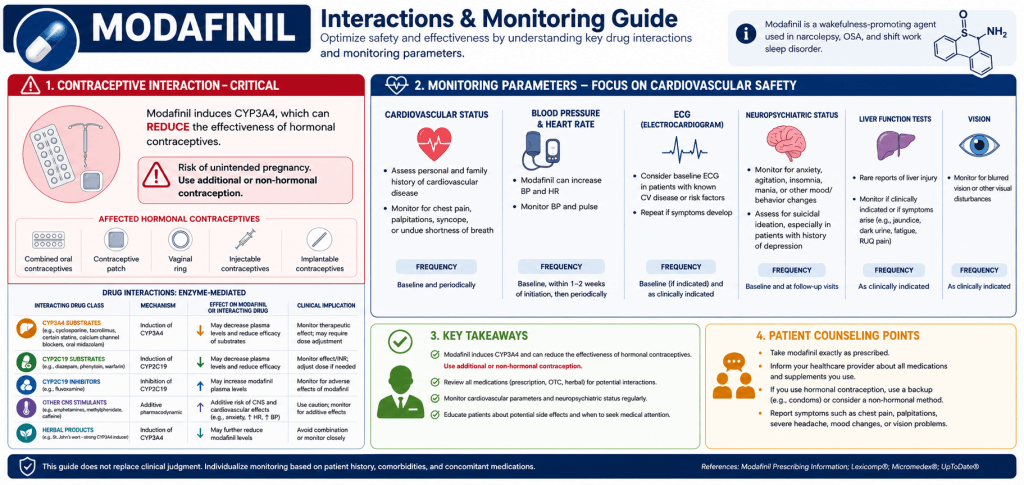
While modest, increases in blood pressure and heart rate (typically 3-5 mmHg and 2-4 bpm) can be clinically significant in susceptible individuals. Baseline and periodic monitoring of blood pressure is advisable, particularly in patients with pre-existing cardiovascular disease.
Critical Drug Interactions
Hormonal Contraceptives (Highest Clinical Priority):
Modafinil induces the CYP3A4 enzyme system, which metabolizes estrogen-containing contraceptives. This reduces contraceptive efficacy to the point of clinically significant risk.
| Contraceptive Type | Interaction Effect | Clinical Recommendation |
|---|---|---|
| Oral Contraceptives | Reduced estrogen levels; breakthrough bleeding; contraceptive failure | Must use non-hormonal backup method throughout treatment and for 1 month after discontinuation |
| Transdermal Patches | Reduced absorption | Same as oral |
| Vaginal Rings | Reduced efficacy | Same as oral |
| Progestin-Only Implants | Reduced efficacy | Same as oral |
| Emergency Contraception | Potentially reduced efficacy | May require higher dose under medical supervision |
I cannot overstate the importance of this interaction. Multiple reports in the literature describe unplanned pregnancies in modafinil-treated women. This is a mandatory counseling point for all female patients of childbearing potential.
Other Significant Drug Interactions:
- Cyclosporine: Modafinil can reduce cyclosporine levels, potentially affecting transplant patient management
- Warfarin: Increased metabolism may necessitate INR monitoring and dose adjustment
- Antidepressants (SSRIs, Tricyclics): Modafinil may alter their metabolism; monitoring for efficacy and toxicity is important
- Antiepileptics (Phenytoin, Carbamazepine): Reduced levels may require dose adjustment
Comprehensive Management Strategies: Beyond Medication
While modafinil is a powerful tool, optimal SWSD management requires a multifaceted approach addressing sleep hygiene, environmental factors and lifestyle modifications.
Sleep Hygiene for the Shift Worker
Creating an optimal sleep environment is essential for achieving restorative daytime sleep:
Light Management:
Installing blackout curtains or using sleep masks can eliminate daylight penetration and an eye mask with a contoured design that doesn’t press against the eyes may be more comfortable. Using low-wattage amber or red lights in the bedroom can also help minimize melatonin suppression.
Noise Control:
Using white noise machines or apps can help mask daytime environmental sounds and foam earplugs may provide additional sound reduction. It is also helpful to inform family members of your sleep schedule and request their cooperation.
Temperature Regulation:
Keeping bedroom temperature between 60-67°F (15-19°C) promotes optimal sleep, as the body’s core temperature naturally drops during sleep and a cool room facilitates this process. In warmer climates, using fans or cooling mattress technologies can be helpful.
Consistency:
Maintaining a consistent sleep schedule, even on days off when possible, helps the body adapt to a new circadian cycle and reduces “social jetlag.” If the schedule varies, try to keep sleep times within 2–3 hours of the usual post-shift bedtime.
Strategic Light Exposure
Light is the primary zeitgeber (“time-giver”) that synchronizes the circadian rhythm. During the shift, using bright light (2,500-10,000 lux) during the first 4–6 hours, via light therapy boxes placed at the workstation, helps trick the brain into treating night as day. Following the shift, wearing blue-light-blocking glasses on the drive home reduces morning light exposure, as blue light (particularly at 480 nm wavelength) suppresses melatonin and promotes wakefulness. Since early morning sunlight is the strongest circadian reset signal, avoiding it helps maintain nighttime orientation.
The combination of bright light during the shift and blue-light-blocking glasses after the shift can significantly shift circadian phase and improve daytime sleep quality.
Caffeine Management Strategies
Caffeine is a valuable tool but requires strategic use:
| Time Relative to Shift | Recommendation |
|---|---|
| Shift Start | Consider coffee or tea to enhance alertness |
| 2-4 Hours Into Shift | Strategic use to maintain alertness |
| Last 3-4 Hours | Avoid to prevent interference with post-shift sleep |
| After Shift | Strictly avoid; caffeine’s half-life of 3-7 hours can disrupt daytime sleep |
Caffeine’s benefits are most pronounced in individuals who are not chronic consumers. Tolerance develops rapidly, so I recommend limiting intake to workdays only and using the lowest effective dose.
Prophylactic and Strategic Napping
Napping is a highly effective but underutilized strategy:
Prophylactic Nap: Take a 20-30 minute nap immediately before the first night shift. This helps “bank” sleep and reduce sleep pressure that accumulates during the shift.
Strategic Nap: When possible, take a 20-30 minute nap during a break (often during the “circadian trough” around 2-4 AM). This has been shown to significantly improve performance during the remainder of the shift.
Important Note: Naps longer than 30 minutes may induce sleep inertia a period of grogginess upon awakening. For shift workers, this can be dangerous if they must return to safety-sensitive duties. Shorter naps prevent entering the deeper stages of sleep that produce this effect.
Comparative Effectiveness: How Modafinil Compares to Alternatives
| Medication | Mechanism | Dose for SWSD | Advantages | Disadvantages |
|---|---|---|---|---|
| Modafinil (Provigil) | Eugeroic; multi-system | 200 mg, 1 hr pre-shift | FDA-approved; low abuse potential; well-studied; clean alertness | CYP3A4 induction; headache; insomnia if late dosing |
| Armodafinil (Nuvigil) | R-enantiomer of modafinil | 150 mg, 1 hr pre-shift | Longer half-life; FDA-approved; beneficial for extended shifts | Same CYP interaction; similar side effect profile |
| Caffeine | Adenosine antagonist | Variable; 40-200 mg | Accessible; inexpensive; immediate effect | Jitteriness; tolerance; anxiety; sleep disruption; cardiovascular stimulation |
| Amphetamine Stimulants | Monoamine release | Off-label; variable | Powerful wakefulness | High abuse potential (Schedule II); cardiovascular risks; mood instability; not recommended for chronic SWSD |
| Solriamfetol (Sunosi) | DNRI | 75-150 mg; off-label | Long duration; FDA-approved for narcolepsy | Not specifically approved for SWSD; expensive; blood pressure effects |
Conclusion: A Patient-Centered Approach to SWSD Management
Shift Work Sleep Disorder is a significant medical condition with far-reaching implications for individual health and public safety. Modafinil provides an evidence-based pharmacologic solution that specifically addresses the profound sleepiness associated with nontraditional work hours.
However, the most successful treatment outcomes occur when modafinil is integrated into a comprehensive management strategy. This approach includes pharmacologic intervention with appropriate dosing timed to individual shift schedules, behavioral modifications such as strategic light exposure, optimized sleep hygiene and caffeine management, environmental adaptations to create supportive sleep environments despite daytime demands, lifestyle integration through maintaining consistent schedules, strategic napping and adequate recovery time and safety monitoring with regular clinical follow-up to assess efficacy and monitor for side effects or interactions.
Patients who embrace this comprehensive approach achieve significantly better outcomes than those relying on medication alone. The medication provides the tool for alertness, the lifestyle modifications provide the foundation for health.
FAQ
Can I take modafinil every day for my night shifts?
Yes, this is the approved regimen for SWSD. Take 200 mg before each scheduled night shift to maintain consistent alertness. The medication should not be taken on days off, as this can disrupt natural circadian rhythms and potentially lead to the development of tolerance.
How long does it take to work, and how long do effects last?
Onset of action is approximately 60-90 minutes, with peak effect at 2-3 hours. The wakefulness-promoting effects persist for 10-12 hours, making it suitable for standard 8-12 hour shifts. This long duration underscores the importance of precise timing, administering it later in the shift can interfere with attempted daytime sleep.
Will modafinil help me sleep better during the day?
No, this is a common misconception. Modafinil promotes wakefulness during the desired period, it does not directly improve sleep quality. To achieve better daytime sleep, implement the strategies discussed above: excellent sleep hygiene, strategic light management and consistent scheduling. The medication allows you to work safely, sleep strategies allow you to recover effectively.
Can I combine modafinil with other wakefulness-promoting substances?
I strongly caution against this. Combining modafinil with other stimulants (including high-dose caffeine, amphetamines or over-the-counter energy supplements) can lead to additive cardiovascular effects and increased psychiatric side effects. Many patients find they need less caffeine on modafinil, which is beneficial for sleep quality.
‼️ Disclaimer: The information provided in this article about modafinil is intended for informational purposes only and is not a substitute for professional medical consultation or recommendations. The author of the article are not responsible for any errors, omissions, or actions based on the information provided.
References:
- Beers, TM. Flexible schedules and shift work: replacing the 9-to-5 workday? Monthly Labor Rev 2000
- Akerstedt, T. Shift work and disturbed sleep/wakefulness. Occup Med (Lond) 2003
- Diagnostic and statistical manual of mental disorders, 4th ed. Washington, D.C.: American Psychiatric Association, 2000
- ICSD international classification of sleep disorders: diagnostic and coding manual. 2nd ed. Westchester, Ill.American Academy of Sleep Medicine. 2005
- Knutsson, A. Health disorders of shift workers. Occup Med. 2003
- US Modafinil in Narcolepsy Multicenter Study Group. Randomized trial of modafinil for the treatment of pathological somnolence in narcolepsy. Ann Neurol. 1998
- Black, JE, Hirshkowitz, M. Modafinil for treatment of residual excessive sleepiness in nasal continuous positive airway pressure-treated obstructive sleep apnea/hypopnea syndrome. Sleep. 2005
- Dorrian J, Rogers NL, Dinges DF. Psychomotor vigilance performance: neurocognitive assay sensitive to sleep loss. In: Kushida CA, ed. Sleep deprivation: clinical issues, pharmacology and sleep loss effects. New York: Marcel Dekker. 2005
- Carskadon MA, Hirshkowitz M. Evaluating sleepiness. In: Kryger MH, Roth T, Dement WC, eds. Principles and practice of sleep medicine. 3rd ed. Philadelphia: W.B. Saunders, 2000
- Neubauer, D. Does modafinil safely and effectively treat shift-work sleep disorder? Nat Rev Neurol. 2006
- Sack, R. L., Auckley, D., Auger, R. R., Carskadon, M. A., Wright, K. P., Jr, Vitiello, M. V., Zhdanova, I. V., & American Academy of Sleep Medicine. 2007. https://pubmed.ncbi.nlm.nih.gov/18041480/