
Last Updated on 07/09/2026
The Temptation of a Quick Fix
A blinking cursor on the screen. Rising anxiety. Scrolling through social media feeds. The deadline is looming, yet you still haven’t started the task. Procrastination, the tendency to put off important and urgent matters, is something millions of people grapple with every day.
One patient once said he would do “anything” just to stop procrastinating. Many people read about modafinil online and become convinced it is the solution to the problem. He expected modafinil to help transform him from someone who constantly avoided tasks into a productive professional. However, the reality turned out to be far more complex. The ensuing conversation revealed a deeper issue: underlying anxiety, perfectionism and a fear of failure. Factors that cannot be eliminated with medication.
Understanding Procrastination
What Is Procrastination, Really?
Procrastination is not laziness. It is an active process of avoiding a task despite knowing the consequences. Psychologists define it as a self-regulation failure, where immediate comfort outweighs long-term goals.
- Deliberate delay of intended action
- Awareness of potential negative consequences
- Emotional discomfort preceding task initiation
The Neurobiology of Procrastination
Modern neuroscience reveals procrastination as a battle between two brain systems. The limbic system, home of the amygdala, processes immediate emotions. The prefrontal cortex handles planning and impulse control. When discomfort dominates, the brain prioritizes short-term relief over long-term goals.
Dopamine plays a central role. Tasks without immediate rewards fail to trigger dopamine release, making them feel unrewarding. This creates a cycle: avoidance reduces anxiety temporarily, reinforcing procrastination.
Modafinil and Its Effects on Cognition
Mechanism of Action
Modafinil is a wakefulness-promoting agent approved for narcolepsy, shift work sleep disorder and obstructive sleep apnea. Its mechanism involves dopamine transporter inhibition, orexin activation and histamine release.
Neurotransmitter Effects and Potential Impact on Procrastination
| Neurotransmitter | Modafinil Effect | Potential Impact on Procrastination | Clinical Relevance |
|---|---|---|---|
| Dopamine | Increased availability via DAT inhibition | Enhanced motivation and reward anticipation | May help initiate tasks |
| Norepinephrine | Increased alertness | Improved focus and energy | May sustain effort |
| Histamine | Sustained wakefulness | Reduced fatigue | May help when fatigue drives avoidance |
| Orexin | Activation | Stabilized wakefulness | May support prolonged focus |
What the Research Actually Shows
Studies consistently demonstrate modafinil’s benefits for attention, working memory, and executive function in specific populations—particularly those who are sleep-deprived. Some research suggests it enhances effort-based decision-making.
However, no study has evaluated modafinil specifically for procrastination. The evidence for this application is entirely anecdotal.
Theoretical Benefits and Unsubstantiated Claims
Could Modafinil Help?
The theoretical appeal is understandable. Modafinil enhances wakefulness, which could reduce fatigue-driven procrastination. It improves executive function, which might help with task initiation and planning. It increases dopamine, which could make tasks feel more rewarding.
A patient described his first experience with modafinil as “turning on a light switch.” He felt motivated, focused and finally able to tackle tasks he had avoided for weeks. For a few days, he was thrilled.
Perceived vs. Actual Effects for Procrastination
| Claim | Evidence Level | Clinical Reality |
|---|---|---|
| “Modafinil cures procrastination” | None | No clinical evidence supports this, procrastination is behavioral |
| “It makes tasks feel rewarding” | Low | May enhance dopamine signaling but doesn’t address emotional roots |
| “It eliminates task-related anxiety” | None | Can exacerbate anxiety in vulnerable individuals |
| “It’s a safe solution for anyone” | Moderate | Side effects and dependency risks exist, not for everyone |
| “It works for chronic procrastinators” | None | No studies in this population |
The Evidence Gap
The scientific literature is remarkably silent on this specific question. While modafinil has been studied extensively for wakefulness and cognition, no randomized controlled trial has evaluated its effects on procrastination as a primary outcome. The gap between popular use and clinical evidence is vast.
Risks and Side Effects
Common Side Effects
Headache is the most frequently reported side effect, often related to dehydration or muscle tension. Insomnia can occur, particularly with late dosing. Anxiety and nervousness may emerge, especially in individuals with underlying anxiety disorders. Nausea is common but often resolves with food.
Serious Risks
Cardiovascular effects, including increased blood pressure and heart rate, require monitoring. Psychiatric effects, such as worsening of anxiety, mania or psychosis, can occur in vulnerable individuals. Stevens-Johnson syndrome, though rare, is a serious skin reaction requiring immediate discontinuation. Psychological dependence can develop, particularly in individuals using modafinil for non-medical purposes.
The Clinical Reality
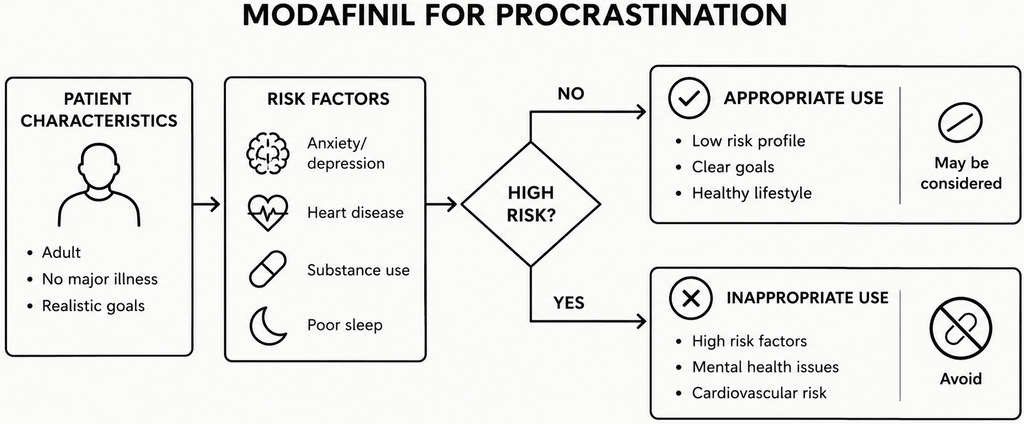
When Modafinil May Be Appropriate
Modafinil is appropriate for individuals with diagnosed sleep disorders, where it may improve fatigue-related procrastination. It may help some patients with ADHD when stimulants aren’t tolerated and it can address fatigue and cognitive symptoms in treatment-resistant depression.
When It Is Not Appropriate
Modafinil is not appropriate for primary procrastination, as no evidence supports this use. It should be avoided in individuals with underlying anxiety disorders, as it may worsen symptoms. Those with substance use disorder history face dependency risks and individuals with cardiovascular conditions have safety concerns.
Evidence-Based Alternatives
Behavioral Strategies
Cognitive behavioral therapy addresses the thought patterns underlying avoidance and has high evidence. Task chunking reduces overwhelm by breaking large projects into smaller steps. Implementation intentions use pre-planned “if-then” rules to automate action. Time blocking structures schedules effectively. The Pomodoro Technique uses short focus sprints to build momentum.
Lifestyle Modifications
Regular sleep schedules align circadian rhythms with peak productivity times. Balanced nutrition stabilizes blood sugar and prevents energy crashes. Daily exercise boosts mood and executive function. Mindfulness practices reduce stress and improve emotional regulation.
Conclusion
Procrastination is a complex behavioral pattern driven by emotional regulation mechanisms and neurobiology. While modafinil can promote focus and alertness, it does not address the underlying causes of avoidant behavior.
Patients seeking a quick fix often face disappointment. A genuine solution lies in understanding emotional triggers and developing sustainable strategies. This process requires patience, practice and often professional guidance.
FAQ
Can modafinil cure procrastination?
No. There is no evidence that modafinil treats procrastination specifically. It may help with focus and wakefulness, but the behavioral and emotional roots of procrastination require comprehensive management.
Is modafinil safe for healthy individuals?
Short-term use in healthy adults appears relatively safe, but side effects and dependency risks exist. Long-term safety data are limited.
Who should avoid modafinil?
Individuals with heart conditions, anxiety disorders, psychosis history, or substance use disorders should avoid it. Pregnant women should also avoid it.
What are the best alternatives?
Cognitive behavioral therapy, structured planning, task chunking, and lifestyle optimization are proven, safe alternatives.
Reviewed By: Dr. Dave Lewis, MD, PhD, Clinical Pharmacologist, Board Certified in Psychiatry and Neuropharmacology
References:
- U.S. Food and Drug Administration. PROVIGIL. U.S. Department of Health and Human Services. https://www.accessdata.fda.gov/drugsatfda_docs/label/2015/020717s037s038lbl.pdf . 2015
- Ballon JS, Feifel D. A systematic review of modafinil: potential clinical uses and mechanisms of action. J Clin Psychiatry. 2006
- Willavize, S. A., Nichols, A. I., & Lee, J. Population pharmacokinetic modeling of armodafinil and its major metabolites. https://doi.org/10.1002/jcph.800 . 2016
- Becker, P. M., Schwartz, J. R., Feldman, N. T., & Hughes, R. J. Effect of modafinil on fatigue, mood, and health-related quality of life in patients with narcolepsy. https://doi.org/10.1007/s00213-003-1508-9 . 2004
- Wirz S., Nadstawek J., Kühn K. U., Vater S., Junker U., Wartenberg H. C. Modafinil zur Behandlung der Tumorfatigue: Eine Interventionsstudie [Modafinil for the treatment of cancer-related fatigue: An intervention study]. https://doi.org/10.1007/s00482-010-0987-y . 2010
- Woo, J., & Verduzco-Gutierrez, M. Traumatic brain injury: An overview of epidemiology, pathophysiology, and medical management. Medical Clinics of North America. https://doi.org/10.1016/j.mcna.2019.11.001 . 2020
- Oliva Ramirez A, Keenan A, Kalau O, Worthington E, Cohen L, Singh S. Prevalence and burden of multiple sclerosis-related fatigue: a systematic literature review. https://doi.org/10.1186/s12883-021-02396-1 . 2021.
- Ciancio A, Moretti MC, Natale A, Rodolico A, Signorelli MS, Petralia A. Personality Traits and Fatigue in Multiple Sclerosis: A Narrative Review. Journal of Clinical Medicine. https://doi.org/10.3390/jcm12134518 . 2023
- Mereu, M., Bonci, A., Newman, A. H., & Tanda, G. The neurobiology of modafinil as an enhancer of cognitive performance and a potential treatment for substance use disorders. https://doi.org/10.1007/s00213-013-3232-4 . 2013
- Greenblatt, K., & Adams, N. Modafinil. StatPearls Publishing. https://www.ncbi.nlm.nih.gov/books/NBK531476/ . 2023
- U Müller, JB Rowe, T Rittman, C Lewis, TW Robbins, BJ Sahakian. Effects of modafinil on non-verbal cognition, task enjoyment and creative thinking in healthy volunteers. Neuropharmacology. https://pmc.ncbi.nlm.nih.gov/articles/PMC3485563/. 2013
- Carmen Pope. Modafinil: Smart Drug For Decision Fatigue Or Workaholic Crutch? https://www.drugs.com/medical-answers/modafinil-smart-drug-decision-fatigue-workaholic-3573722/ . 2025