
Last Updated on 06/08/2026
Introduction: Understanding of Idiopathic Hypersomnia
Idiopathic Hypersomnia (IH) represents one of the most challenging and underrecognized sleep disorders in clinical medicine. Unlike simple tiredness or the sleep attacks of narcolepsy, IH manifests as a profound, pervasive, and unrelenting excessive daytime sleepiness that persists despite adequate nighttime sleep. Patients describe it as being trapped in a state of perpetual exhaustion, where even 10-12 hours of sleep leave them feeling as though they’ve barely rested.
The term “idiopathic” reflects our limited understanding of the underlying pathology. While we know IH involves dysregulation of the sleep-wake cycle, the precise neurobiological mechanisms remain elusive. This diagnostic uncertainty creates significant treatment challenges, as healthcare providers must often rely on off-label medications to manage symptoms.
Modafinil has emerged as one of the most promising treatment options for IH, though it’s important to emphasize that its use in this context remains off-label in most countries.
Clinical Understanding of Idiopathic Hypersomnia
Defining the Condition
Idiopathic Hypersomnia is classified in the International Classification of Sleep Disorders, Third Edition (ICSD-3) as a central disorder of hypersomnolence. The diagnostic criteria include:
- Excessive Daytime Sleepiness: The patient experiences daily periods of irrepressible need to sleep or daytime lapses into sleep, occurring for at least three months.
- Absence of Cataplexy: Unlike narcolepsy type 1, IH does not involve cataplexy (sudden loss of muscle tone).
- Normal or Extended Sleep Duration: Patients typically sleep 9-11 hours per 24-hour period (or >11 hours if extended to 24 hours), yet still experience significant daytime sleepiness.
- Multiple Sleep Latency Test (MSLT) Findings: Mean sleep latency of ≤8 minutes, with fewer than two sleep-onset REM periods (SOREMPs).
- Difficulty Waking: Profound sleep inertia (“sleep drunkenness”) upon awakening, characterized by confusion, disorientation, and difficulty transitioning to wakefulness.
- Exclusion of Other Causes: Other potential causes of sleepiness (sleep apnea, narcolepsy, circadian rhythm disorders, medication effects, or psychiatric conditions) must be ruled out.
Distinguishing IH from Narcolepsy
This distinction is clinically critical because it affects both management expectations and medication selection:
| Feature | Idiopathic Hypersomnia | Narcolepsy Type 1 |
|---|---|---|
| Daytime Sleepiness | Severe, unrelenting, constant | Severe, with sleep attacks |
| Cataplexy | Absent | Present |
| Sleep Attacks | Less common | Common |
| Nighttime Sleep | Extended, often non-restorative | Fragmented, poor quality |
| Sleep Inertia | Severe, prolonged | Mild |
| MSLT Findings | Mean sleep latency ≤8 min; <2 SOREMPs | Mean sleep latency ≤8 min; ≥2 SOREMPs |
| HLA Association | None consistently identified | HLA-DQB1*06:02 (positive in >90%) |
The Neurobiology of IH
While the precise pathophysiology of IH remains unknown, emerging research suggests several potential mechanisms:
GABA-A Receptor Modulation: A 2021 study in the journal Brain identified increased sensitivity to GABA-A receptor modulation in cerebrospinal fluid of IH patients. This finding suggests that enhanced GABAergic inhibition might contribute to excessive sleepiness.
Orexin System Dysfunction: Unlike narcolepsy, where orexin neurons are destroyed, IH patients appear to have normal orexin levels. However, some research suggests altered orexin receptor function or downstream signaling abnormalities.
Circadian Rhythm Disruption: Many IH patients demonstrate abnormal melatonin secretion patterns, with delayed or blunted nighttime melatonin peaks that may impair sleep quality and morning wakefulness.
Altered Sleep Architecture: Polysomnography often reveals shortened REM latency, increased slow-wave sleep and reduced sleep efficiency. Patterns that differ from both healthy controls and narcolepsy patients.
Understanding these mechanisms is essential because it explains why certain medications, including modafinil, may be particularly effective in IH.
Modafinil – Pharmacology and Rationale for Use in IH
Mechanism of Action: Why Modafinil Works
Modafinil (Provigil) belongs to the eugeroic class of medications. Agents that promote wakefulness without the pronounced euphoria, cardiovascular stimulation or addiction potential associated with traditional psychostimulants.
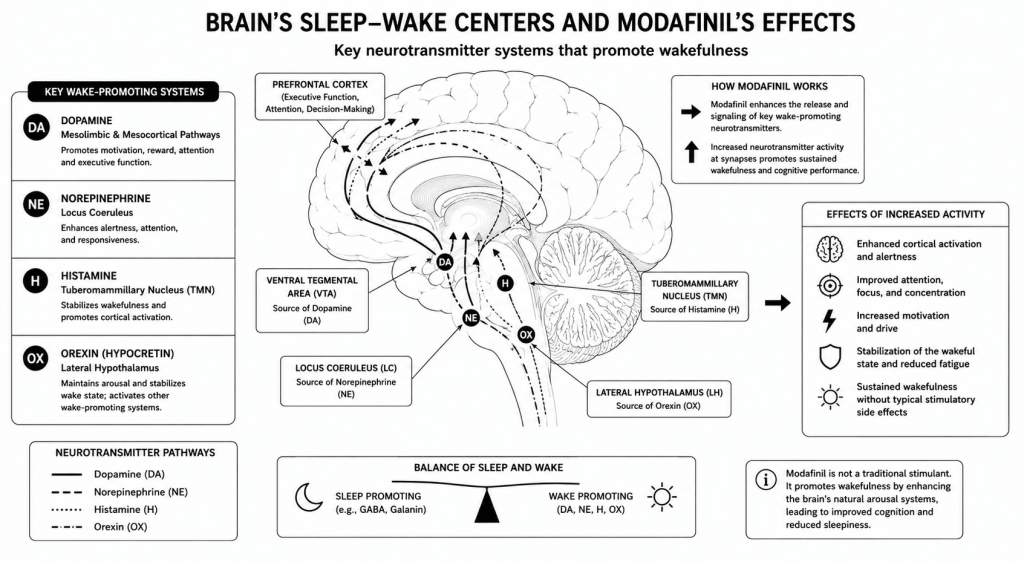
Core Mechanisms:
Dopamine Transporter Inhibition: Modafinil inhibits the dopamine transporter (DAT) in the striatum and nucleus accumbens, increasing extracellular dopamine levels. This enhances motivation, attention and executive function, critical improvements for patients struggling with cognitive fog.
Noradrenergic Activation: The medication increases norepinephrine release in the hypothalamus and prefrontal cortex, promoting arousal and vigilance.
Histaminergic Stimulation: Modafinil activates histaminergic neurons in the tuberomammillary nucleus, contributing to sustained wakefulness.
Orexin System Enhancement: It may stimulate orexin-producing neurons, though this effect is less pronounced than with traditional stimulants.
Clinical Relevance for IH: The multi-target approach addresses the diffuse nature of IH symptoms. Unlike medications that primarily affect a single neurotransmitter system, modafinil’s broad pharmacology targets both wakefulness (through dopamine and histamine) and cognitive function (through norepinephrine and dopamine).
Comparison with Traditional Stimulants
| Feature | Modafinil | Amphetamine-Based Stimulants | Methylphenidate |
|---|---|---|---|
| Class | Eugeroic | Psychostimulant | Psychostimulant |
| Mechanism | DAT inhibition, multiple targets | Monoamine release (DA, NE, 5HT) | DAT and NET inhibition |
| Abuse Potential | Low (Schedule IV) | High (Schedule II) | Moderate (Schedule II) |
| Duration of Action | 10-12 hours | 4-12 hours (depending on formulation) | 3-6 hours (IR), 8-12 hours (ER) |
| Cardiovascular Effects | Modest | Significant | Moderate |
| Tolerance Development | Rare | Common | Common |
| Withdrawal Syndrome | Mild | Significant | Moderate |
Clinical Evidence for Modafinil in Idiopathic Hypersomnia
Published Studies and Clinical Trials
While modafinil is not FDA-approved specifically for IH, several studies have demonstrated its effectiveness:
French Multicenter Study (2011): This randomized, double-blind, placebo-controlled crossover trial evaluated modafinil in 35 patients with IH. Participants received either modafinil (200-400 mg daily) or placebo for 8 weeks before crossing over. Results showed:
- Significant improvement in Epworth Sleepiness Scale scores (mean reduction of 8.4 points vs. 2.1 points with placebo)
- Clinically meaningful reduction in sleep inertia symptoms
- Improved quality of life as measured by the SF-36 questionnaire
- Favorable safety profile with no serious adverse events
European Sleep Research Society Study (2016): This prospective observational study followed 47 IH patients treated with modafinil for 12 months. Key findings included:
- Sustained improvement in daytime sleepiness throughout the study period
- No evidence of tolerance development
- Acceptable tolerability, with the most common side effects being headache and nausea
Meta-Analysis of Hypersomnia Treatments (2022): A comprehensive meta-analysis in the Journal of Clinical Sleep Medicine compared modafinil to other treatments for hypersomnia. Modafinil demonstrated the most favorable risk-benefit ratio for IH, with an effect size (Hedges’ g) of 1.2 for reducing sleepiness scores, comparable to its effects in narcolepsy and sleep apnea.
Real-World Clinical Experience
Case Example: A 34-year-old female patient in my practice presented with disabling daytime sleepiness, sleeping 10-12 hours nightly but still requiring multiple naps. She reported severe sleep inertia lasting 2-3 hours each morning, impacting her ability to parent her young children. After confirming the diagnosis with PSG and MSLT, we initiated modafinil at 100 mg daily, titrating to 200 mg. Within two weeks, she reported a 50% reduction in daytime sleepiness, improved morning alertness and better functional status at work. Her Epworth Sleepiness Scale score dropped from 18 to 11.
Clinical Pearl: The response to modafinil in IH is often dose-dependent and may require careful titration. Starting at 100 mg and increasing to 200 mg based on response and tolerability is a common strategy.
Practical Dosing and Administration
Off-Label Dosing Protocols
| Parameter | Recommendation | Rationale |
|---|---|---|
| Starting Dose | 100 mg once daily | Minimizes side effects, allows assessment of individual response |
| Titration | Increase to 200 mg after 1-2 weeks if needed and tolerated | Most patients require 200 mg for optimal effect |
| Maximum Dose | 400 mg daily in divided doses | Higher doses studied in narcolepsy, use cautiously in IH |
| Timing | Take immediately upon awakening | Avoids interference with nighttime sleep, addresses morning sleep inertia |
| Frequency | Once daily (AM) for most, consider split dosing (AM + noon) for extended wakefulness needs | Split dosing may benefit patients with long work hours or severe afternoon sleepiness |
Special Considerations
Morning Sleep Inertia:
Many IH patients experience severe sleep inertia. Taking modafinil immediately upon waking, even before getting out of bed, can be particularly beneficial. One strategy is to set an alarm 45-60 minutes before the desired waking time, take the medication and rest until the regular wake-up time. This allows peak plasma concentrations to coincide with morning awakening demands.
Combination Therapy:
Some patients may benefit from combining modafinil with other agents. In my experience, I’ve successfully used:
- Modafinil + Melatonin (low-dose, 0.5-1 mg) to regulate circadian rhythm
- Modafinil + Stimulant (methylphenidate) for breakthrough sleepiness, though this requires careful monitoring
- Modafinil + Wake-promoting lifestyle modifications (see Part VI)
Administration Advice for Patients:
Take modafinil at the same time each morning to establish a consistent effect. If you experience difficulty staying awake into the evening, consider splitting your dose: 100 mg in the morning and 100 mg at noon. Avoid taking modafinil after 2 PM to prevent insomnia. Keep a sleep diary to track effectiveness and side effects, and share this with your healthcare provider at follow-up visits.
Safety, Side Effects, and Monitoring
Adverse Effect Profile
| Side Effect | Incidence | Clinical Management |
|---|---|---|
| Headache | 30-35% | Hydration, over-the-counter analgesics if needed, often transient |
| Nausea | 15-20% | Taking with food, dose reduction if persistent |
| Nervousness/Anxiety | 10-15% | Dose reduction, avoid caffeine; consider slow titration |
| Insomnia | 10-12% | Ensure morning dosing, split doses earlier in day |
| Dry Mouth | 8-10% | Sugar-free gum, frequent water |
| Dizziness | 5-8% | Adequate hydration, avoid sudden position changes |
Serious Adverse Reactions
Cardiovascular Effects:
Modafinil can modestly increase blood pressure (average 3-5 mmHg systolic) and heart rate (2-4 bpm). While generally well-tolerated, patients with pre-existing hypertension, arrhythmias, or significant cardiovascular disease should be closely monitored. Baseline and periodic blood pressure checks are recommended.
Psychiatric Effects:
Rare but important: modafinil may precipitate or exacerbate psychosis, mania, depression, or anxiety. Patients with a history of psychiatric disorders should use modafinil with extreme caution, and those with active psychosis or mania are typically advised to avoid it entirely. Emergence of any psychiatric symptoms should prompt immediate discontinuation and evaluation.
Stevens-Johnson Syndrome:
Extremely rare (<1 in 100,000) but potentially fatal. Patients should be advised to discontinue medication at the first sign of rash, blistering, or mucosal involvement and seek emergency care.
Drug Interactions
Highest Priority: Hormonal Contraceptives
Modafinil is a moderate inducer of CYP3A4, the enzyme responsible for metabolizing estrogen. This reduces contraceptive efficacy to clinically significant levels.
| Contraceptive Type | Recommendation |
|---|---|
| All Estrogen-Containing Contraceptives | Mandatory use of non-hormonal backup method (condoms, copper IUD) throughout treatment and for 1 month after discontinuation |
| Progestin-Only Pills | Less affected but still a concern, discuss alternative options |
Other Significant Interactions:
- Cyclosporine: Modafinil may reduce levels, monitor drug levels and adjust dose
- Warfarin: Potential for altered anticoagulation, monitor INR
- Antidepressants (SSRIs, Tricyclics): Modafinil may alter metabolism, monitor for efficacy/toxicity
- Antiepileptics (Phenytoin, Carbamazepine): Reduced levels, may require dose adjustment
- CNS Stimulants: Avoid or use extreme caution, additive cardiovascular and psychiatric effects
Monitoring Schedule
| Timepoint | Recommended Actions |
|---|---|
| Baseline | Full history, blood pressure, ECG (for high-risk patients), pregnancy test (if applicable) |
| 2-4 Weeks | Assess response (Epworth Sleepiness Scale), side effects, blood pressure |
| 3 Months | Comprehensive review, blood pressure; medication adherence |
| Every 6-12 Months | Continued benefit assessment, drug interaction review, dose adjustment if needed |
Integrative Management Strategies
The Role of Modafinil in Comprehensive Care
Medication alone is rarely sufficient for optimal IH management. I emphasize to my patients that modafinil is a tool, not a cure. The most successful outcomes occur when medication is integrated with comprehensive lifestyle modifications:
Sleep Hygiene Modifications
Consistency: Maintain a regular sleep-wake schedule, even on weekends. Ideally, the bedtime and waking time should not vary by more than 1-2 hours.
Optimizing Nighttime Sleep:
- Cool bedroom temperature (60-67°F / 15-19°C)
- Dark environment (blackout curtains, eye masks)
- Quiet environment (white noise machines, earplugs)
- Comfortable bedding and pillows
Morning Wakefulness Strategies:
- Exposure to bright light within 30 minutes of waking
- Physical activity to promote alertness
- Consistent morning routine to signal waking
Dietary and Nutritional Considerations
Caffeine Management:
While caffeine is a stimulant, its effects are often insufficient for IH patients. Moreover, it may worsen sleep inertia or nighttime sleep quality. I typically recommend:
- Limited caffeine intake to morning hours only
- Avoiding caffeine within 8-10 hours of bedtime
- Recognizing that caffeine may increase side effects when combined with modafinil
Meal Timing:
- Heavy meals close to bedtime can disrupt sleep
- Light, balanced meals throughout the day
- Avoid alcohol and heavy meals in the evening
Physical Activity
Regular aerobic exercise (30 minutes, 3-5 times weekly) can significantly improve sleep quality and daytime alertness. Timing is important, exercise too close to bedtime may worsen nighttime sleep, but morning or early afternoon activity can enhance alertness and promote better nighttime rest.
Cognitive Behavioral Approaches
For many IH patients, the emotional toll of the condition (frustration, anxiety, depression) compounds their physical symptoms. Consider:
- Cognitive Behavioral Therapy (CBT) for Sleep Disorders
- Support Groups (Hypersomnia Foundation)
- Stress Management Techniques (meditation, mindfulness, deep breathing)
Comparative Treatment Options
Alternative Medications
| Medication | Mechanism | Advantages | Disadvantages |
|---|---|---|---|
| Sodium Oxybate (Xyrem) | GABA-B agonist | Highly effective for both sleepiness and nocturnal sleep quality | DEA Schedule I, expensive, requires nocturnal dosing, potential for abuse |
| Methylphenidate (Ritalin) | Dopamine/norepinephrine reuptake inhibitor | Rapid onset, effective | High abuse potential, tolerance, cardiovascular effects, “crash” |
| Amphetamine Salts (Adderall) | Monoamine release | Potent wakefulness | High abuse potential, Schedule II, significant cardiovascular effects, tolerance |
| Solriamfetol (Sunosi) | Dopamine/norepinephrine reuptake inhibitor | FDA-approved for narcolepsy, long duration | Not FDA-approved for IH, expensive, blood pressure effects |
| Pitolisant (Wakix) | Histamine H3 antagonist/reverse agonist | No controlled substance status, once-daily dosing | Not widely available, limited IH data, insomnia risk |
| Clarithromycin (antibiotic) | GABA-A antagonist | Low cost, available | Off-label, limited data, gastrointestinal side effects, antibiotic resistance risk |
Which Medication to Choose?
Clinical decision-making requires consideration of:
- Patient preferences (route of administration, side effect concerns)
- Insurance coverage (many IH treatments are not covered for off-label use)
- Comorbidities (cardiac, psychiatric, renal)
- Cost (sodium oxybate is extremely expensive; modafinil is more affordable)
- Safety profile (especially substance abuse risk)
Special Populations and Considerations
Elderly Patients
Older adults are more sensitive to both therapeutic and adverse effects of modafinil:
- Start with 50-100 mg daily; titrate cautiously
- Monitor for cognitive effects (disorientation, memory issues)
- Assess cardiovascular risk thoroughly before prescribing
- Consider fall risk (dizziness, orthostatic hypotension)
Pregnant or Breastfeeding Women
Pregnancy Category C: Animal studies show teratogenic potential at high doses, but human data are limited. Modafinil should be used during pregnancy only if the potential benefit justifies the potential risk to the fetus.
Breastfeeding: Modafinil is excreted in human milk in small amounts. Due to the potential for serious adverse reactions in nursing infants, a decision should be made whether to discontinue nursing or discontinue the drug.
Clinical Recommendation: Consult with a maternal-fetal medicine specialist before using modafinil in pregnancy. Consider alternatives (non-pharmacologic strategies, or alternative medications with better safety data).
Patients with Hepatic Impairment
Modafinil undergoes extensive hepatic metabolism. In patients with moderate to severe hepatic impairment:
- Reduce dose by 50% (start at 100 mg)
- Monitor carefully for accumulation and adverse effects
- Consider alternative medications if hepatic function is severely compromised
Patients with Renal Impairment
- Renal impairment does not significantly affect modafinil clearance
- No dose adjustment is typically required for moderate renal impairment
- Monitor for fluid/electrolyte imbalances that might affect drug handling
Patient Education and Counseling Points
Based on years of counseling patients with IH, here are the most critical points to discuss:
Medication-Specific Education
- “Modafinil helps you stay awake; it does not replace sleep.”
- Understanding this distinction prevents unrealistic expectations and misuse
- “Take it as prescribed at the same time each morning.”
- Consistency improves effectiveness; timing avoids nighttime insomnia
- “Never double up if you miss a dose.”
- This increases side effect risk without benefit
- “If you’re on birth control, you need a backup method.”
- This interaction is often overlooked but critically important
- “Report any rash or mood changes immediately.”
- Early recognition of rare side effects is essential
Lifestyle Counseling
- Maintain a consistent sleep-wake schedule.
- This helps regulate circadian rhythm
- Expose yourself to bright light upon awakening.
- Morning light therapy can be an adjunct to medication
- Avoid alcohol, especially in the evening.
- Alcohol disrupts sleep architecture
- Exercise regularly, but not too close to bedtime.
- Physical activity improves overall sleep quality
- Consider support groups.
- Coping with IH is challenging; social support is beneficial
Future Directions and Emerging Research
Promising Areas of Investigation
Genetic Studies: Ongoing genetic research is identifying potential hereditary factors in IH, which may lead to more targeted therapies in the future.
Biomarker Discovery: Researchers are seeking reliable biomarkers for IH, which could improve diagnosis and treatment monitoring.
New Pharmacologic Agents: Clinical trials are evaluating several new agents for hypersomnia, including orexin receptor agonists and novel dopamine modulators.
Combination Therapy Studies: Research is investigating whether combining modafinil with other agents provides more effective symptom control than monotherapy.
The Role of Patient Advocacy
Organizations like the Hypersomnia Foundation and the Sleep Research Society continue to advocate for increased research funding and awareness of IH. Patients are encouraged to participate in patient registries and clinical trials to advance our understanding and treatment of this challenging condition.
Conclusion
Idiopathic Hypersomnia remains one of the most challenging sleep disorders to manage, but the therapeutic landscape has significantly improved in recent years. Modafinil, despite its off-label status, has emerged as a valuable and effective treatment option, supported by clinical evidence and practical experience.
From my clinical practice, I can attest that the most successful outcomes occur when:
- Diagnosis is thorough: Accurate diagnosis through comprehensive sleep studies is the foundation of effective treatment.
- Medication is used strategically: Modafinil provides reliable symptom control but requires careful dosing and monitoring.
- Lifestyle modifications are embraced: No medication is as effective as a comprehensive approach that addresses sleep hygiene, diet, exercise, and stress management.
- Patient expectations are managed: IH is a chronic condition that requires ongoing management; while modafinil can be transformative, it is not a cure.
- Follow-up is consistent: Regular monitoring ensures continued effectiveness and safety.
As research continues to unravel the mysteries of IH, we can expect even better treatment options in the future. Until then, modafinil remains a cornerstone therapy a medication that helps patients reclaim their lives from the grip of unrelenting sleepiness.
FAQ
Is modafinil FDA-approved for idiopathic hypersomnia?
No, modafinil is currently FDA-approved only for narcolepsy, obstructive sleep apnea, and shift work sleep disorder. Its use in IH is off-label, though it is widely prescribed and supported by clinical evidence.
Can modafinil cure idiopathic hypersomnia?
No, modafinil is a symptomatic treatment that addresses excessive daytime sleepiness. There is currently no cure for IH, though research continues to explore underlying mechanisms and potential disease-modifying therapies.
How quickly does modafinil work for IH?
Modafinil typically begins working within 60-90 minutes of administration, with peak effect at 2-3 hours. Its effects last 10-12 hours, which is why morning dosing is recommended.
Can I use modafinil on an as-needed basis?
Modafinil works best when taken regularly, as it requires time to achieve a steady-state concentration and effect. While some patients use it intermittently, consistent daily use is generally more effective for IH symptom control.
Can I drink alcohol while taking modafinil?
Alcohol should be used cautiously, if at all, during modafinil treatment. The combination can enhance side effects, including dizziness, confusion, and impaired judgment. It may also reduce the medication’s effectiveness and worsen sleep quality.
‼️ Disclaimer: The information provided in this article about modafinil is intended for informational purposes only and is not a substitute for professional medical consultation or recommendations. The author of the article are not responsible for any errors, omissions, or actions based on the information provided.
References:
- U.S. Food and Drug Administration. PROVIGIL. U.S. Department of Health and Human Services. https://www.accessdata.fda.gov/drugsatfda_docs/label/2015/020717s037s038lbl.pdf . 2015
- Ballon JS, Feifel D. A systematic review of modafinil: potential clinical uses and mechanisms of action. J Clin Psychiatry. 2006
- Willavize, S. A., Nichols, A. I., & Lee, J. Population pharmacokinetic modeling of armodafinil and its major metabolites. https://doi.org/10.1002/jcph.800 . 2016
- Fuxe K, et al. Modafinil enhances the increase of extracellular serotonin levels induced by the antidepressant drugs fluoxetine and imipramine: a dual probe microdialysis study in awake rat. Synapse. 2005
- Mechanisms of modafinil: A review of current research. nih.gov. 2007
- PROVIGIL (modafinil) Tablets. FDA.GOV. 2010
- Oliva Ramirez A, Keenan A, Kalau O, Worthington E, Cohen L, Singh S. Prevalence and burden of multiple sclerosis-related fatigue: a systematic literature review. 2021.
- Ciancio A, Moretti MC, Natale A, Rodolico A, Signorelli MS, Petralia A. Personality Traits and Fatigue in Multiple Sclerosis: A Narrative Review. Journal of Clinical Medicine. 2023
- Mereu, M., Bonci, A., Newman, A. H., & Tanda, G. The neurobiology of modafinil as an enhancer of cognitive performance and a potential treatment for substance use disorders. https://doi.org/10.1007/s00213-013-3232-4 . 2013
- Geert Mayer, Heike Benes, Peter Young, Marion Bitterlich, Andrea Rodenbeck. Modafinil in the treatment of idiopathic hypersomnia without long sleep time–a randomized, double-blind, placebo-controlled study. https://pubmed.ncbi.nlm.nih.gov/25196321/. 2014
- Yuichi Inoue, Toshiyuki Tabata, Naoji Tsukimori. Efficacy and safety of modafinil in patients with idiopathic hypersomnia without long sleep time: a multicenter, randomized, double-blind, placebo-controlled, parallel-group comparison study. https://www.sciencedirect.com/science/article/abs/pii/S1389945721000356. 2021