Prescription Nootropics at a Regulatory Crossroads
Prescription nootropics, commonly referred to as cognitive enhancers, are moving from the margins of clinical neuroscience into mainstream political and regulatory debate. We observe an accelerating convergence of factors aging populations, productivity-driven economies, mental health normalization, and technological competition that is forcing policymakers in both the United States and the European Union to reconsider legacy drug-control frameworks. This analysis outlines plausible legalization and reclassification scenarios grounded in prevailing political narratives, regulatory incentives, and institutional constraints.
Defining the Policy Object: What Counts as a Prescription Nootropic
From a regulatory standpoint, prescription nootropics typically include modafinil, armodafinil, methylphenidate, and select cholinergic or dopaminergic agents originally approved for narcolepsy, ADHD, or neurodegenerative disorders. The current debate does not center on recreational drugs but on off-label cognitive use by healthy adults in competitive academic and professional environments.
The legal question is not whether these substances exist, but whether controlled medical access can be expanded without undermining public health safeguards.
United States: Incremental Liberalization Through Medicalization
Federal Regulatory Climate and the FDA’s Role
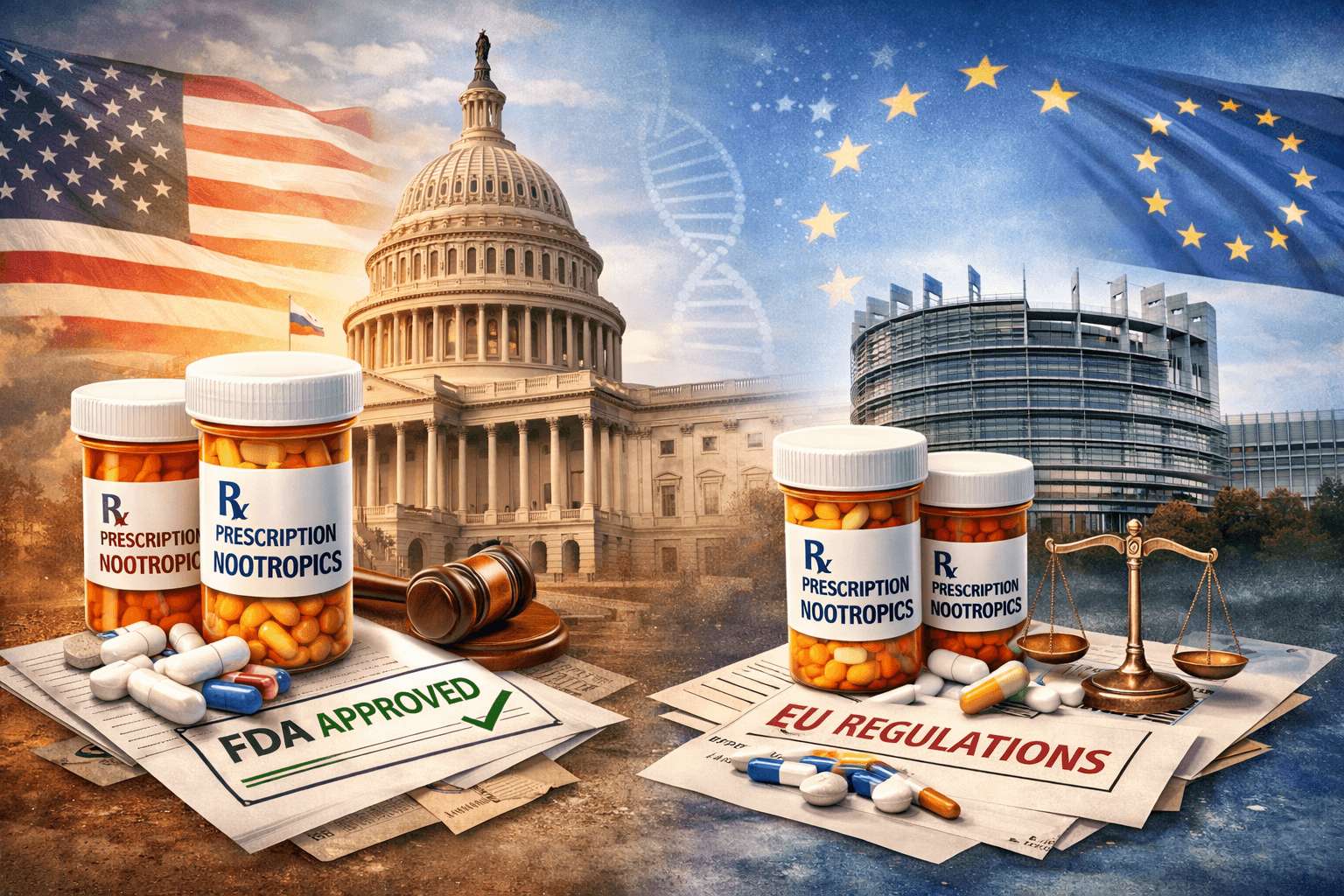
In the US, any pathway toward broader legalization runs through the Food and Drug Administration (FDA) and the Controlled Substances Act (CSA). We anticipate no abrupt deregulation. Instead, the dominant scenario is incremental liberalization via medical reclassification.
Political debates increasingly frame cognitive decline, burnout, and attention disorders as public health productivity risks. This framing aligns with bipartisan interests: economic competitiveness for conservatives and healthcare access for progressives.
Scenario One: Expanded Indications and Off-Label Normalization
The most probable near-term scenario involves FDA approval of expanded therapeutic indications. Conditions such as age-related cognitive impairment, post-COVID neurological fatigue, and treatment-resistant depression are already cited in policy-adjacent discussions.
Under this model:
- Prescription nootropics remain Rx-only
- Physicians gain wider discretion
- Insurance reimbursement expands selectively
- Off-label use becomes de facto normalized
This approach avoids politically sensitive “legalization” language while materially increasing access.
Scenario Two: Rescheduling Under the CSA
A more ambitious, medium-term scenario involves rescheduling certain nootropics from Schedule IV to a less restrictive category. This would reduce prescribing friction and lower compliance costs for healthcare providers.
Rescheduling debates are already informed by precedent, particularly the evolving treatment of psychedelic-assisted therapies at the state level. While nootropics lack the cultural momentum of psychedelics, they benefit from a lower stigma profile and established clinical safety data.
European Union: Fragmented Progress Within a Harmonized Framework
EMA Authority Versus National Sovereignty
In the EU, regulatory dynamics are shaped by the European Medicines Agency (EMA) alongside national health ministries. While drug approval is centralized, prescription rules and reimbursement remain largely national competencies.
This creates a dual-speed Europe in which legalization trajectories diverge by member state.
Scenario One: Therapeutic Expansion Through Aging Policy
The EU’s demographic reality rapid population aging makes cognitive health a strategic priority. We observe growing alignment between nootropic policy and active aging strategies promoted by the European Commission.
Under this scenario:
- Nootropics are repositioned as geriatric-support medications
- Prescription access expands for cognitive maintenance
- Use is framed as preventive healthcare, not enhancement
Northern and Western European states with robust public health systems are most likely to lead this shift.
Scenario Two: National-Level Liberalization Pilots
A second scenario involves national pilot programs in innovation-forward states. Countries with strong life sciences sectors may authorize controlled access programs for professionals in high-cognitive-demand fields.
Such pilots would:
- Collect real-world evidence
- Inform EMA-level reassessments
- Normalize enhancement discourse without EU-wide mandates
This bottom-up approach mirrors prior EU experiences with digital health and telemedicine regulation.
Political Narratives Shaping Legalization Outcomes
Productivity, Competitiveness, and Cognitive Capital
Across both jurisdictions, we see nootropics increasingly discussed in terms of human capital optimization. In a global economy defined by AI, automation, and knowledge work, cognitive performance is framed as an economic asset.
This narrative resonates strongly with:
- Technology sector lobbying
- Defense and security planning
- Education reform debates
Equity and Access Considerations
Opposition arguments focus less on safety and more on equity. Policymakers express concern that unrestricted access could exacerbate socioeconomic disparities. As a result, legalization scenarios consistently incorporate medical gatekeeping rather than over-the-counter availability.
What Legalization Will Not Look Like
It is critical to note what scenarios remain politically implausible:
- Full over-the-counter availability
- Recreational classification
- Deregulation without physician oversight
Both US and EU debates remain anchored in medical legitimacy, not lifestyle liberalization.
Market and Industry Implications
For pharmaceutical manufacturers and healthcare providers, gradual legalization signals:
- Increased R&D investment in next-generation nootropics
- Growth in personalized cognitive medicine
- Expansion of digital prescription platforms
Regulatory clarity, even without full liberalization, reduces uncertainty and unlocks capital deployment across the sector.
Strategic Forecast: Convergence Without Uniformity
We conclude that prescription nootropics are on a measured path toward broader legality, defined by reclassification, expanded indications, and normalized prescribing practices rather than headline-grabbing legalization acts.
The US will likely move faster through federal medical frameworks, while the EU advances unevenly through national initiatives within a harmonized approval system. In both cases, the decisive factor is not public enthusiasm but institutional willingness to redefine cognitive health as a legitimate medical domain.
‼️ Disclaimer: The information provided in this article about modafinil is intended for informational purposes only and is not a substitute for professional medical consultation or recommendations. The author of the article are not responsible for any errors, omissions, or actions based on the information provided.