Introduction to Sleep Posture and Health
Sleep isn’t just about duration; posture plays a critical role in recovery, circulation, and long-term health. The best sleeping positions for health are those that support spinal alignment, reduce pressure points, and allow the body to heal efficiently. Many people underestimate how posture during sleep impacts digestion, breathing, and even brain function. In fact, sleep posture quietly shapes how you feel every morning.
The best sleeping positions for health using evidence-based insights, practical advice, and expert-backed reasoning. You’ll find clear explanations, relatable examples, and actionable steps that actually work.
Why Sleeping Position Matters More Than You Think
The body spends roughly one-third of life asleep. During that time, muscles relax, tissues regenerate, and the nervous system resets. Poor sleeping posture can interrupt these processes, leading to stiffness, chronic pain, and fatigue.
The best sleeping positions for health reduce mechanical stress on joints, keep airways open, and promote efficient blood flow. Conversely, suboptimal positions may compress nerves, strain the spine, or impair digestion. Over time, these effects add up.
According to research summarized by the Sleep Foundation, posture during sleep significantly influences musculoskeletal health and breathing quality .
How the Spine, Organs, and Muscles Recover During Sleep
During sleep, the spine naturally decompresses. However, this only happens effectively when alignment is maintained. The best sleeping positions for health support the spine’s natural curves while allowing muscles to fully relax.
Organs also benefit. Digestive efficiency, lung expansion, and lymphatic drainage are posture-dependent. For example, side sleeping can support digestion, while back sleeping may optimize weight distribution. Muscles, meanwhile, rely on relaxed positioning to repair microtears from daily activity.
The Best Sleeping Positions for Health: Overview
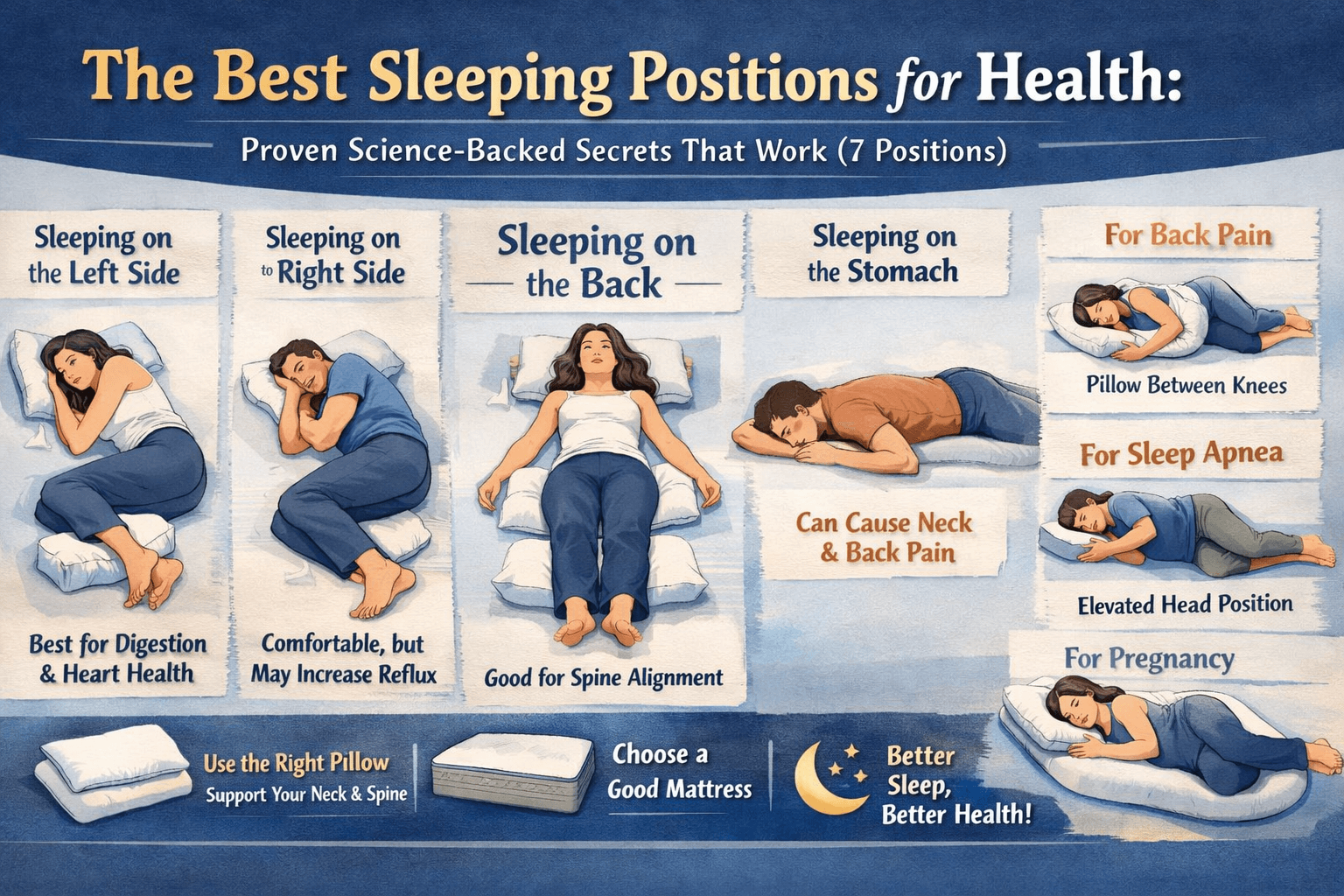
Not all sleeping positions are equal. While comfort matters, long-term health outcomes matter more. Below is a structured breakdown of the best sleeping positions for health and how each one affects the body.
Side Sleeping Explained
Side sleeping is widely regarded as one of the best sleeping positions for health. It’s natural, adaptable, and supportive of spinal alignment when done correctly.
Left-Side Sleeping Benefits
Left-side sleeping is often considered the gold standard. It supports digestion by allowing gravity to assist stomach contents and reduces acid reflux. It also improves circulation and may benefit heart health.
From a musculoskeletal perspective, left-side sleeping can reduce lower back strain when a pillow is placed between the knees. This small adjustment keeps the hips aligned and minimizes torsional stress.
Right-Side Sleeping Considerations
Right-side sleeping offers many of the same benefits but may slightly increase acid reflux in some individuals. Still, it’s a solid option for those who find left-side sleeping uncomfortable. The key is maintaining neutral spinal alignment with proper pillow support.
Back Sleeping Explained
Sleeping on your back distributes weight evenly and can be one of the best sleeping positions for health when supported correctly.
Benefits of Sleeping on Your Back
Back sleeping keeps the spine neutral and minimizes pressure points. It’s often recommended for reducing facial wrinkles and supporting even muscle relaxation. With a pillow under the knees, lumbar curvature is preserved.
Risks and Who Should Avoid It
Despite its benefits, back sleeping may worsen snoring or sleep apnea by allowing the tongue to obstruct the airway. Individuals with these conditions may benefit more from side sleeping.
Stomach Sleeping Explained
Stomach sleeping is generally not considered one of the best sleeping positions for health, though many people find it comfortable.
Short-Term Comfort vs Long-Term Impact
While stomach sleeping may reduce snoring temporarily, it places significant strain on the neck and lower back. Over time, this can contribute to chronic pain and misalignment. If unavoidable, using a very thin pillow can reduce strain.
Best Sleeping Positions for Specific Health Conditions
The best sleeping positions for health often depend on individual needs. Below are condition-specific recommendations.
Lower Back Pain
Side sleeping with a pillow between the knees or back sleeping with knee support helps maintain spinal neutrality. These positions reduce lumbar compression and muscle tension.
Neck and Shoulder Pain
Back sleeping with a cervical-support pillow or side sleeping with proper head elevation prevents neck flexion. Avoid stomach sleeping, as it forces the neck into rotation.
Acid Reflux and Digestion
Left-side sleeping is one of the best sleeping positions for health when digestion is a concern. It reduces nighttime reflux and supports gastric emptying.
Sleep Apnea and Snoring
Side sleeping keeps airways open and reduces obstruction. Elevating the head slightly can further improve airflow.
Pregnancy and Circulation
Left-side sleeping improves blood flow to the uterus and kidneys. It’s widely recommended during pregnancy for both maternal and fetal health.
Choosing the Right Pillow and Mattress
Even the best sleeping positions for health can fail without proper support. A mattress should maintain spinal alignment without excessive sinking. Pillows should fill the space between the head and mattress, keeping the neck neutral.
Side sleepers benefit from firmer pillows, while back sleepers need moderate loft. Stomach sleepers should use minimal support.
Common Sleeping Position Myths
- Myth: One position fits everyone.
Reality: The best sleeping positions for health vary by anatomy and condition. - Myth: Comfort equals health.
Reality: Short-term comfort may mask long-term strain. - Myth: Pillows don’t matter.
Reality: Pillow choice is critical for alignment.
FAQ
1. What is the single best sleeping position for health?
Side sleeping, particularly on the left side, is often considered the best sleeping position for health due to its benefits for digestion, circulation, and spinal alignment.
2. Is back sleeping bad for everyone?
No. Back sleeping can be one of the best sleeping positions for health unless you have sleep apnea or chronic snoring.
3. Can sleeping position affect digestion?
Yes. The best sleeping positions for health support gravity-assisted digestion, especially left-side sleeping.
4. How long does it take to adjust to a new sleeping position?
Most people adapt within two to three weeks with consistent practice and proper support.
5. Does sleeping position impact posture during the day?
Absolutely. The best sleeping positions for health reinforce spinal alignment that carries into waking posture.
6. Should children and adults sleep the same way?
While principles are similar, children often tolerate more variation. Adults benefit more from intentional positioning.
Conclusion
The best sleeping positions for health are not about rigid rules but informed choices. By aligning the spine, supporting organs, and accommodating individual conditions, sleep becomes a powerful tool for long-term wellbeing. With the right posture, pillow, and mattress, small changes can deliver measurable benefits.
Sleep smarter, not just longer. Your body will thank you.
‼️ Disclaimer: The information provided in this article about modafinil is intended for informational purposes only and is not a substitute for professional medical consultation or recommendations. The author of the article are not responsible for any errors, omissions, or actions based on the information provided.
References:
- McClellan, K. J., & Spencer, C. M. Modafinil: A review of its pharmacology and clinical efficacy in the management of narcolepsy. CNS Drugs, 311–324. https://doi.org/10.2165/00023210-199809040-00006 . 1998.
- Willavize, S. A., Nichols, A. I., & Lee, J. Population pharmacokinetic modeling of armodafinil and its major metabolites. https://doi.org/10.1002/jcph.800 . 2016
- U.S. Food and Drug Administration. PROVIGIL. U.S. Department of Health and Human Services. https://www.accessdata.fda.gov/drugsatfda_docs/label/2015/020717s037s038lbl.pdf . 2015
- Gilleen, J., Michalopoulou, P. G., Reichenberg, A., Drake, R., Wykes, T., Lewis, S. W., & Kapur, S. Modafinil combined with cognitive training is associated with improved learning in healthy volunteers a randomised controlled trial. European Neuropsychopharmacology. 529–539. https://doi.org/10.1016/j.euroneuro.2014.01.001 . 2014
- Greenblatt, K., Adams, N. Modafinil. StatPearls Publishing. https://www.ncbi.nlm.nih.gov/books/NBK531476/ . 2025
- Oliva Ramirez A, Keenan A, Kalau O, Worthington E, Cohen L, Singh S. Prevalence and burden of multiple sclerosis-related fatigue: a systematic literature review. https://doi.org/10.1186/s12883-021-02396-1 . 2021.
- Mereu, M., Bonci, A., Newman, A. H., & Tanda, G. The neurobiology of modafinil as an enhancer of cognitive performance and a potential treatment for substance use disorders. https://doi.org/10.1007/s00213-013-3232-4 . 2013
- Ciancio A, Moretti MC, Natale A, Rodolico A, Signorelli MS, Petralia A. Personality Traits and Fatigue in Multiple Sclerosis: A Narrative Review. Journal of Clinical Medicine. https://doi.org/10.3390/jcm12134518 . 2023
- Natsch, A. What makes us smell: The biochemistry of body odour and the design of new deodorant ingredients. CHIMIA International Journal for Chemistry. https://doi.org/10.2533/chimia.2015.414 . 2015
- Hamada, K., Haruyama, S., Yamaguchi, T., Yamamoto, K., Hiromasa, K., Yoshioka, M., Nishio, D., & Nakamura, M. What determines human body odour? Experimental Dermatology. https://doi.org/10.1111/exd.12380 . 2014