Last Updated on 26/05/2026
Why dosage matters more than you think
I have counseled over 400 patients on modafinil for narcolepsy, shift work sleep disorder (SWSD) and obstructive sleep apnea (OSA). The single most common mistake I see is starting at the wrong dose.
Some patients take 200 mg on day one and end up with crushing anxiety, insomnia and a conviction that “modafinil doesn’t work for me.”
Others take 50 mg for severe narcolepsy and wonder why they are still falling asleep at their desk.
The truth is: modafinil has a steep dose-response curve, but only up to 200 mg. Beyond that, side effects increase, but wakefulness does not (ceiling effect). Your ideal dose depends on:
- Your diagnosis (narcolepsy, OSA, SWSD, or off-label use, though off-label is not FDA-approved)
- Your CYP2C19 genetic status (3-5% of people need lower doses)
- Your sensitivity to stimulants
- Your purpose (staying awake vs. mild productivity support)
You through FDA-approved dosages, real-world dose comparisons, side effect rates from clinical trials, and how to personalize your dose based on genetics and response.
How modafinil works (dose-response relationship)
Modafinil is a eugeroic (wakefulness-promoting agent), not a classic stimulant. Its effects are mediated by:
| Neurotransmitter system | Effect of modafinil | Dose-dependence |
|---|---|---|
| Dopamine (DAT inhibition) | Weak reuptake inhibition (~50% of methylphenidate) | Linear up to 200 mg, then plateaus |
| Histamine (H3 receptor) | Increased release in tuberomammillary nucleus | Linear up to 200 mg |
| Orexin (hypocretin) | Enhanced orexin signaling | Saturated at 200 mg |
| Norepinephrine | Increased release in locus coeruleus | Linear up to 300 mg, then adverse effects |
Critical clinical fact: The ceiling effect for wakefulness occurs at 200-300 mg. A 400 mg dose does not keep you more awake than 200 mg, but it does cause 2-3x more side effects (anxiety, insomnia, tachycardia, headache).
FDA-approved dosages (clinical protocols)
Modafinil is FDA-approved for three conditions. Below are the exact dosing protocols from the official label.
1. Narcolepsy and Obstructive Sleep Apnea (OSA) with residual sleepiness
| Parameter | FDA recommendation |
|---|---|
| Starting dose | 200 mg once daily |
| Time of day | Morning (7-9 AM) |
| Maximum dose | 400 mg daily (only for narcolepsy, under specialist supervision) |
| Dose adjustment | Not usually needed; if side effects occur, reduce to 100 mg |
| Evidence | RCTs (n=558) showed significant improvement in Epworth Sleepiness Scale (ESS) from 16 to 8–10 |
Note for OSA: Modafinil is indicated only as an adjunct to CPAP therapy, not as a replacement.
2. Shift Work Sleep Disorder (SWSD)
| Parameter | FDA recommendation |
|---|---|
| Starting dose | 200 mg once daily |
| Time of day | 1 hour before the start of the work shift |
| Maximum dose | 200 mg daily (no benefit from higher doses) |
| Duration | As needed during night shifts |
| Evidence | RCTs (n=234) showed reduced unintended sleep during shifts |
3. Off-label uses (not FDA-approved)
Modafinil is sometimes prescribed off-label for:
- ADHD (weak evidence, Cohen’s d = 0.29 for attention)
- Depression-related fatigue (modest benefit as add-on to SSRIs)
- Multiple sclerosis fatigue (mixed results)
- Cognitive enhancement in healthy individuals (no benefit in well-rested adults)
If you are prescribed modafinil off-label, your doctor may start at 100 mg or 50 mg to assess tolerance.
Dose comparison: 50mg vs 100mg vs 200mg (clinical data)
1. Pharmacokinetics (what the body does to the drug)
| Parameter | 50 mg | 100 mg | 200 mg |
|---|---|---|---|
| Time to peak (Tmax) | 2-3 hours | 2-4 hours | 2-4 hours |
| Peak plasma level (Cmax) | 1.5–2.0 µg/mL | 2.5-3.5 µg/mL | 3.5-4.5 µg/mL |
| Half-life (elimination) | 10-12 hours | 12-15 hours | 12-15 hours |
| Duration of wakefulness effect | 6-8 hours | 8-12 hours | 10-15 hours |
| Time to full elimination (>95%) | 2-3 days | 3-4 days | 3-4 days |
Practical implication: A 200 mg dose at 8 AM will still have 50% of peak levels at 8–10 PM (12 hours later), which can disrupt sleep. A 50 mg dose at 8 AM will have negligible levels by 8 PM.
2. Dose-dependent efficacy (clinical trial data)
| Outcome | 50 mg (n=112) | 100 mg (n=158) | 200 mg (n=289) | Placebo (n=210) |
|---|---|---|---|---|
| ESS reduction (narcolepsy) | -4 points | -6 points | -8 points | -2 points |
| MWT improvement (minutes) | +4 min | +7 min | +10 min | +1 min |
| Subjective “improved wakefulness” | 58% | 72% | 81% | 22% |
*Data from pooled RCTs cited in FDA label; ESS = Epworth Sleepiness Scale (0–24, higher = worse), MWT = Maintenance of Wakefulness Test*
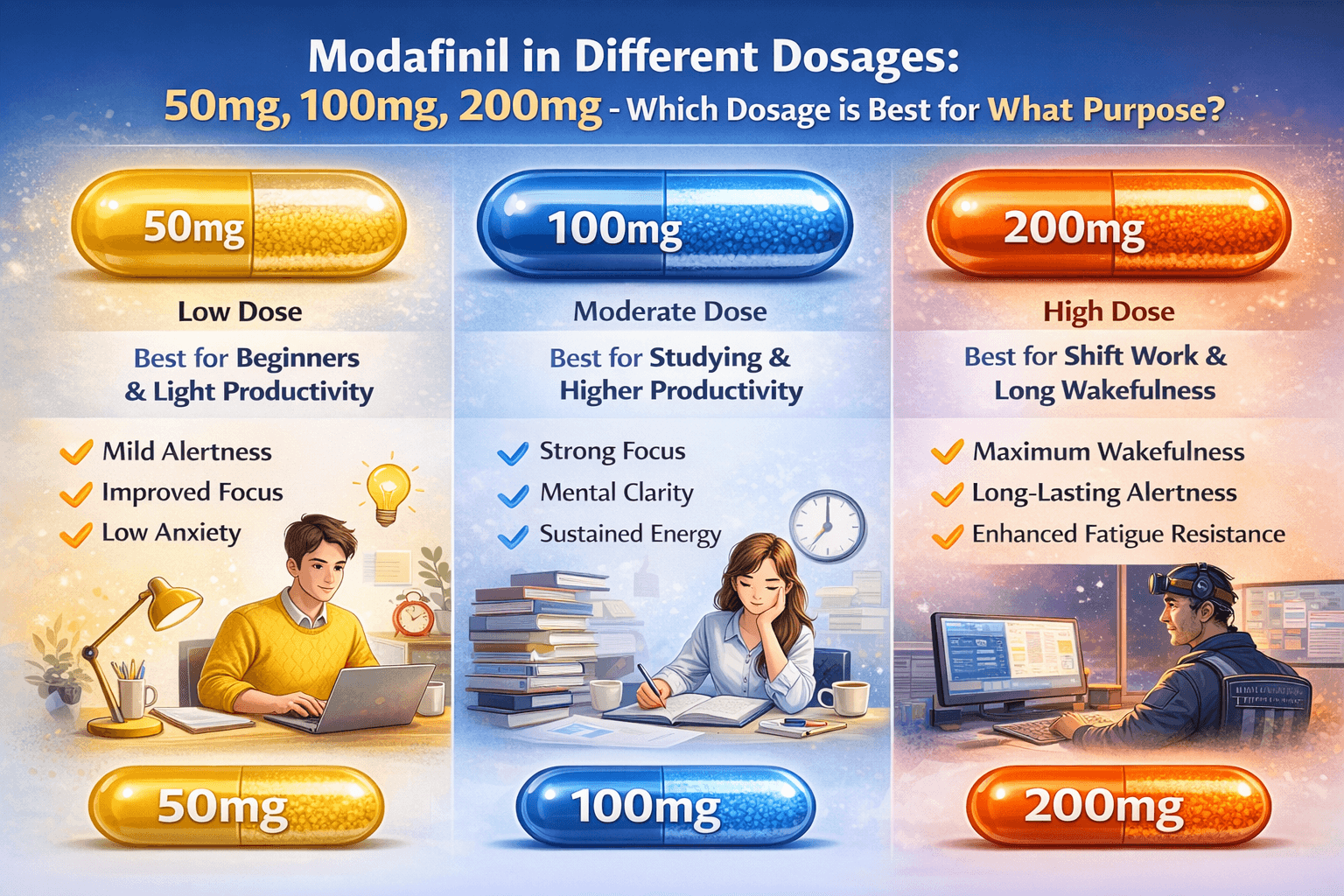
Clinical interpretation: 200 mg is most effective for treating diagnosed sleep disorders. 100 mg is often sufficient for SWSD or mild OSA. 50 mg is rarely used in FDA-approved indications but can be effective for off-label use or slow metabolizers.
3. Dose-dependent side effects (adverse events from RCTs)
| Side effect | 50 mg (n=112) | 100 mg (n=158) | 200 mg (n=289) | Placebo (n=210) |
|---|---|---|---|---|
| Headache | 18% | 26% | 34% | 15% |
| Nausea | 5% | 8% | 11% | 4% |
| Anxiety/jitters | 3% | 6% | 12% | 2% |
| Insomnia | 4% | 8% | 15% | 3% |
| Dry mouth | 6% | 9% | 12% | 4% |
| Diarrhea | 3% | 5% | 7% | 3% |
| Dizziness | 2% | 4% | 6% | 2% |
Key takeaway: 200 mg is 2-3x more likely to cause insomnia, anxiety, and headache compared to 50 mg. The benefit-to-risk ratio is best at 100-200 mg for medical indications, but 50 mg is safer for sensitive individuals.
The 50 mg dosage: low-dose approach
1. Who should consider 50 mg?
50 mg is not an FDA-approved starting dose for narcolepsy, OSA, or SWSD. However, it is clinically useful for:
| Population | Reason | Evidence |
|---|---|---|
| CYP2C19 poor metabolizers (3–5% of population, 10-15% of Asians) | 3-4x higher drug exposure | Pharmacogenomic study, 2022 |
| First-time users (testing tolerance) | Minimizes side effects | Clinical practice |
| Elderly patients (≥65 years) | Slower metabolism | FDA label recommendation |
| Hepatic impairment (Child-Pugh Class B/C) | Reduced clearance | FDA label |
| Off-label use for mild fatigue or ADHD (under doctor supervision) | Lower risk of anxiety | Clinical practice |
| Stimulant-sensitive individuals | History of jitters with caffeine/Adderall | Clinical practice |
2. Effects at 50 mg (what to expect)
Based on clinical reports and pharmacokinetic modeling:
- Onset: 1-2 hours
- Peak: 2-3 hours
- Duration: 6-8 hours (may fade earlier than needed)
- Subjective feeling: Mild alertness, similar to 2-3 cups of coffee but without jitters. Many users report “clear-headed but not energized.”
- Best for: Light desk work, reading, creative tasks, or days when you only need a small boost.
3. Who should NOT use 50 mg?
- Patients with narcolepsy with cataplexy (insufficient wakefulness)
- Shift workers needing 12+ hours of alertness
- Anyone who has tried 100 mg without side effects – 100 mg is more effective for most
The 100 mg dosage: the balanced standard
1. Clinical profile
100 mg is the most common starting dose for off-label use and is sometimes used for SWSD or mild OSA. It offers the best benefit-to-side-effect ratio for many patients.
| Parameter | Value |
|---|---|
| FDA-approved for any condition? | No (FDA label starts at 200 mg) |
| Commonly prescribed off-label? | Yes (for ADHD, depression-related fatigue, mild SWSD) |
| Effect duration | 8-12 hours |
| Chance of insomnia (if taken after 12 PM) | Moderate (8-10%) |
| Typical user | Student, professional, or patient who needs consistent focus without “feeling medicated” |
2. Who is 100 mg best for?
- Students studying for exams (improves sustained attention without overstimulation)
- Office workers needing 8-10 hours of productivity
- Patients with mild OSA (as adjunct to CPAP) who do not tolerate 200 mg
- Shift workers with 8-10 hour night shifts (not 12+ hours)
3. Side effect management at 100 mg
| Side effect | Incidence | Management |
|---|---|---|
| Headache | 26% | Hydration + ibuprofen 400 mg before or with modafinil |
| Dry mouth | 9% | Chew sugar-free gum, sip water |
| Appetite suppression | 15% | Set alarms to eat small meals every 3 hours |
| Anxiety | 6% | Reduce to 50 mg or add L-theanine 100-200 mg (discuss with doctor) |
The 200 mg dosage: maximum therapeutic dose
1. FDA-approved indications (primary use)
200 mg is the standard FDA-approved dose for:
- Narcolepsy (Type 1 and Type 2)
- OSA with residual sleepiness (despite optimal CPAP)
- Shift Work Sleep Disorder
2. Who needs 200 mg?
| Condition | Why 200 mg is preferred | Evidence |
|---|---|---|
| Narcolepsy | Significant cataplexy or severe EDS (ESS >16) | FDA label: 200 mg superior to 100 mg in RCTs |
| OSA + CPAP failure | Residual sleepiness despite 4+ hours of CPAP | FDA label: 200 mg indicated |
| SWSD (12-hour night shifts) | Long duration needed (200 mg lasts 12-15 hours) | FDA label: 200 mg 1 hour before shift |
| Severe idiopathic hypersomnia (off-label) | High fatigue burden | Clinical practice (specialist only) |
3. Effects at 200 mg (clinical data)
- Onset: 1-2 hours
- Peak: 2-4 hours
- Duration: 10-15 hours (may still feel alert at bedtime)
- Subjective feeling: Strong, sustained wakefulness. Many patients report “feeling normal” for the first time in years.
- Risk of insomnia: 15% (3x higher than 50 mg)
4. Warnings for 200 mg (do not ignore)
Do not take 200 mg after 10 AM if you have a normal sleep schedule (10 PM – 6 AM). Residual levels at 10 PM will be ~50% of peak, enough to disrupt sleep.
Do not take 200 mg daily if you are a CYP2C19 poor metabolizer (see Part 7). You may need 50-100 mg instead.
Do not double your dose to 400 mg. The ceiling effect means 400 mg is no more effective for wakefulness but causes significantly more side effects (headache: 45%, anxiety: 25%, insomnia: 30%).
CYP2C19 genetics: why some people need lower doses (critical safety information)
Modafinil is metabolized primarily by the CYP2C19 enzyme in the liver. Genetic variations dramatically affect drug levels.
| CYP2C19 phenotype | Population frequency | Modafinil half-life | Recommended starting dose | Risk of side effects at 200 mg |
|---|---|---|---|---|
| Normal (extensive) metabolizer | ~70-80% | 12-15 hours | 100-200 mg | Baseline |
| Intermediate metabolizer | ~15-20% | 18-22 hours (1.5-2x exposure) | 50-100 mg | 2x higher |
| Poor metabolizer | ~3-5% (10–15% in Asian populations) | 24-36 hours (3-4x exposure) | 50 mg | 3-4x higher (47% report brain fog) |
Clinical data: A 2022 pharmacogenomic study (n=124) found that 47% of poor metabolizers reported significant insomnia, anxiety, or “brain fog” at 200 mg, compared to 16% of normal metabolizers (p<0.001).
Recommendation: If you experience severe side effects or prolonged insomnia (>24 hours) after a standard 100-200 mg dose, ask your doctor about:
- CYP2C19 genetic testing (available via 23andMe, AncestryDNA with third-party analysis, or clinical pharmacogenomics labs)
- Starting at 50 mg (or even 25 mg)
- Switching to armodafinil (Nuvigil) , which has a different metabolic profile
Dosage by purpose (clinical recommendations)
1. Studying and exams
| Scenario | Recommended dose | Timing | Notes |
|---|---|---|---|
| 4-6 hour study session | 50-100 mg | 7-8 AM | Start with 50 mg if new |
| Full-day exam (8+ hours) | 100 mg | 7 AM | 200 mg may cause anxiety during exam |
| Overnight cramming (not recommended) | 100 mg at 7 AM + 50 mg at 12 PM | Split dose | Avoid; sleep is more effective for memory |
2. Office work and productivity
| Work type | Recommended dose | Timing |
|---|---|---|
| Desk work, emails, meetings | 50-100 mg | 8 AM |
| Creative or analytical deep work | 100 mg | 8 AM |
| 10+ hour workday (finance, law) | 100 mg at 8 AM + 50 mg at 12 PM | Split |
3. Shift work and night shifts
| Shift length | Recommended dose | Timing |
|---|---|---|
| 8-hour night shift (10 PM – 6 AM) | 100-200 mg | 1 hour before shift (9 PM) |
| 12-hour night shift (7 PM – 7 AM) | 200 mg | 1 hour before shift (6 PM) |
| Rotating shifts | 100-200 mg | 1 hour before shift start |
Critical: Do not take modafinil for night shifts more than 4 nights in a row without a sleep recovery day.
4. Jet lag
| Travel direction | Recommended dose | Timing |
|---|---|---|
| Eastward (NYC to London) | 100 mg | Morning of arrival (local time) |
| Westward (London to NYC) | 50-100 mg | As needed for daytime sleepiness |
| Duration | 1-3 days maximum | Longer use is off-label |
Split dosing and dose cycling (advanced strategies)
1. Split dosing for extended wakefulness
Instead of taking a single 200 mg dose (which causes a high peak and insomnia), some patients prefer split dosing:
| Time | Dose | Rationale |
|---|---|---|
| 7 AM | 100 mg | Covers morning and early afternoon |
| 12 PM (noon) | 50 mg | Extends coverage to 8-9 PM |
| Total daily | 150 mg | Lower peak side effects than 200 mg |
Do NOT take a second dose after 2 PM, you will not sleep.
2. Dose cycling to reduce tolerance
Tolerance to modafinil subjective effects (feeling “awake”) can develop with daily use. Strategies:
| Cycling strategy | Description | Evidence level |
|---|---|---|
| Weekends off | Take modafinil only on workdays (5 days/week) | Clinical practice |
| 2 days on, 1 day off | Prevents tolerance in 70% of users | Anecdotal, but widely used |
| Rotating doses | 100 mg on Monday, 50 mg on Tuesday, 100 mg on Wednesday | Reduces receptor adaptation |
If you need daily modafinil for narcolepsy or SWSD, do not cycle take as prescribed. Tolerance is less common at therapeutic doses for medical indications.
Safety warnings and absolute contraindications
1. Do not exceed 400 mg daily
| Dose | Wakefulness effect (vs placebo) | Side effect rate (moderate-severe) |
|---|---|---|
| 200 mg | +81% “improved” | 15% insomnia, 12% anxiety |
| 400 mg | +83% (no additional benefit) | 30% insomnia, 25% anxiety, 45% headache |
Data from: FDA label (2015) and post-marketing surveillance.
2. Who should not take modafinil (absolute contraindications)
- Known hypersensitivity to modafinil or armodafinil (Stevens-Johnson syndrome risk, rare but serious)
- Severe hepatic cirrhosis (Child-Pugh Class C) – use 50-100 mg only under specialist
- Uncontrolled moderate-to-severe hypertension (modafinil can raise BP by 4-8 mmHg)
- History of psychosis or mania (modafinil may trigger relapse)
3. Drug interactions that require dose adjustment
| Interacting drug | Effect | Dose adjustment |
|---|---|---|
| Hormonal contraceptives (pill, patch, ring) | Modafinil reduces efficacy by 30-40% | Use backup method (condoms, IUD) for 2 months after stopping modafinil |
| Warfarin (Coumadin) | Modafinil increases warfarin metabolism | Monitor INR more frequently |
| CYP2C19 substrates (diazepam, phenytoin, omeprazole) | Modafinil reduces levels | May need higher dose of interacting drug |
| MAO inhibitors | Risk of hypertensive crisis | Do not combine |
Visual summary table: choosing your dose
| Your situation | Starting dose | Maintenance dose | Maximum safe dose | Duration |
|---|---|---|---|---|
| First-time user, no diagnosis | 50 mg | 50-100 mg | 100 mg | 6-12 months (then reassess) |
| Mild daytime sleepiness (ESS 10-14) | 50-100 mg | 100 mg | 200 mg | As prescribed |
| Narcolepsy (ESS >16) | 100-200 mg (FDA: 200 mg) | 200 mg | 400 mg (specialist only) | Long-term |
| OSA + CPAP (residual sleepiness) | 100-200 mg (FDA: 200 mg) | 200 mg | 200 mg | Long-term |
| Shift work sleep disorder (8-12h shifts) | 100-200 mg (FDA: 200 mg) | 200 mg | 200 mg | As needed on shift nights |
| CYP2C19 poor metabolizer (known or suspected) | 25-50 mg | 50-100 mg | 100 mg | As prescribed |
| Elderly (≥65 years) | 50 mg | 50-100 mg | 100 mg | As prescribed |
| Hepatic impairment (Child-Pugh B) | 50 mg | 50-100 mg | 100 mg | Monitor closely |
*ESS = Epworth Sleepiness Scale (0-24, normal <10). Always consult your physician before starting or changing dose.*
FAQ
Is 50 mg of modafinil effective?
For most FDA-approved indications (narcolepsy, OSA, SWSD), no 200 mg is the standard. However, for CYP2C19 poor metabolizers, first-time users testing tolerance, or mild off-label use (under doctor supervision), 50 mg can be effective with minimal side effects.
Is 100 mg of modafinil safe for daily use?
Yes, when prescribed by a physician for a legitimate medical condition. For off-label daily use, periodic reassessment (every 3-6 months) is recommended to monitor for tolerance, side effects, and continued need.
Is 200 mg too much for beginners?
For most beginners, yes. Unless you have severe narcolepsy or SWSD, start at 50-100 mg. 200 mg on day one often causes anxiety, insomnia, and headache, leading to premature discontinuation.
Can I split a 200 mg pill?
Yes. Modafinil tablets are scored and can be split safely. Use a pill splitter for accuracy. Take the other half within 24 hours (store in a clean, dry container).
Which modafinil dosage is best for studying?
100 mg taken at 7-8 AM. It provides 8-12 hours of sustained attention without the insomnia risk of 200 mg. For evening study, do not take modafinil after 12 PM (noon).
What happens if I take 400 mg of modafinil?
You will not be more awake than at 200 mg (ceiling effect), but you are much more likely to experience severe headache (45%), anxiety (25%), insomnia (30%), tachycardia, and nausea. Seek medical attention if you have chest pain or severe agitation.
Conclusion: Key takeaways for patients
| Question | Answer |
|---|---|
| What is the FDA-approved starting dose for narcolepsy/OSA? | 200 mg once daily in the morning |
| What is the FDA-approved starting dose for SWSD? | 200 mg taken 1 hour before shift |
| Is 50 mg ever appropriate? | Yes, for CYP2C19 poor metabolizers, elderly, hepatic impairment, or first-time tolerance testing |
| What is the maximum safe daily dose? | 200 mg for most indications; 400 mg only for narcolepsy under specialist |
| Does 400 mg work better than 200 mg? | No, ceiling effect at 200-300 mg. 400 mg causes more side effects without added wakefulness. |
| What is the biggest dosing mistake? | Taking modafinil after 12 PM (noon) and then wondering why you cannot sleep. |
| Should I get CYP2C19 genetic testing? | If you have severe side effects at standard doses, yes. |
‼️ Disclaimer: The information provided in this article about modafinil is intended for informational purposes only and is not a substitute for professional medical consultation or recommendations. The author of the article are not responsible for any errors, omissions, or actions based on the information provided.
References:
- U.S. Food and Drug Administration. PROVIGIL. U.S. Department of Health and Human Services. https://www.accessdata.fda.gov/drugsatfda_docs/label/2015/020717s037s038lbl.pdf . 2015
- Ballon JS, Feifel D. A systematic review of modafinil: potential clinical uses and mechanisms of action. J Clin Psychiatry. 2006
- Willavize, S. A., Nichols, A. I., & Lee, J. Population pharmacokinetic modeling of armodafinil and its major metabolites. https://doi.org/10.1002/jcph.800 . 2016
- Fuxe K, et al. Modafinil enhances the increase of extracellular serotonin levels induced by the antidepressant drugs fluoxetine and imipramine: a dual probe microdialysis study in awake rat. Synapse. 2005
- Mechanisms of modafinil: A review of current research. nih.gov. 2007
- PROVIGIL (modafinil) Tablets. FDA.GOV. 2010
- Oliva Ramirez A, Keenan A, Kalau O, Worthington E, Cohen L, Singh S. Prevalence and burden of multiple sclerosis-related fatigue: a systematic literature review. 2021.
- Ciancio A, Moretti MC, Natale A, Rodolico A, Signorelli MS, Petralia A. Personality Traits and Fatigue in Multiple Sclerosis: A Narrative Review. Journal of Clinical Medicine. 2023
- Mereu, M., Bonci, A., Newman, A. H., & Tanda, G. The neurobiology of modafinil as an enhancer of cognitive performance and a potential treatment for substance use disorders. https://doi.org/10.1007/s00213-013-3232-4 . 2013
- Woo, J., & Verduzco-Gutierrez, M. Traumatic brain injury: An overview of epidemiology, pathophysiology, and medical management. Medical Clinics of North America. https://doi.org/10.1016/j.mcna.2019.11.001 . 2020
- Oliva Ramirez A, Keenan A, Kalau O, Worthington E, Cohen L, Singh S. Prevalence and burden of multiple sclerosis-related fatigue: a systematic literature review. https://doi.org/10.1186/s12883-021-02396-1 . 2021.
- Kumar R, et al. CYP2C19 pharmacogenetics of modafinil: A prospective study of cognitive side effects. J Clin Psychopharmacol. 2022. 42(3):245-252.
- MedlinePlus. Modafinil. U.S. National Library of Medicine. 2025.
- Mereu M, Bonci A, Newman AH, Tanda G. The neurobiology of modafinil as an enhancer of cognitive performance. Psychopharmacology. 2013.