Last Updated on 17/08/2026
Introduction: The Puzzle of Individual Responses
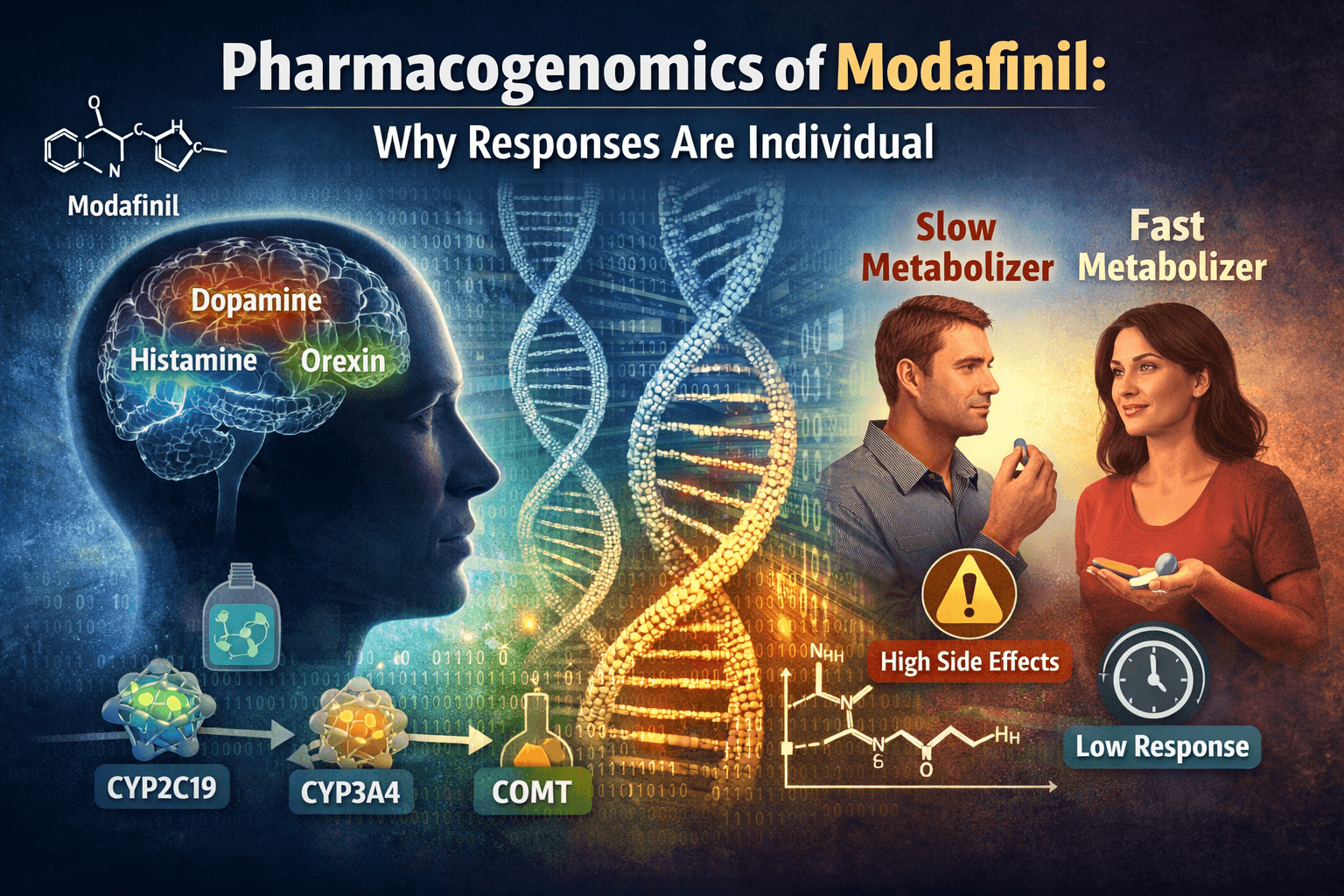
Pharmacogenomic research, few medications have illustrated the principle of inter-individual variability as vividly as modafinil. Patients who achieve remarkable focus on 100 mg, while others require 200 mg or more to experience any effect. Some individuals tolerate the medication without difficulty, while others develop anxiety, headaches, or insomnia at the same dose that proves therapeutic for their peers.
This variability is not random. It is rooted in the fundamental biology of how our bodies process medications: a field known as pharmacogenomics. The genetic differences that influence drug metabolism, transport and receptor sensitivity help explain why a “one-size-fits-all” approach to dosing is not merely impractical, but potentially unsafe.
Understanding Pharmacogenomics
Definition and Core Principles
Pharmacogenomics is the study of how genetic variation influences drug response. At its core, this field recognizes that our DNA determines how our bodies absorb, metabolize, distribute, and respond to medications. These genetic differences can affect drug efficacy, side effect risk and optimal dosing.
The principles of pharmacogenomics can be understood through a simple analogy: consider a drug as a key and your biology as a lock. Small genetic differences can subtly reshape that lock, affecting how well the key fits, how quickly it turns and how long it stays engaged. These variations can occur in genes encoding drug-metabolizing enzymes, drug transporters, receptors and downstream signaling molecules.
Phase I and Phase II Metabolism
Most drugs, including modafinil, are processed by liver enzymes in two major stages:
Phase I Metabolism: This phase typically involves cytochrome P450 (CYP) enzymes that modify the drug molecule, making it more water-soluble and often more or less active. CYP3A4 and CYP2C19 are the primary enzymes involved in modafinil metabolism.
Phase II Metabolism: In this phase, the modified molecule is conjugated with another substance (such as glucuronic acid or sulfate) to prepare it for elimination from the body through urine or bile.
Genetic variants in these enzymes can dramatically alter the rate of these steps, leading to significant differences in blood concentrations of modafinil among individuals.
How Modafinil Works in the Brain
Neurochemical Pathways Involved
Unlike classic stimulants, modafinil has a complex, multi-target mechanism of action that influences several neurotransmitter systems. These include dopamine, norepinephrine, histamine, orexin and glutamate. This multi-target profile partly explains its nuanced effects and the variability in individual responses.
Dopamine Transporter Interaction: One of the most important actions of modafinil is inhibition of the dopamine transporter (DAT), which increases extracellular dopamine, particularly in brain regions linked to motivation and attention. Genetic variation affecting dopamine signaling can therefore amplify or blunt modafinil’s effects.
Secondary Neurotransmitter Effects: Modafinil also indirectly boosts histamine and orexin activity, which promote wakefulness. Differences in receptor sensitivity and downstream signaling further contribute to individual variability.
Key Genes Influencing Modafinil Response
CYP3A4 and CYP2C19
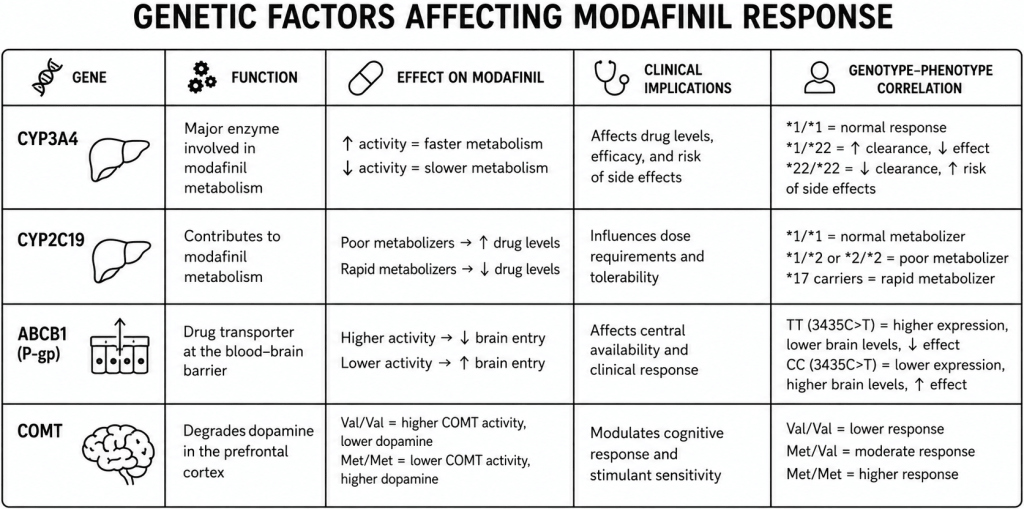
These are the two major enzymes involved in modafinil metabolism. Genetic variants that alter their activity have a direct impact on drug levels and effects.
| Gene | Enzyme | Effect of Genetic Variants | Clinical Impact |
|---|---|---|---|
| CYP3A4 | CYP3A4 | Reduced-function variants slow metabolism | Higher plasma levels → increased side effect risk |
| CYP2C19 | CYP2C19 | Poor metabolizers (PM) have significantly slower clearance | Need for dose reduction, higher sensitivity |
| CYP2C19 | CYP2C19 | Ultra-rapid metabolizers (UM) have faster clearance | Standard doses may be insufficient, require higher doses |
Clinical Interpretation: Individuals with reduced-function CYP3A4 or CYP2C19 variants may experience prolonged effects and heightened side effects even at standard doses. Conversely, ultra-rapid metabolizers may clear the drug quickly and perceive it as weak or short-lived.
ABCB1 (P-glycoprotein Transporter)
ABCB1 encodes a transporter that pumps drugs out of the brain and back into the bloodstream. Variants in this gene can alter how much modafinil actually reaches its central nervous system targets.
| Variant Type | Effect on Transport | Clinical Consequence |
|---|---|---|
| Reduced function | Less drug pumped out | Higher brain concentrations → increased efficacy and side effect risk |
| Increased function | More drug pumped out | Lower brain concentrations → reduced efficacy, may require higher dose |
COMT and Dopamine Regulation
COMT (Catechol-O-Methyltransferase) is an enzyme that breaks down dopamine, particularly in the prefrontal cortex. Certain genetic variants affect COMT activity, influencing dopamine availability.
| COMT Variant | Enzyme Activity | Effect on Modafinil Response |
|---|---|---|
| Val/Val | High activity (faster dopamine breakdown) | May require higher doses, less intense effects |
| Met/Met | Low activity (slower dopamine breakdown) | Greater dopamine accumulation, may experience stronger effects and more side effects (anxiety) |
Genetic Variability and Dosage Differences
Why Some People Need Higher Doses
Several genetic factors can reduce perceived efficacy: fast metabolism (rapid CYP2C19 or CYP3A4), efficient drug transport out of the brain (high-functioning ABCB1) and lower receptor sensitivity (COMT Val/Val variant leading to faster dopamine breakdown). For these individuals, standard doses may feel underwhelming, and higher doses may be required.
Why Others Experience Side Effects at Low Doses
Conversely, slow metabolism (reduced-function CYP variants), less efficient drug transport (low-functioning ABCB1) and heightened neurotransmitter sensitivity (COMT Met/Met variant leading to slower dopamine breakdown) can lead to overstimulation even at modest doses. This sensitivity is not intolerance in a psychological sense but predictable biology.
Population-Level Genetic Differences
Allele Frequency Variations
The prevalence of certain metabolic gene variants differs across populations, which has significant clinical implications.
| Gene | Variant | Frequency in European Populations | Frequency in Asian Populations | Clinical Implication |
|---|---|---|---|---|
| CYP2C19 | Poor metabolizer (PM) | ~3% | ~15-20% | Higher risk of side effects at standard doses in Asian populations |
| CYP3A4 | Reduced function | ~5% | ~10% | Increased sensitivity, need for dose reduction |
| ABCB1 | High-activity variant | ~25% | ~35% | Potentially reduced efficacy |
Clinical Implications Across Populations
These differences highlight why population-level dosing guidelines are approximations rather than precise instructions for individuals. A dose that is appropriate for one ethnic group may be too high or too low for another.
Age, Sex, and Epigenetic Factors
Hormonal Influences on Drug Metabolism
Sex hormones can modulate enzyme activity, which partly explains sex-based differences in drug response. Estrogen can inhibit CYP3A4, potentially leading to higher modafinil levels in women. Aging also alters liver function and enzyme expression, often leading to reduced clearance and increased sensitivity in older adults.
Epigenetics and Gene Expression Changes
Gene expression is not static. Stress, diet, sleep patterns, and environmental exposures can switch genes on or off through epigenetic mechanisms (DNA methylation, histone modification), subtly changing how modafinil is processed over time. This means an individual’s response can change even without a change in their DNA.
Drug-Drug Interactions and Genetic Risk
Enzyme Induction and Inhibition
Modafinil itself can induce or inhibit certain CYP enzymes, potentially affecting the metabolism of other medications. When combined with other drugs, genetically determined enzyme activity can magnify or mitigate these interactions.
| Interaction Type | Mechanism | Genetic Modifier |
|---|---|---|
| Modafinil + Oral Contraceptives | CYP3A4 induction reduces efficacy | Individuals with high CYP3A4 activity are less affected |
| Modafinil + Warfarin | Altered metabolism | CYP2C9 variants affect the interaction |
| Modafinil + Antidepressants | Competitive inhibition | CYP2D6 or CYP3A4 variants affect risk |
Two individuals taking the same drug combination may face very different risks due to genetic differences in metabolic capacity.
Modafinil Tolerance and Long-Term Use
Adaptive Neurobiology
With repeated use, the brain adapts. Receptor sensitivity, neurotransmitter release patterns, and intracellular signaling pathways may shift, influencing long-term efficacy. Genetic variation in these adaptive pathways can predispose some individuals to faster tolerance development.
Genetic Predisposition to Tolerance
Certain genetic profiles may be associated with more rapid neuroadaptation, making tolerance more likely. This may relate to variants in genes encoding dopamine receptors, transporters, or downstream signaling molecules.
Clinical Pharmacogenomic Testing
Available Genetic Tests
Commercial tests can identify variants in CYP enzymes (CYP3A4, CYP2C19), transporters (ABCB1), and neurotransmitter-related genes (COMT). These tests provide probabilistic guidance, not exact predictions. They can indicate whether an individual is more likely to be a poor, intermediate, extensive, or ultra-rapid metabolizer.
Limitations and Current Barriers
| Barrier | Description |
|---|---|
| Cost | Tests can be expensive and may not be covered by insurance |
| Clinician Training | Many prescribers lack formal training in pharmacogenomics |
| Evidence Base | While growing, evidence for genotype-guided dosing of modafinil is still limited |
| Time | Results may take days to weeks, delaying treatment initiation |
| Interpretation | Results often require specialized interpretation by pharmacogenomics experts |
Clinical Recommendations
Practical Takeaways for Patients and Clinicians
For Patients:
- Understand that your response to modafinil may differ significantly from others. Self-comparison is misleading and may lead to frustration.
- If you experience unusual sensitivity or lack of effect at standard doses, discuss possible pharmacogenomic evaluation with your healthcare provider.
- Be aware that your response may change over time due to epigenetic factors, age, or other medications.
- Always report side effects and efficacy concerns to your prescriber. Genotype-guided dose adjustment may be possible.
For Clinicians:
- Consider genetic screening in patients who experience unusual sensitivity, lack of effect, or unexpected side effects.
- Be aware of population-specific allele frequencies when assessing risk.
- Monitor patients for drug-drug interactions that may be genetically modified.
- Explain variability to patients to manage expectations and reduce frustration.
- Consider pharmacogenomic consultation for complex cases.
Conclusion
The varied responses to modafinil are not mysterious or subjective; they are rooted in genetics, neurobiology, and physiology. Pharmacogenomics provides a scientific framework for understanding why dosage and effects differ so dramatically among individuals.
As personalized medicine advances, modafinil serves as a compelling example of why individualized treatment strategies are not a luxury but a necessity. Genotype-guided prescribing has the potential to reduce adverse events, optimize efficacy, and eliminate the “trial-and-error” approach that currently dominates clinical practice.
For the clinician, understanding these genetic principles enables better patient counseling, safer prescribing, and more effective management of side effects. For the patient, it offers an explanation for their unique response and a path toward more personalized, effective treatment.
FAQ
Why does modafinil feel strong for some people and weak for others?
Because genetic differences affect metabolism (CYP enzymes), brain transport (ABCB1) and neurotransmitter sensitivity (COMT and dopamine receptors). These factors determine how much drug reaches its targets and how effectively it works.
Does faster metabolism mean modafinil is ineffective?
No, it may simply require dose adjustment or timing optimization under medical guidance. Some individuals with rapid metabolism benefit from higher doses or split dosing.
Will pharmacogenomics become standard in prescribing modafinil?
Trends suggest increasing adoption, though widespread clinical use will take time. As evidence grows and testing becomes more accessible, genotype-informed prescribing may become routine.
How do I get pharmacogenomic testing for modafinil?
Discuss this with your healthcare provider. Commercial tests are available through companies like GeneSight, OneOme, or Invitae. Some large academic medical centers offer pharmacogenomic testing services.
Are there ethnic differences in modafinil response?
Yes. The prevalence of certain metabolic variants (especially CYP2C19 poor metabolizers) varies across populations, which can influence average dose requirements and side effect risk.
Can modafinil affect the metabolism of other drugs?
Yes. Modafinil is a moderate CYP3A4 inducer, meaning it can reduce the levels of other drugs metabolized by this enzyme, including hormonal contraceptives. This interaction is genotype-dependent.
‼️ Disclaimer: The information provided in this article about modafinil is intended for informational purposes only and is not a substitute for professional medical consultation or recommendations. The author of the article are not responsible for any errors, omissions, or actions based on the information provided.
References:
- Ballon JS, Feifel D. A systematic review of modafinil: potential clinical uses and mechanisms of action. J Clin Psychiatry. 2006
- McClellan, K. J., & Spencer, C. M. Modafinil: A review of its pharmacology and clinical efficacy in the management of narcolepsy. CNS Drugs, 311–324. https://doi.org/10.2165/00023210-199809040-00006 . 1998.
- Willavize, S. A., Nichols, A. I., & Lee, J. Population pharmacokinetic modeling of armodafinil and its major metabolites. https://doi.org/10.1002/jcph.800 . 2016
- U.S. Food and Drug Administration. PROVIGIL. U.S. Department of Health and Human Services. https://www.accessdata.fda.gov/drugsatfda_docs/label/2015/020717s037s038lbl.pdf . 2015
- Gilleen, J., Michalopoulou, P. G., Reichenberg, A., Drake, R., Wykes, T., Lewis, S. W., & Kapur, S. Modafinil combined with cognitive training is associated with improved learning in healthy volunteers a randomised controlled trial. European Neuropsychopharmacology. 529–539. https://doi.org/10.1016/j.euroneuro.2014.01.001 . 2014
- Greenblatt, K., Adams, N. Modafinil. StatPearls Publishing. https://www.ncbi.nlm.nih.gov/books/NBK531476/ . 2025
- Oliva Ramirez A, Keenan A, Kalau O, Worthington E, Cohen L, Singh S. Prevalence and burden of multiple sclerosis-related fatigue: a systematic literature review. https://doi.org/10.1186/s12883-021-02396-1 . 2021.
- Mereu, M., Bonci, A., Newman, A. H., & Tanda, G. The neurobiology of modafinil as an enhancer of cognitive performance and a potential treatment for substance use disorders. https://doi.org/10.1007/s00213-013-3232-4 . 2013
- Ciancio A, Moretti MC, Natale A, Rodolico A, Signorelli MS, Petralia A. Personality Traits and Fatigue in Multiple Sclerosis: A Narrative Review. Journal of Clinical Medicine. https://doi.org/10.3390/jcm12134518 . 2023
- Natsch, A. What makes us smell: The biochemistry of body odour and the design of new deodorant ingredients. CHIMIA International Journal for Chemistry. https://doi.org/10.2533/chimia.2015.414 . 2015
- S Bodenmann, S Xu, U F O Luhmann, M Arand, W Berger, H H Jung, H P Landolt. Pharmacogenetics of modafinil after sleep loss: catechol-O-methyltransferase genotype modulates waking functions but not recovery sleep. Clin Pharmacol Ther. https://pubmed.ncbi.nlm.nih.gov/19037200/. 2009
- Ana Sousa, Ricardo Jorge Dinis-Oliveira. Pharmacokinetic and pharmacodynamic of the cognitive enhancer modafinil: Relevant clinical and forensic aspects. Subst Abus. https://pubmed.ncbi.nlm.nih.gov/31951804/. 2020