
Last Updated on 17/08/2026
Introduction: Separating Fact from Fear
The question of whether modafinil is addictive occupies a unique position in medical discourse. On one hand, it is celebrated as a “non-addictive smart drug” with remarkable cognitive benefits. On the other, it is sometimes viewed with suspicion, its stimulant properties raising concerns about addiction potential.
The clinical truth, as always, lies in the nuanced pharmacology. To ask whether modafinil is addictive is to ask a question with an answer that depends on how one defines addiction. This analysis will demonstrate that while modafinil carries some risks, particularly psychological dependence and mild physical dependence, its addiction liability is fundamentally different from that of classical stimulants like amphetamines or cocaine.
Critical Definitions: Addiction, Dependence, and Misuse
Any meaningful discussion of this topic requires precise terminology. These terms are frequently conflated in public discourse, leading to confusion and fear.
Addiction (Substance Use Disorder): A complex behavioral condition characterized by compulsive drug seeking, impaired control over use, craving, and continued use despite significant harm. It is a chronic, relapsing brain disorder. Addiction is defined by the behavioral pathology, not merely by the presence of withdrawal symptoms.
Physical Dependence: A physiological adaptation to a drug, manifested by withdrawal syndrome upon abrupt discontinuation or dose reduction. Physical dependence can occur with many non-addictive medications, including beta-blockers, antidepressants, and corticosteroids. A patient can be physically dependent on modafinil without being addicted.
Tolerance: A diminished response to a fixed dose over time, requiring dose escalation to achieve the initial effect. Tolerance to modafinil is variable and often overstated. While some users report stable efficacy for years, others may notice diminished effects over time.
Misuse: Using a medication outside of prescribed parameters, including higher doses, different routes of administration or non-medical purposes. Misuse of modafinil occurs, primarily for cognitive enhancement in healthy individuals, but route misuse (such as insufflation) is rare.
Neurochemical Basis of Modafinil’s Low Abuse Potential
To understand why modafinil is not amphetamine, one must examine the kinetics and dynamics of its interaction with key neurotransmitter systems, particularly the dopamine transporter (DAT).
The Dopamine Transporter Hypothesis
All drugs with high addiction liability (cocaine, amphetamine, methamphetamine) produce a rapid, high-magnitude surge of dopamine in the nucleus accumbens. This supraphysiological spike is the neurochemical signature of euphoria and the primary driver of compulsive reinforcement.
Modafinil’s action at DAT is fundamentally different. It binds DAT with significantly lower affinity than cocaine or amphetamine, enters the DAT binding site slowly (producing a gradual rise in extracellular dopamine rather than an explosive surge) and achieves only approximately 50% DAT occupancy at therapeutic doses (200-400 mg). This contrasts sharply with the greater than 80% occupancy typical of abused stimulants.
Absence of VMAT2 Interaction and Other Mechanisms
Amphetamines actively reverse the vesicular monoamine transporter 2 (VMAT2), forcing stored vesicular dopamine into the cytoplasm and then into the synapse. This mechanism is responsible for the massive, rapid dopamine efflux characteristic of amphetamines. Modafinil does not interact with VMAT2. It only blocks reuptake of dopamine that has been naturally released. This amplifies physiologic dopaminergic signaling but does not override it.
Additionally, modafinil has negligible direct serotonergic activity, unlike drugs like MDMA or high-dose amphetamine, which cause significant serotonin release contributing to their subjective effects and reinforcing properties.
Comparative Abuse Liability
The Controlled Substances Act (CSA) schedules drugs based on accepted medical use and relative abuse potential. This classification provides a useful benchmark for understanding modafinil’s position relative to other substances.
| Agent | DEA Schedule | DAT Occupancy (Therapeutic) | Euphoria (Self-Report) | Withdrawal Syndrome | Reinforcement (Animal Models) |
|---|---|---|---|---|---|
| Heroin | I (none) / II (pharma) | N/A | ++++ | Severe, medical emergency | High |
| Cocaine | II | >80% | ++++ | Severe (crash, anhedonia) | High |
| Amphetamine (Adderall) | II | >80% | +++ | Moderate-Severe | High |
| Methylphenidate (Ritalin) | II | >60% | ++ | Moderate | Moderate-High |
| Modafinil (Provigil) | IV | ~50% | Minimal/Absent | Mild (rebound sleepiness) | Low / Inconsistent |
| Caffeine | Not Scheduled | N/A | None | Mild (headache) | Very Low |
| Placebo | N/A | 0% | None | None | None |
Schedule IV status, shared with benzodiazepines and phentermine, indicates low abuse potential relative to Schedule II drugs. This classification reflects a formal regulatory acknowledgment of modafinil’s distinct, favorable profile based on empirical evidence, not politics.
Evidence for Dependence and Withdrawal
Physical Dependence
Chronic, continuous use of modafinil can induce mild physical dependence. Abrupt cessation may result in rebound hypersomnia (a temporary return or worsening of the underlying excessive sleepiness), fatigue and lethargy as the brain readjusts to the absence of the wakefulness-promoting stimulus and mild dysphoria or irritability in some individuals. Dependence is best managed by tapering under medical supervision, not abrupt cessation. Withdrawal is not life-threatening and does not require detoxification protocols used for opioids or alcohol.
Psychological Dependence and Misuse Patterns
This is the more relevant risk. Psychological dependence on modafinil manifests as a belief of inefficacy without the drug—a cognitive distortion where the user doubts their ability to focus or perform without the medication—preoccupation with supply, leading to anxiety about running out, stockpiling or seeking multiple prescribers, and escalation for perceived effect, where the patient increases the dose not due to true tolerance but in pursuit of a subjective “edge.”
True modafinil use disorder is rare in clinical populations. Misuse is almost exclusively confined to individuals with a prior history of stimulant or polysubstance abuse and off-label users (healthy individuals) self-prescribing for cognitive enhancement, often at supratherapeutic doses.
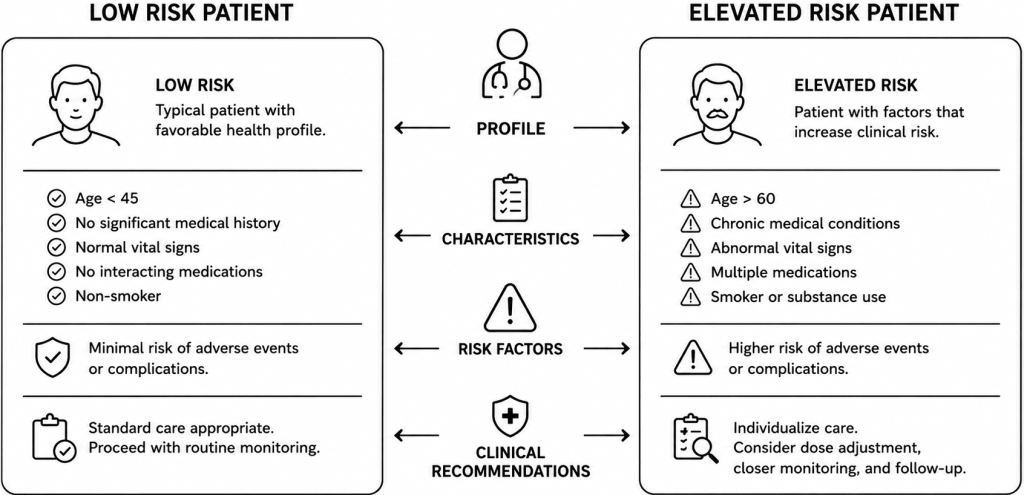
Risk Stratification – Who Is Vulnerable?
Not all users share the same risk profile. Responsible prescribing requires individualizing risk assessment.
Low-Risk Profile:
- Prescribed for FDA-approved indication (narcolepsy, OSA, SWSD)
- No personal or strong family history of substance use disorder
- Uses at stable, therapeutic dose (100-200 mg/day)
- Uses under consistent medical supervision
- Understands medication as a tool, not an identity
Elevated-Risk Profile:
- No prescription; obtaining medication from online vendors or peers
- History of cocaine, amphetamine, or alcohol use disorder
- Using doses exceeding 400 mg/day or via non-oral routes
- Using primarily for “recreation” or to achieve euphoria (uncommon with modafinil, should raise suspicion of other substance use)
- Expresses inability to function academically or professionally without the drug
Clinical Safeguards and Safe Use Protocols
For Prescribers
Screen for Substance Use Disorder History: Use validated tools such as CAGE-AID or ASSIST before initiating therapy. This is the most critical step in identifying elevated-risk patients.
Set Clear Expectations: Educate patients that modafinil is not a euphoriant and will not produce a “high.” This reduces disappointment and the urge to escalate doses in pursuit of a nonexistent effect.
Start Low, Go Slow: Initiate at 100 mg daily. Titrate only if clinically necessary. This approach minimizes the risk of overstimulation and helps patients understand the medication’s appropriate role.
Monitor Regularly: Assess efficacy, side effects, and any signs of dose escalation or early refill requests. Regular monitoring allows early intervention if concerning patterns emerge.
Avoid in Active Addiction: Modafinil is generally contraindicated in individuals with active stimulant use disorder. In such cases, the potential risks outweigh the benefits.
For Patients
Use Only as Prescribed: Do not alter the dose, frequency, or route of administration. If you feel the medication is not working, discuss this with your physician rather than self-adjusting.
Avoid Daily Use If Possible: For off-label or non-severe indications, discuss intermittent dosing (“drug holidays”) with your physician to prevent tolerance and dependence.
Never Share Medication: Your prescription is for you. Diversion is illegal and dangerous. Sharing medications can harm others and has legal consequences.
Report Concerning Patterns: If you feel you are becoming psychologically dependent, tell your doctor immediately. Early intervention is highly effective and can prevent more serious problems.
Understand the Risk Context: Recognize that while modafinil has low addiction potential, psychological dependence is possible. Maintaining awareness of your relationship with the medication is essential for safe use.
Clinical Vignettes
Low Risk: A 45-year-old female patient with narcolepsy, confirmed by polysomnography and MSLT, has been using modafinil 200 mg daily for three years. She has no history of substance use, uses the medication consistently, and reports stable efficacy. She understands that the medication is a tool for managing her symptoms and has no concerns about running out. Patient uses it only on workdays to maintain effectiveness.
Elevated Risk: A 28-year-old male software developer, without a prescription, purchases modafinil from an online vendor. He uses doses up to 400 mg daily, often with caffeine, to enhance his work performance. Patient reports a history of cannabis and stimulant use during college. He expresses anxiety about his supply and states he “can’t work without it.” Patient has not discussed his use with a physician. This patient demonstrates multiple risk factors for problematic use and would benefit from a comprehensive evaluation.
Comparison of Modafinil with Other Cognitive Enhancers
| Medication | Mechanism | Addiction Potential | Common Side Effects | Prescription Status |
|---|---|---|---|---|
| Modafinil | DAT inhibition (~50% occupancy) | Low | Headache, insomnia, nausea | Prescription only (Schedule IV) |
| Amphetamine (Adderall) | DAT reversal, VMAT2 release | High | Insomnia, anxiety, appetite loss | Prescription only (Schedule II) |
| Methylphenidate (Ritalin) | DAT inhibition (>60% occupancy) | Moderate-High | Insomnia, nervousness, headache | Prescription only (Schedule II) |
| Atomoxetine (Strattera) | NET inhibition | None | GI upset, insomnia, dry mouth | Prescription only (non-scheduled) |
| Caffeine | Adenosine antagonism | Very Low | Jitteriness, insomnia, tachycardia | Over-the-counter |
| Nicotine | nAChR activation | High | Cardiovascular, respiratory effects | Regulated (tobacco/vaping products) |
Conclusion
The question of whether modafinil is addictive demands a sophisticated answer. It is not a simple “no,” but it is emphatically not a “yes” in the same category as classical stimulants.
Modafinil is a unique pharmacological entity. Its mechanism, slow DAT occupancy, absence of VMAT2 reversal, negligible euphoria, confers a fundamentally lower liability for compulsive, destructive addiction. The scientific consensus, reflected in the DEA scheduling, FDA labeling, and decades of clinical experience, is clear on this point.
However, no centrally acting agent has zero abuse potential. Any substance that enhances cognition or alters mood can be psychologically coveted. The risk with modafinil is primarily one of psychological over-reliance and mild physical dependence, not the chaotic, life-destroying addiction seen with high-liability stimulants.
For the vast majority of patients using modafinil therapeutically under medical supervision, addiction is not a significant concern. The risks are magnified dramatically when the drug is obtained illicitly, used at supratherapeutic doses or used by individuals with a pre-existing vulnerability to substance misuse.
The key to safe use lies in informed, supervised and respectful use, recognizing both the medication’s power and its limitations. For the responsible patient under the care of a knowledgeable physician, the fear of addiction should not be a barrier to accessing an effective and potentially life-changing medication.
FAQ
Can you get “high” from modafinil?
In therapeutic doses, no. Modafinil does not produce the euphoria characteristic of amphetamines or cocaine. Some individuals may experience mild mood elevation or a sense of well-being, but this is distinct from a euphoric “rush.” Reports of a “high” are rare and often indicate either extremely high, supra-pharmacologic doses, misattribution, or adulterated product.
Why do some people feel “addicted” to modafinil?
This is almost always psychological dependence, not physical addiction. The individual may feel they cannot work or study effectively without it. This is a cognitive and behavioral pattern, not a neurochemically driven compulsion. It is best addressed through education, cognitive-behavioral therapy (CBT) and supervised dose tapering or drug holidays.
Will I experience withdrawal if I stop taking modafinil?
If you have taken it continuously for a prolonged period, you may experience rebound sleepiness and fatigue for a few days. This is mild and self-limiting. It is not a severe withdrawal syndrome. Gradual tapering under medical advice can minimize this.
Can modafinil be used to treat other addictions?
Some research has explored modafinil as a potential treatment for cocaine and methamphetamine addiction, with mixed results. It is not FDA-approved for this indication and the evidence remains inconclusive. Modafinil should not be used as a primary treatment for substance use disorders.
‼️ Disclaimer: The information provided in this article about modafinil is intended for informational purposes only and is not a substitute for professional medical consultation or recommendations. The author of the article are not responsible for any errors, omissions, or actions based on the information provided.
References:
- Oliva Ramirez A, Keenan A, Kalau O, Worthington E, Cohen L, Singh S. Prevalence and burden of multiple sclerosis-related fatigue: a systematic literature review. https://doi.org/10.1186/s12883-021-02396-1 . 2021.
- Ciancio A, Moretti MC, Natale A, Rodolico A, Signorelli MS, Petralia A. Personality Traits and Fatigue in Multiple Sclerosis: A Narrative Review. Journal of Clinical Medicine. https://doi.org/10.3390/jcm12134518 . 2023
- Mereu, M., Bonci, A., Newman, A. H., & Tanda, G. The neurobiology of modafinil as an enhancer of cognitive performance and a potential treatment for substance use disorders. https://doi.org/10.1007/s00213-013-3232-4 . 2013
- U.S. Food and Drug Administration. PROVIGIL. U.S. Department of Health and Human Services. https://www.accessdata.fda.gov/drugsatfda_docs/label/2015/020717s037s038lbl.pdf . 2015
- Ballon JS, Feifel D. A systematic review of modafinil: potential clinical uses and mechanisms of action. J Clin Psychiatry. 2006
- Willavize, S. A., Nichols, A. I., & Lee, J. Population pharmacokinetic modeling of armodafinil and its major metabolites. https://doi.org/10.1002/jcph.800 . 2016
- ADHD: Clinical practice guideline for the diagnosis, evaluation, and treatment of attention-deficit/hyperactivity disorder in children and adolescents. https://www.ncbi.nlm.nih.gov/pubmed/22003063. 2011
- Arnold, V. K. A 9-week, randomized, double-blind, placebo-controlled, parallel-group, dose-finding study to evaluate the efficacy and safety of modafinil as treatment for adults with ADHD. Available at: https://www.ncbi.nlm.nih.gov/pubmed/22617860. 2012
- Clinical Pharmacology. Elsevier, Tampa, FL. Available at: http://www.clinicalpharmacology-ip.com. 2018
- Huseyin Alacam, Omer Basay, Selim Tumkaya, Mehmet Mart, Gokce Kar. Modafinil Dependence: A Case with Attention-Deficit/Hyperactivity Disorder. Psychiatry Investig. https://pmc.ncbi.nlm.nih.gov/articles/PMC5912487/. 2018.
- Raman Krishnan, Krishnan Vengadaragava Chary. A rare case modafinil dependence. J Pharmacol Pharmacother. https://pmc.ncbi.nlm.nih.gov/articles/PMC4319252/. 2015