Last Updated on 03/02/2026 by James Anderson
The quest to improve social interactions, whether to overcome anxiety, enhance professional networking, or simply feel more at ease, is a common human endeavor. In this pursuit, some have turned to Modafinil, a powerful wakefulness-promoting agent originally designed to treat narcolepsy. But can a “smart drug” also function as a “social drug”? As a neuroscientist specializing in psychopharmacology, I will provide a detailed analysis that moves beyond simplistic pros and cons. This guide explores the nuanced, and sometimes contradictory, ways Modafinil influences the intricate neurobiological processes underpinning social adaptation, offering a clear-eyed view of its potential benefits, significant risks, and ultimate limitations as a social tool.
Understanding Social Adaptation: A Neurochemical Balancing Act
True social adaptation is a complex, high-order cognitive function that requires the seamless integration of multiple brain systems. It involves:
- Cognitive Processing: Quick thinking, verbal fluency, working memory to follow conversations, and executive function to plan appropriate responses.
- Emotional Intelligence: The ability to perceive, interpret, and respond to subtle emotional cues in others (cognitive empathy) and to share and regulate one’s own emotional states (emotional empathy).
- Motivation and Reward: The intrinsic drive to engage with others and the rewarding feeling derived from positive social contact, heavily mediated by the brain’s dopamine and endogenous opioid systems.
- Anxiety Regulation: The capacity to manage the physiological and psychological arousal that social evaluation can trigger, governed by circuits involving the amygdala and prefrontal cortex.
When we consider a pharmacological agent like Modafinil, we must ask: which of these systems does it enhance, and which might it inadvertently suppress?
The Neuropharmacology of Modafinil: Beyond Simple Stimulation
To understand its social effects, we must first dissect its primary mechanisms. Unlike classic stimulants (amphetamines) that cause a broad, forceful flood of neurotransmitters, Modafinil’s action is more targeted:
- Dopamine Reuptake Inhibition: Its most significant effect is blocking the dopamine transporter (DAT), increasing extracellular dopamine in key brain regions like the prefrontal cortex (PFC). This is crucial for improved executive function, working memory, and motivation all of which can support the cognitive demands of socializing.
- Histamine and Orexin Activation: Modafinil stimulates wakefulness-promoting systems. This leads to heightened alertness and can reduce the mental fatigue that often derails social endurance, especially for introverts.
- Norepinephrine and Serotonin Modulation: It has secondary, more complex effects on these systems, which can influence arousal, mood, and stress response.
This selective neurochemical profile is the key to its unique and double-edged social impact.
The Potential “Pros”: How Modafinil Can Facilitate Social Performance
When Modafinil’s pharmacology aligns with the user’s needs, specific social enhancements can occur. The table below categorizes these potential benefits by the underlying cognitive function they support.
| Perceived Social Benefit | Underlying Neurological Action | Ideal Use Context |
|---|---|---|
| Enhanced Verbal Fluency & Mental Clarity | Increased prefrontal dopamine improves lexical access, idea generation, and cognitive control over speech. | Important meetings, presentations, debates, or any scenario requiring quick, articulate thought. |
| Reduced Social Overthinking & Anxiety | Improved top-down PFC control can dampen hyperactivity in the amygdala (fear/anxiety center), quieting intrusive thoughts. | Situations where self-consciousness or “analysis paralysis” typically impairs performance. |
| Increased Motivation to Engage | Dopamine-mediated boost in drive and reward anticipation makes initiating and sustaining social interaction feel more appealing. | Networking events, parties, or periods requiring proactive social outreach. |
| Improved Cognitive Empathy (“Reading the Room”) | Enhanced attention and focus allow for better tracking of verbal and non-verbal social cues. | Complex group dynamics, negotiations, or managing team interactions. |
Important Caveat: These are performance-enhancing effects, not skill-building ones. They optimize existing social abilities under the drug’s influence but do not teach new skills that persist without it.
The Significant “Cons”: The Risks of Pharmacological Social Enhancement
The flip side of Modafinil’s focused neurochemical push is the potential suppression or distortion of other vital social faculties. These are not mere side effects; they are direct consequences of its mechanism.
- Emotional Blunting and Reduced Affective Empathy: This is the most commonly reported and significant social drawback. By prioritizing dopaminergic and cognitive circuits, Modafinil can lead to a state of hyper-rationality. Users may become adept at logically parsing a conversation while feeling detached from its emotional subtext. This can manifest as:
- Difficulty genuinely sharing in others’ joy or sadness.
- A flattened affective tone, making the user seem aloof, cold, or “robotic.”
- Impaired ability to connect on a deep, emotionally resonant level, which is the bedrock of intimacy and trust.
- Social Irritability and Overstimulation: The sustained, heightened alertness can backfire in prolonged, unstructured, or overly stimulating social settings (loud bars, large conventions). Users may become:
- Hyper-aware of minor social slights or inefficiencies, leading to impatience.
- Sensory overload, making it difficult to filter background noise and focus on individuals.
- Emotionally brittle, with a lower threshold for frustration.
- The “Actor-Authenticity” Paradox: Relying on Modafinil for social success creates a psychological dilemma. The confidence and wit felt on the drug can feel disassociated from one’s “true” self. When the drug wears off, users may question the authenticity of their interactions and experience a rebound decrease in social drive or increased anxiety, potentially worsening baseline social functioning.
- Tolerance and Psychological Dependence: While physical addiction risk is low, a problematic pattern can emerge: the user associates social competence solely with the drugged state. This can erode natural, drug-free social confidence and create a cycle of dependence where any important social event “requires” Modafinil.
A Targeted Analysis: Who Might Benefit vs. Who Should Avoid
This framework helps identify where Modafinil social profile might be applicable or dangerous.
Potential Candidates (with Extreme Caution):
- Individuals with ADHD: For whom social struggles are often rooted in inattention, poor impulse control, and working memory deficits. Modafinil can directly ameliorate these core symptoms, potentially leading to more organic social improvement.
- Neurotypical Professionals in Specific, High-Stakes Scenarios: A salesperson before a major pitch, a lawyer during a deposition, or an executive at a critical board meeting. Here, the need for peak cognitive performance (fluency, focus, quick thinking) temporarily outweighs the need for deep emotional bonding.
Individuals Who Should Likely Avoid This Approach:
- Those with Primary Social Anxiety Disorder (SAD): Modafinil is not an anxiolytic. It may reduce the cognitive worry but can exacerbate the physiological symptoms of anxiety (heart rate). It does not address the core fear of negative evaluation and can become a maladaptive coping mechanism.
- People with Mood Disorders (Bipolar, Depression): It can trigger manic episodes or severe anxiety.
- Anyone Seeking a “Personality Transplant”: Modafinil will not make a shy person the life of the party. It modifies performance within an individual’s existing social range.
A Responsible Protocol: If One Chooses to Proceed
If, after careful consideration, an individual decides to experiment, this protocol minimizes harm:
- Medical Clearance is Non-Negotiable: Discuss with a doctor to rule out contraindications.
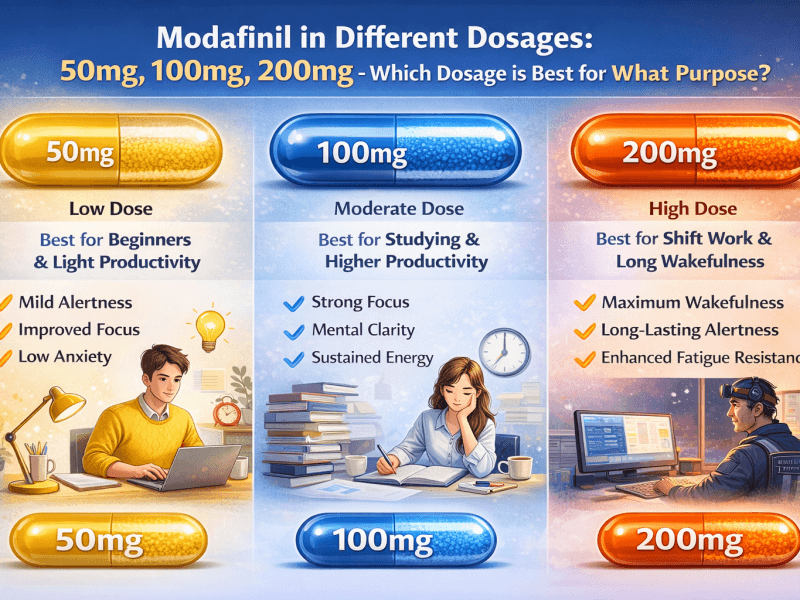
- Start Very Low, Isolate the Variable: Begin with 50-100mg (not 200mg). Use it first in a low-stakes, non-critical social setting to observe personal reactions without pressure.
- Conduct a Rigorous Self-Audit: After the experience, ask:
- Did I feel more clear-headed, or emotionally distant?
- Were my interactions smoother, or more transactional?
- How did I feel the next day recharged or socially depleted?
- Mandatory Cycling and Integration: Never use daily for social purposes. Follow a strict schedule (once or twice a week at most). Use insights gained on the drug to practice skills off it.
- Prioritize Foundational Skills: Modafinil should be a potential adjunct, not the foundation. Continue to invest in therapy (CBT for social anxiety), mindfulness, and real-world social exposure.
Conclusion: A Tool, Not a Solution
Modafinil’s impact on social adaptation is a profound demonstration of neurochemical trade-offs. It can enhance the cognitive scaffolding of social interaction focus, fluency, and motivation while simultaneously risking the erosion of its emotional core.
Its most appropriate, albeit niche, use is as a rare, strategic tool for specific performance scenarios where cognitive demands are paramount and emotional depth is secondary. It is a profoundly poor choice as a general social lubricant or a long-term strategy for personal development.
The most sustainable path to social adaptation lies not in pharmacology, but in developing skills, building genuine confidence through exposure, and perhaps most importantly, learning to channel one’s natural cognitive and emotional style awkwardnesses and all into authentic connection. Modafinil may change how you perform in a social setting, but it cannot change who you are in a relationship.
FAQ
Can Modafinil actually cure my shyness or social anxiety?
No, it cannot and should not be used for this purpose. Modafinil is not a treatment for Social Anxiety Disorder (SAD). While it may temporarily reduce overthinking, it does not address the core fear of negative evaluation and can worsen the physical symptoms of anxiety. Effective treatments for SAD include Cognitive Behavioral Therapy (CBT) and SSRIs, prescribed by a psychiatrist.
Is there a difference between Modafinil and Armodafinil for social effects?
Armodafinil (the R-enantiomer) has a slightly longer half-life and a more gradual onset. Some users report its effects are “smoother” and less prone to causing the jittery overstimulation that can lead to social irritability. However, the core pharmacological profile is similar, meaning the risks of emotional blunting and the benefits to cognitive fluency remain. It is not a fundamentally different social drug.
What’s the single biggest mistake people make when using Modafinil socially?
The biggest mistake is using it as a first-line tool for untested social situations. People often take it for a critical event a first date, a major job interview, a wedding without knowing how they will react. This can lead to disastrous outcomes if they experience unexpected irritability, emotional flatness, or anxiety. The first use should always be in a low-stakes, forgiving environment.
‼️ Disclaimer: The information provided in this article about modafinil is intended for informational purposes only and is not a substitute for professional medical consultation or recommendations. The author of the article are not responsible for any errors, omissions, or actions based on the information provided.
References:
- U.S. Food and Drug Administration. PROVIGIL. U.S. Department of Health and Human Services. https://www.accessdata.fda.gov/drugsatfda_docs/label/2015/020717s037s038lbl.pdf . 2015
- Ballon JS, Feifel D. A systematic review of modafinil: potential clinical uses and mechanisms of action. J Clin Psychiatry. 2006
- Willavize, S. A., Nichols, A. I., & Lee, J. Population pharmacokinetic modeling of armodafinil and its major metabolites. https://doi.org/10.1002/jcph.800 . 2016
- Fuxe K, et al. Modafinil enhances the increase of extracellular serotonin levels induced by the antidepressant drugs fluoxetine and imipramine: a dual probe microdialysis study in awake rat. Synapse. 2005
- Mechanisms of modafinil: A review of current research. nih.gov. 2007
- PROVIGIL (modafinil) Tablets. FDA.GOV. 2010
- Oliva Ramirez A, Keenan A, Kalau O, Worthington E, Cohen L, Singh S. Prevalence and burden of multiple sclerosis-related fatigue: a systematic literature review. 2021.
- Ciancio A, Moretti MC, Natale A, Rodolico A, Signorelli MS, Petralia A. Personality Traits and Fatigue in Multiple Sclerosis: A Narrative Review. Journal of Clinical Medicine. 2023
- Mereu, M., Bonci, A., Newman, A. H., & Tanda, G. The neurobiology of modafinil as an enhancer of cognitive performance and a potential treatment for substance use disorders. https://doi.org/10.1007/s00213-013-3232-4 . 2013