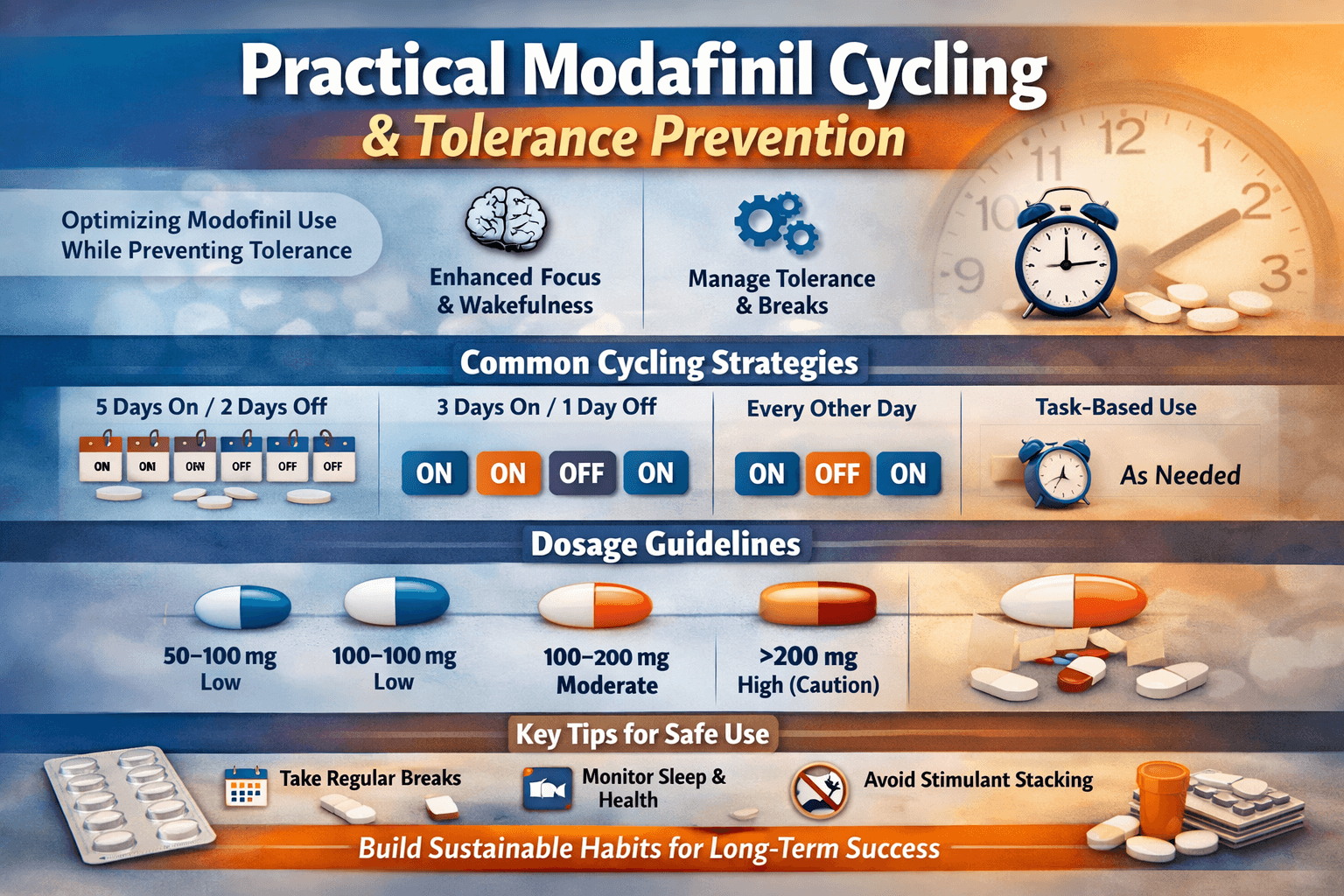
Introduction to Modafinil
Modafinil is often described as a “wakefulness-promoting agent,” but that label barely scratches the surface. For many users, it feels like mental fog lifting, focus snapping into place, and energy becoming smoother rather than jittery. Sounds appealing, right? It is, but only when used intelligently.
Takes a practical, safety-oriented look at modafinil cycling: how people structure intake periods, why breaks matter, and how tolerance can quietly creep in if you ignore the rules of the road.
What Modafinil Is and How It Works
Modafinil influences multiple neurotransmitter systems, including dopamine, norepinephrine, histamine, and orexin. Instead of flooring the gas pedal like classic stimulants, it fine-tunes the engine. That is why many users report alertness without the “wired” feeling.
Why People Use Modafinil
People turn to modafinil for demanding cognitive workloads: long shifts, intensive study, complex problem-solving. The common thread is sustained attention, not raw stimulation.
Understanding Tolerance
What Is Drug Tolerance
Tolerance occurs when the brain adapts to repeated exposure, reducing the drug’s perceived effect. Think of it like background noise you stop noticing it over time.
Can Tolerance Develop With Modafinil
Yes, although it tends to develop more slowly than with traditional stimulants. Subtle signs include needing higher doses, reduced clarity, or mental fatigue creeping back in.
Neurochemical Perspective
Repeated dopamine modulation can trigger compensatory mechanisms. Cycling interrupts this adaptation, giving receptors time to “reset.”
Why Cycling Modafinil Matters
Continuous Use vs Cycled Use
Daily, uninterrupted use may feel productive short term, but it increases the risk of tolerance and side effects. Cycling introduces friction in a good way.
Benefits of Strategic Breaks
Breaks help preserve effectiveness, protect sleep quality, and reduce psychological reliance. In simple terms: less is more.
Safety First – General Principles
Medical Oversight and Legal Status
Modafinil is a prescription medication in many countries. Any use should be discussed with a qualified healthcare professional. This article is educational, not a substitute for medical advice.
Individual Sensitivity and Risk Factors
Genetics, sleep quality, anxiety levels, and cardiovascular health all matter. What feels mild to one person can feel overwhelming to another.
Standard Dosage Ranges (Educational Overview)
Low, Moderate, and Upper Ranges
Educational discussions often reference:
- Low: 50-100 mg
- Moderate: 100-200 mg
- Upper ranges are generally discouraged without medical supervision.
Why “More” Is Not “Better”
Beyond a certain point, benefits plateau while side effects rise. Productivity turns into agitation surprisingly fast.
The Classic 5 Days On / 2 Days Off Cycle
How the Cycle Works
Five consecutive days of use (often aligned with a workweek), followed by two days off. Simple, predictable, and easy to maintain.
Pros and Cons
Pros:
- Mimics natural work-rest rhythm
- Reduces cumulative tolerance
Cons:
- Less flexible
- Weekend fatigue may feel more noticeable
Who This Cycle Is Best Suited For
Professionals with structured schedules and predictable workloads.
Alternative Modafinil Cycling Strategies
3 Days On / 1 Day Off
A tighter cycle that suits intense project bursts. Breaks arrive before tolerance gains momentum.
Every-Other-Day Use
Ideal for long-term sustainability. Effects often remain strong, even at lower doses.
Task-Based or Situational Use
Instead of calendar-based cycling, modafinil is reserved for genuinely demanding days. This approach minimizes exposure.
Monthly Deload Weeks
Some users schedule a full week off every 4-6 weeks. Think of it as a nervous system vacation.
Long-Term Use Considerations
Signs You May Need a Break
- Reduced motivation
- Headaches
- Irritability
- Sleep disruption
Psychological vs Physical Dependence
Modafinil has low physical dependence risk, but psychological reliance can sneak up quietly.
Sleep, Recovery, and Modafinil
Sleep Debt and Its Hidden Costs
Modafinil masks fatigue it does not erase it. Ignoring sleep debt is like hiding warning lights on a dashboard.
Aligning Cycles With Circadian Rhythm
Early dosing and strict cut-off times protect sleep quality and reduce downstream fatigue.
Stacking, Interactions, and What to Avoid
Caffeine and Other Stimulants
Combining stimulants increases strain on the nervous system. Many users reduce caffeine on modafinil days.
Supplements Commonly Discussed
Magnesium, L-theanine, and omega-3s are often mentioned for balance, though evidence varies.
Risk Amplification
More compounds mean more variables and more ways things can go wrong.
Practical Cycling Table
| Cycle Type | Typical Use Pattern | Suggested Dose Range | Tolerance Risk | Best For |
|---|---|---|---|---|
| 5 On / 2 Off | Weekdays only | 100-200 mg | Moderate | Office professionals |
| 3 On / 1 Off | Short bursts | 100 mg | Low-Moderate | Project sprints |
| Every Other Day | Alternating days | 50-100 mg | Low | Long-term use |
| Task-Based | As needed | 50-100 mg | Very Low | Occasional demand |
| Monthly Deload | 3-5 weeks on, 1 off | Varies | Very Low | High-awareness users |
Common Mistakes in Modafinil Use
Ignoring Early Warning Signs
Pushing through side effects is not discipline, it is denial.
Chasing Productivity at All Costs
Sustainable performance beats short-term output every time.
Ethical and Lifestyle Considerations
Performance vs Sustainability
The real goal is consistent clarity, not artificial overdrive.
Building Non-Pharmacological Focus
Sleep hygiene, structured work blocks, and exercise multiply modafinil’s benefits or replace the need entirely.
High Dosages of 400 mg and Above
When discussing high dosages of 400 mg and above, it is critical to approach the topic with caution and realism. While some individuals report short-term increases in wakefulness at these levels, evidence and user reports consistently show diminishing cognitive returns alongside a sharp rise in side effects. At 400 mg+, modafinil is far more likely to disrupt sleep architecture, elevate anxiety, increase heart rate and blood pressure, and produce irritability or emotional blunting. Rather than enhancing focus, excessive dosing often leads to scattered attention like turning the brightness up so high that details wash out. From a tolerance standpoint, high doses accelerate neuroadaptation, making subsequent breaks less effective and increasing psychological reliance. For long-term, sustainable use, doses at or above 400 mg are generally viewed as counterproductive and should only ever be considered under strict medical supervision, if at all.
Conclusion
Modafinil can be a powerful cognitive tool, but only when treated with respect. Cycling is not a restriction, it is a strategy. By building in breaks, moderating dosage, and listening to your nervous system, you protect both performance and long-term health. The smartest use is not the most aggressive one, but the most sustainable.
FAQ
Is daily modafinil use safe long term?
Daily use increases tolerance risk. Cycles and breaks are widely discussed for sustainability.
Does tolerance fully reset after a break?
Many users report significant sensitivity returning after 1-2 weeks off, though responses vary.
Is 200 mg always better than 100 mg?
No. Many people experience equal or better focus at lower doses.
Can cycling prevent all side effects?
No, but it significantly reduces cumulative risk.
Is modafinil a replacement for sleep?
Absolutely not. It delays fatigue perception; it does not eliminate biological need for rest.
‼️ Disclaimer: The information provided in this article about modafinil is intended for informational purposes only and is not a substitute for professional medical consultation or recommendations. The author of the article are not responsible for any errors, omissions, or actions based on the information provided.
References:
- Ballon JS, Feifel D. A systematic review of modafinil: potential clinical uses and mechanisms of action. J Clin Psychiatry. 2006
- McClellan, K. J., & Spencer, C. M. Modafinil: A review of its pharmacology and clinical efficacy in the management of narcolepsy. CNS Drugs, 311–324. https://doi.org/10.2165/00023210-199809040-00006 . 1998.
- Willavize, S. A., Nichols, A. I., & Lee, J. Population pharmacokinetic modeling of armodafinil and its major metabolites. https://doi.org/10.1002/jcph.800 . 2016
- U.S. Food and Drug Administration. PROVIGIL. U.S. Department of Health and Human Services. https://www.accessdata.fda.gov/drugsatfda_docs/label/2015/020717s037s038lbl.pdf . 2015
- Gilleen, J., Michalopoulou, P. G., Reichenberg, A., Drake, R., Wykes, T., Lewis, S. W., & Kapur, S. Modafinil combined with cognitive training is associated with improved learning in healthy volunteers a randomised controlled trial. European Neuropsychopharmacology. 529–539. https://doi.org/10.1016/j.euroneuro.2014.01.001 . 2014
- Greenblatt, K., Adams, N. Modafinil. StatPearls Publishing. https://www.ncbi.nlm.nih.gov/books/NBK531476/ . 2025
- Oliva Ramirez A, Keenan A, Kalau O, Worthington E, Cohen L, Singh S. Prevalence and burden of multiple sclerosis-related fatigue: a systematic literature review. https://doi.org/10.1186/s12883-021-02396-1 . 2021.
- Mereu, M., Bonci, A., Newman, A. H., & Tanda, G. The neurobiology of modafinil as an enhancer of cognitive performance and a potential treatment for substance use disorders. https://doi.org/10.1007/s00213-013-3232-4 . 2013
- Ciancio A, Moretti MC, Natale A, Rodolico A, Signorelli MS, Petralia A. Personality Traits and Fatigue in Multiple Sclerosis: A Narrative Review. Journal of Clinical Medicine. https://doi.org/10.3390/jcm12134518 . 2023
- Natsch, A. What makes us smell: The biochemistry of body odour and the design of new deodorant ingredients. CHIMIA International Journal for Chemistry. https://doi.org/10.2533/chimia.2015.414 . 2015