Last Updated on 22/12/2025 by James Anderson
Introduction to Wakefulness-Promoting Medications
If you have ever struggled to stay awake during the day despite getting enough sleep, you are not alone. Millions of people deal with excessive daytime sleepiness caused by medical conditions, work schedules, or neurological disorders. This is where wakefulness-promoting medications like Provigil and Nuvigil come into play. They are often mentioned in the same breath, but are they really the same thing?
What Are Provigil and Nuvigil?
Provigil and Nuvigil are prescription medications designed to promote wakefulness. They are not traditional stimulants like amphetamines, yet they help people stay alert, focused, and functional throughout the day. Doctors commonly prescribe them for sleep-related disorders.
Why These Medications Are Often Compared
The comparison exists for a simple reason: they are closely related. Provigil came first, and Nuvigil followed as a refined version. Think of it like upgrading from a standard car model to a newer trim with better efficiency.
Understanding Provigil
What Is Provigil (Modafinil)?
Provigil is the brand name for modafinil. It has been on the market since the late 1990s and quickly gained popularity for its ability to increase alertness without the jittery crash associated with classic stimulants.
Approved Medical Uses of Provigil
Provigil is FDA-approved for:
- Narcolepsy
- Obstructive sleep apnea (as adjunct therapy)
- Shift work sleep disorder
Doctors may also prescribe it off-label for other conditions, which we will discuss later.
How Provigil Works in the Brain
Provigil works by altering certain neurotransmitters in the brain that regulate wakefulness. Instead of flooding the system with stimulation, it gently nudges the brain toward alertness.
Neurotransmitters Affected by Provigil
Provigil influences dopamine, norepinephrine, and histamine pathways. Imagine a dimmer switch instead of an on-off light switch. The brain wakes up smoothly rather than abruptly.
Understanding Nuvigil
What Is Nuvigil (Armodafinil)?
Nuvigil is the brand name for armodafinil. It is closely related to modafinil but represents only one active part of the original compound. This distinction plays a big role in how it behaves in the body.
Approved Medical Uses of Nuvigil
Nuvigil is approved for the same conditions as Provigil:
- Narcolepsy
- Obstructive sleep apnea
- Shift work sleep disorder
The difference lies not in what it treats, but how long and how consistently it works.
How Nuvigil Works in the Brain
Nuvigil affects the same neurotransmitter systems as Provigil but does so in a more targeted way. Many users describe the experience as smoother and longer-lasting.
The R-Enantiomer Advantage
Armodafinil contains only the R-enantiomer of modafinil. In simple terms, this is the more active half of the molecule. The result is prolonged alertness with fewer peaks and valleys.
Chemical and Structural Differences
Modafinil vs. Armodafinil Explained
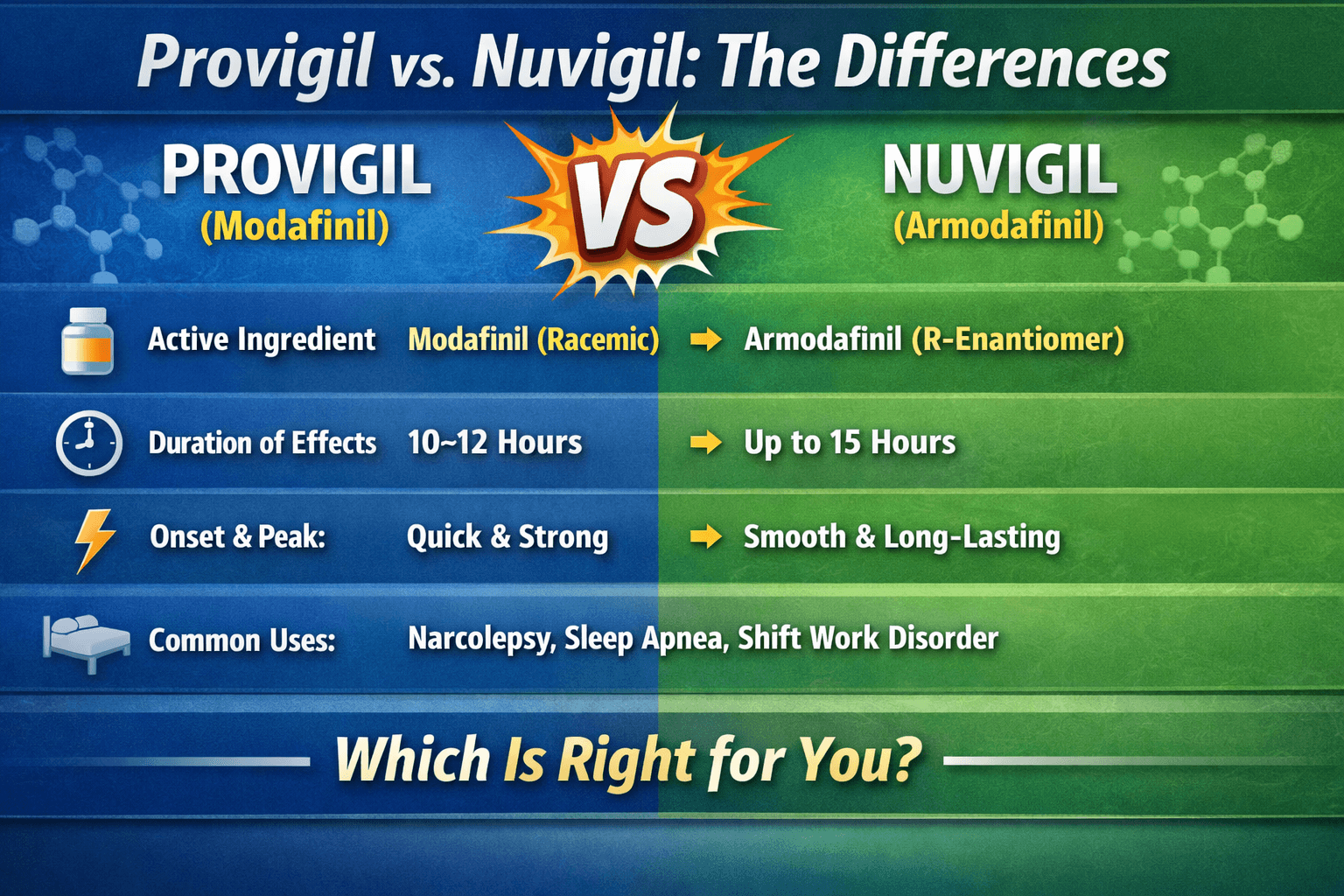
Provigil contains two mirror-image molecules, while Nuvigil contains only one. This might sound like chemistry trivia, but it directly impacts how long the drug stays active in your system.
Why Molecular Structure Matters
Because Nuvigil is more selective, it tends to last longer in the bloodstream. It is like drinking slow-release coffee instead of a quick espresso shot.
Differences in Effectiveness
Duration of Action
Provigil typically lasts 10 to 12 hours. Nuvigil, on the other hand, can last up to 15 hours. For people who need sustained alertness throughout a long workday, this difference matters.
Onset Time and Peak Effects
Both medications begin working within one to two hours. However, Nuvigil often maintains steadier levels later in the day.
Daytime Alertness Comparison
Many users report that Provigil feels slightly stronger at first, while Nuvigil feels more consistent over time.
Side Effects Comparison
Common Side Effects
Both medications share similar side effects:
- Headache
- Nausea
- Dry mouth
- Anxiety
- Insomnia
These effects are usually mild and temporary.
Serious and Rare Side Effects
Rare but serious reactions include severe skin rashes and allergic responses. Any unusual symptoms should be reported to a healthcare provider immediately.
Tolerability Over Long-Term Use
Long-term users often report better tolerance with Nuvigil, likely due to its smoother pharmacological profile.
Dosage and Administration
Typical Provigil Dosage
Provigil is commonly prescribed at 200 mg once daily, usually in the morning.
Typical Nuvigil Dosage
Nuvigil is typically prescribed at 150 mg to 250 mg once daily.
Adjustments and Missed Doses
Missing a dose can disrupt sleep later in the day. These medications should not be taken late unless directed by a physician.
Cost and Availability
Brand vs. Generic Pricing
Generic modafinil is usually less expensive than generic armodafinil. Brand-name versions of both drugs can be costly without insurance.
Insurance Coverage Considerations
Insurance companies may prefer one over the other depending on formularies, often requiring prior authorization.
Off-Label Uses
Cognitive Enhancement and Productivity
Some individuals use these medications off-label to enhance focus, memory, and productivity. While popular in professional circles, this use should always be medically supervised.
Shift Work and Lifestyle Applications
For people with irregular schedules, these medications can feel like a reset button for the brain.
Safety, Dependence, and Legal Status
Controlled Substance Classification
Both drugs are classified as Schedule IV controlled substances, meaning they have a low potential for abuse.
Risk of Dependence or Abuse
The risk is significantly lower than traditional stimulants, but misuse is still possible.
Who Should Choose Provigil?
Ideal Patient Profiles
Provigil may be better for:
- First-time users
- Individuals sensitive to long-lasting effects
- Those seeking a lower-cost option
Who Should Choose Nuvigil?
Ideal Patient Profiles
Nuvigil may be better for:
- People needing longer coverage
- Shift workers with extended hours
- Patients who experience afternoon fatigue on Provigil
Provigil vs. Nuvigil: Head-to-Head Comparison
Quick Comparison Explained
Provigil offers a strong, reliable boost in alertness. Nuvigil offers endurance and consistency. The choice depends on whether you value intensity or longevity.
Final Verdict
Which One Is Better Overall?
Neither medication is universally better. Provigil is like a dependable daily driver. Nuvigil is like a long-distance cruiser. The right choice depends on your schedule, sensitivity, and medical advice.
Conclusion
Provigil and Nuvigil are closely related medications with subtle yet meaningful differences. Provigil offers a proven, cost-effective solution, while Nuvigil provides extended wakefulness with smoother effects. Understanding these distinctions empowers you to make informed decisions alongside your healthcare provider. When it comes to staying alert, the best option is the one that fits your life, not just your prescription.
FAQ
Is Nuvigil stronger than Provigil?
Not necessarily stronger, but longer-lasting and more consistent for many users.
Can I switch from Provigil to Nuvigil?
Yes, but only under medical supervision to ensure proper dosing.
Do Provigil and Nuvigil cause addiction?
They have a low risk of dependence compared to stimulants, but misuse is still possible.
Which is better for shift work sleep disorder?
Nuvigil is often preferred due to its extended duration.
Are generic versions effective?
Yes, generics are considered bioequivalent and effective for most patients.
‼️ Disclaimer: The information provided in this article about modafinil is intended for informational purposes only and is not a substitute for professional medical consultation or recommendations. The author of the article are not responsible for any errors, omissions, or actions based on the information provided.
References:
- McClellan, K. J., & Spencer, C. M. Modafinil: A review of its pharmacology and clinical efficacy in the management of narcolepsy. CNS Drugs, 311–324. https://doi.org/10.2165/00023210-199809040-00006 . 1998.
- Willavize, S. A., Nichols, A. I., & Lee, J. Population pharmacokinetic modeling of armodafinil and its major metabolites. https://doi.org/10.1002/jcph.800 . 2016
- U.S. Food and Drug Administration. PROVIGIL. U.S. Department of Health and Human Services. https://www.accessdata.fda.gov/drugsatfda_docs/label/2015/020717s037s038lbl.pdf . 2015
- Gilleen, J., Michalopoulou, P. G., Reichenberg, A., Drake, R., Wykes, T., Lewis, S. W., & Kapur, S. Modafinil combined with cognitive training is associated with improved learning in healthy volunteers a randomised controlled trial. European Neuropsychopharmacology. 529–539. https://doi.org/10.1016/j.euroneuro.2014.01.001 . 2014
- Greenblatt, K., Adams, N. Modafinil. StatPearls Publishing. https://www.ncbi.nlm.nih.gov/books/NBK531476/ . 2025
- Oliva Ramirez A, Keenan A, Kalau O, Worthington E, Cohen L, Singh S. Prevalence and burden of multiple sclerosis-related fatigue: a systematic literature review. https://doi.org/10.1186/s12883-021-02396-1 . 2021.
- Mereu, M., Bonci, A., Newman, A. H., & Tanda, G. The neurobiology of modafinil as an enhancer of cognitive performance and a potential treatment for substance use disorders. https://doi.org/10.1007/s00213-013-3232-4 . 2013
- Ciancio A, Moretti MC, Natale A, Rodolico A, Signorelli MS, Petralia A. Personality Traits and Fatigue in Multiple Sclerosis: A Narrative Review. Journal of Clinical Medicine. https://doi.org/10.3390/jcm12134518 . 2023
- Natsch, A. What makes us smell: The biochemistry of body odour and the design of new deodorant ingredients. CHIMIA International Journal for Chemistry. https://doi.org/10.2533/chimia.2015.414 . 2015
- Hamada, K., Haruyama, S., Yamaguchi, T., Yamamoto, K., Hiromasa, K., Yoshioka, M., Nishio, D., & Nakamura, M. What determines human body odour? Experimental Dermatology. https://doi.org/10.1111/exd.12380 . 2014