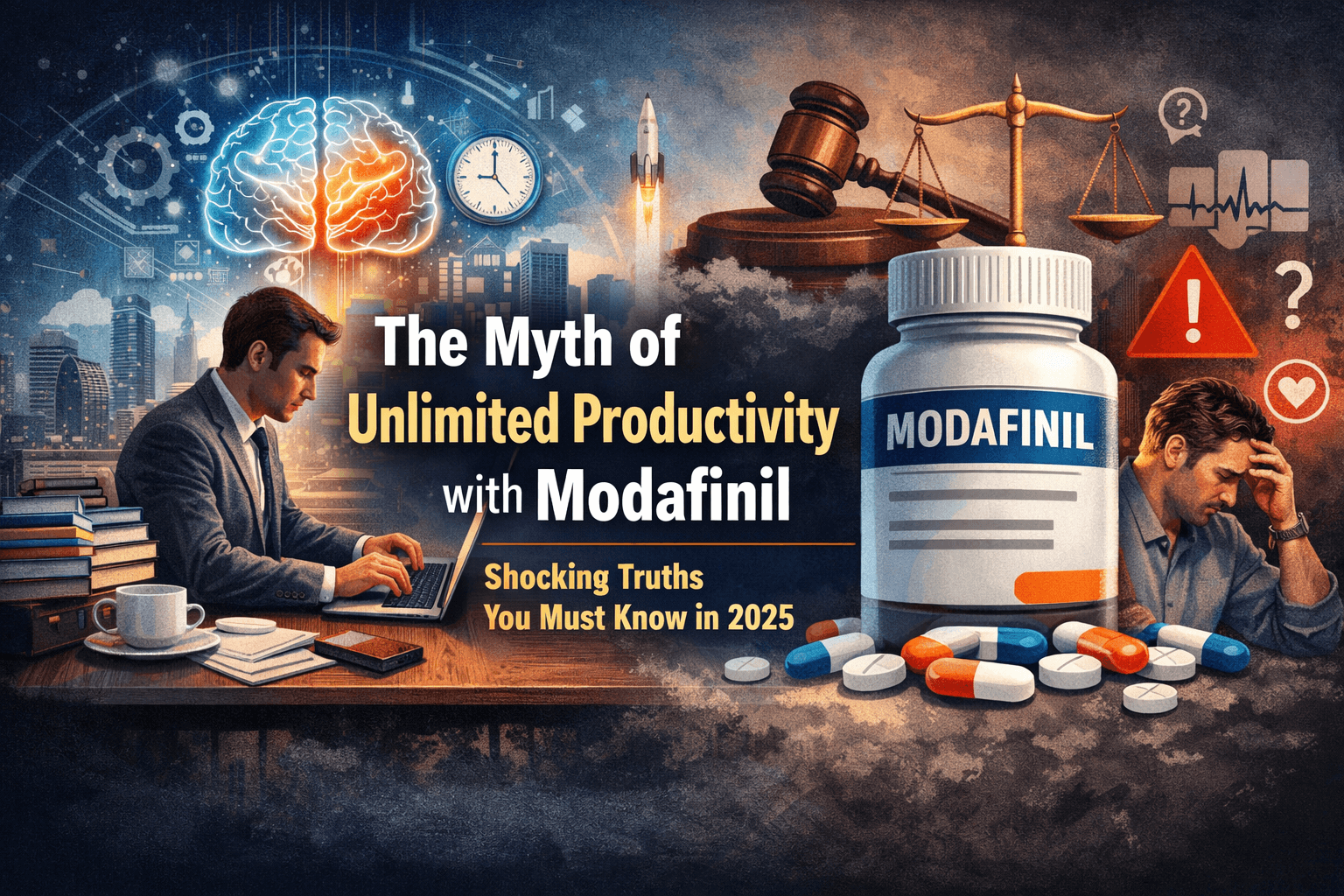
Understanding Modafinil and Modern Productivity
The concept of unlimited productivity with Modafinil has become deeply embedded in modern work culture. Professionals, students, and entrepreneurs alike are drawn to the promise of sharper focus and extended mental stamina. However, productivity is a complex system, not a switch you can flip with a pill.
Modafinil was originally developed to treat narcolepsy and other sleep disorders. Over time, it gained a reputation as a “smart drug.” As a result, the idea of unlimited productivity with Modafinil spread quickly, especially in high-performance environments.
What Modafinil Is and How It Works
Modafinil affects neurotransmitters associated with wakefulness and attention. Unlike classical stimulants, it does not produce an immediate dopamine spike. This mechanism is often cited as evidence supporting unlimited productivity with Modafinil. Still, increased alertness does not equal limitless output.
Why Productivity Myths Spread So Easily
Productivity myths thrive because they offer simple answers to complex problems. In fast-paced industries, people want shortcuts. Consequently, the narrative of unlimited productivity with Modafinil feels convenient, even reassuring.
The Allure of Unlimited Productivity with Modafinil
The promise of unlimited productivity with Modafinil is especially appealing in cultures that reward overwork. Long hours are often mistaken for effectiveness. Therefore, any tool that appears to remove fatigue gains attention quickly.
Cultural Pressure to Perform
From academic settings to corporate environments, expectations keep rising. Modafinil is often framed as a competitive advantage. However, this framing ignores human cognitive limits.
Silicon Valley and Biohacking Narratives
Biohacking communities frequently promote unlimited productivity with Modafinil as part of an optimized lifestyle. While these narratives sound progressive, they often lack balance and scientific restraint.
Scientific Evidence Behind Modafinil Productivity Claims
Scientific literature paints a more nuanced picture. Studies suggest Modafinil may improve alertness and task endurance. Still, there is no credible evidence supporting unlimited productivity with Modafinil.
What Research Actually Shows
According to research summarized by the U.S. National Library of Medicine, Modafinil can enhance performance on specific tasks, particularly in sleep-deprived individuals.
Short-Term Cognitive Effects
Short-term improvements include sustained attention and reduced impulsivity. These effects contribute to the illusion of unlimited productivity with Modafinil, but they are context-dependent.
Long-Term Limitations
Over time, benefits plateau. The brain adapts, expectations increase, and perceived gains diminish. Unlimited productivity with Modafinil remains a myth rather than a measurable outcome.
The Psychological Cost of Chasing Unlimited Productivity
Pursuing unlimited productivity with Modafinil can backfire psychologically. When performance becomes chemically mediated, internal motivation often suffers.
Burnout and Cognitive Fatigue
Ironically, people seeking unlimited productivity with Modafinil may push themselves harder. This behavior increases burnout risk, even if physical fatigue feels suppressed.
Dependency and Expectation Bias
Users may begin to believe they cannot perform without Modafinil. This expectation bias undermines confidence and autonomy, contradicting long-term productivity goals.
Ethical, Legal, and Health Considerations
The conversation around unlimited productivity with Modafinil cannot ignore ethical and legal realities. Modafinil is a prescription medication in many jurisdictions.
Prescription Use vs Off-Label Use
Using Modafinil without medical supervision introduces health risks. The pursuit of unlimited productivity with Modafinil often overlooks these boundaries.
Workplace Ethics
If chemical enhancement becomes normalized, employees may feel coerced. This dynamic raises serious ethical concerns about fairness and consent.
Smarter Alternatives to the Myth
Rather than chasing unlimited productivity with Modafinil, sustainable systems deliver better results over time.
Sustainable Productivity Systems
Time-blocking, priority management, and realistic goal-setting consistently outperform pharmacological shortcuts. These methods respect cognitive limits.
Sleep, Nutrition, and Focus
Sleep quality, balanced nutrition, and intentional breaks remain the most reliable productivity tools. Unlike unlimited productivity with Modafinil, these strategies compound positively.
FAQ
1. Does Modafinil really create unlimited productivity?
No. Scientific evidence does not support unlimited productivity with Modafinil. Effects are limited and context-specific.
2. Is Modafinil safe for healthy individuals?
Safety depends on dosage, supervision, and individual health. Off-label use increases risk.
3. Why do people believe in unlimited productivity with Modafinil?
Marketing narratives, anecdotal success stories, and cultural pressure contribute to the belief.
4. Can Modafinil replace sleep?
No. Modafinil masks sleepiness but does not replace restorative sleep.
5. Is using Modafinil ethical in competitive environments?
This remains debated. Many argue it creates unfair advantages and implicit pressure.
6. What works better than Modafinil for productivity?
Consistent routines, adequate sleep, and cognitive load management outperform drugs long term.
Conclusion
The idea of unlimited productivity with Modafinil is compelling but misleading. While Modafinil has legitimate medical uses and limited cognitive benefits, it does not override human biology. Sustainable productivity comes from systems, habits, and realistic expectations not chemical shortcuts. Understanding this distinction empowers individuals to make smarter, healthier performance decisions.
‼️ Disclaimer: The information provided in this article about modafinil is intended for informational purposes only and is not a substitute for professional medical consultation or recommendations. The author of the article are not responsible for any errors, omissions, or actions based on the information provided.
References:
- McClellan, K. J., & Spencer, C. M. Modafinil: A review of its pharmacology and clinical efficacy in the management of narcolepsy. CNS Drugs, 311–324. https://doi.org/10.2165/00023210-199809040-00006 . 1998.
- Willavize, S. A., Nichols, A. I., & Lee, J. Population pharmacokinetic modeling of armodafinil and its major metabolites. https://doi.org/10.1002/jcph.800 . 2016
- U.S. Food and Drug Administration. PROVIGIL. U.S. Department of Health and Human Services. https://www.accessdata.fda.gov/drugsatfda_docs/label/2015/020717s037s038lbl.pdf . 2015
- Gilleen, J., Michalopoulou, P. G., Reichenberg, A., Drake, R., Wykes, T., Lewis, S. W., & Kapur, S. Modafinil combined with cognitive training is associated with improved learning in healthy volunteers a randomised controlled trial. European Neuropsychopharmacology. 529–539. https://doi.org/10.1016/j.euroneuro.2014.01.001 . 2014
- Greenblatt, K., Adams, N. Modafinil. StatPearls Publishing. https://www.ncbi.nlm.nih.gov/books/NBK531476/ . 2025
- Oliva Ramirez A, Keenan A, Kalau O, Worthington E, Cohen L, Singh S. Prevalence and burden of multiple sclerosis-related fatigue: a systematic literature review. https://doi.org/10.1186/s12883-021-02396-1 . 2021.
- Mereu, M., Bonci, A., Newman, A. H., & Tanda, G. The neurobiology of modafinil as an enhancer of cognitive performance and a potential treatment for substance use disorders. https://doi.org/10.1007/s00213-013-3232-4 . 2013
- Ciancio A, Moretti MC, Natale A, Rodolico A, Signorelli MS, Petralia A. Personality Traits and Fatigue in Multiple Sclerosis: A Narrative Review. Journal of Clinical Medicine. https://doi.org/10.3390/jcm12134518 . 2023
- Natsch, A. What makes us smell: The biochemistry of body odour and the design of new deodorant ingredients. CHIMIA International Journal for Chemistry. https://doi.org/10.2533/chimia.2015.414 . 2015
- Hamada, K., Haruyama, S., Yamaguchi, T., Yamamoto, K., Hiromasa, K., Yoshioka, M., Nishio, D., & Nakamura, M. What determines human body odour? Experimental Dermatology. https://doi.org/10.1111/exd.12380 . 2014