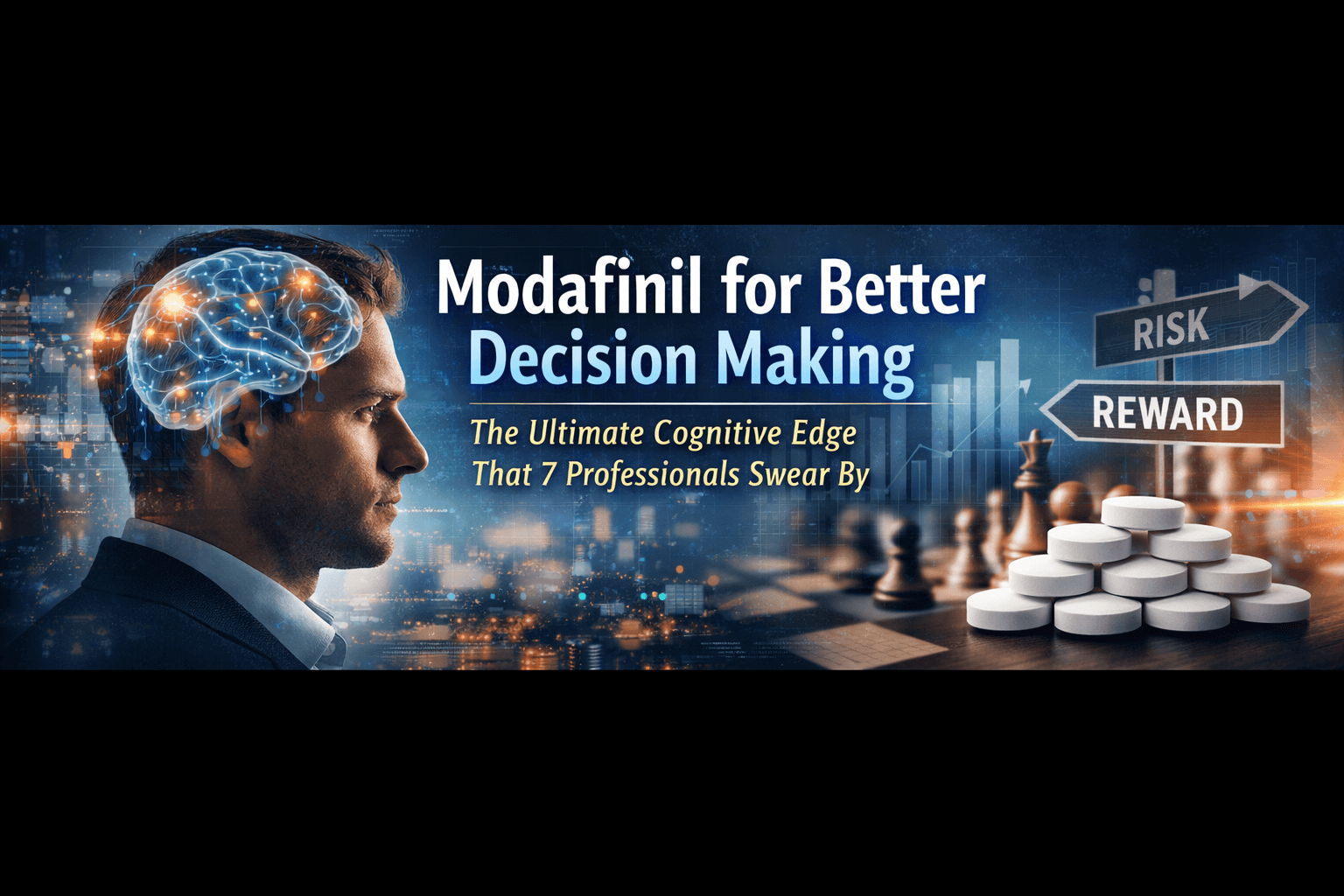
Introduction to Cognitive Decision Making
Decision making is at the core of human performance. Every professional environment whether finance, healthcare, technology, or management demands clear judgment under time pressure. As workloads grow and attention becomes fragmented, people increasingly look for tools that may help maintain cognitive clarity. One compound that frequently enters this discussion is modafinil for better decision making.
Originally developed for medical purposes, modafinil has gained attention beyond clinical settings. Supporters argue it promotes sustained attention, reduces mental fatigue, and supports higher-order thinking. Critics urge caution, emphasizing ethical, legal, and physiological considerations. Structured, evidence-informed look at the topic, focusing on mechanisms, research, and real-world relevance.
What Is Modafinil?
Medical Origins of Modafinil
Modafinil is a prescription medication initially approved for treating sleep related disorders such as narcolepsy, shift work sleep disorder, and obstructive sleep apnea. Its primary function is to promote wakefulness. Unlike traditional stimulants, it was designed to minimize jitteriness and dependency risks.
Over time, clinicians and researchers noticed secondary cognitive effects. Patients often reported improved concentration and mental clarity. These observations triggered broader scientific interest in how modafinil interacts with cognitive processes.
How Modafinil Works in the Brain
Modafinil influences several neurotransmitter systems, including dopamine, norepinephrine, histamine, and orexin. Rather than overstimulating a single pathway, it subtly modulates multiple systems associated with alertness and executive control.
This balanced mechanism is one reason modafinil is often discussed in relation to decision making, not just wakefulness. By reducing cognitive fatigue, it may allow the brain to allocate resources more efficiently during complex reasoning tasks.
The Science Behind Decision Making
Executive Function Explained
Executive functions are high-level cognitive processes responsible for planning, prioritization, inhibition, and flexible thinking. These processes are essential for weighing options, anticipating consequences, and selecting appropriate actions.
Decision making depends heavily on the prefrontal cortex, a brain region particularly sensitive to fatigue and stress. When executive function degrades, individuals may rely on shortcuts, biases, or impulsive choices.
Cognitive Load and Mental Fatigue
Mental fatigue doesn’t just slow reaction times. It alters risk perception, reduces error monitoring, and weakens self-control. Under heavy cognitive load, even experienced professionals can make suboptimal decisions.
This is where interest in modafinil for better decision making emerges. By sustaining alertness and reducing perceived effort, modafinil may help preserve executive resources during prolonged or demanding tasks.
Modafinil for Better Decision Making
Focus and Attention Regulation
One of the most consistently reported effects of modafinil is improved sustained attention. Users often describe an enhanced ability to stay on task without distraction. From a decision-making standpoint, this matters because attention determines which information is processed and which is ignored.
Improved focus can lead to:
- More complete evaluation of available data
- Reduced susceptibility to irrelevant stimuli
- Greater consistency in judgment over time
In complex environments, these factors directly influence decision quality.
Risk Assessment and Impulse Control
Decision making is not just about speed; it’s about balance. Effective decisions require weighing risks against rewards. Some studies suggest modafinil may reduce impulsive responses, particularly in sleep-deprived individuals.
By stabilizing alertness and executive control, modafinil for better decision making may support more deliberate, less emotionally driven choices. That said, effects vary by individual and context.
Evidence from Research and Studies
Clinical Findings
Controlled studies on modafinil show modest but meaningful improvements in attention, working memory, and cognitive flexibility, particularly in individuals experiencing fatigue. In rested individuals, benefits are more nuanced but still observable in demanding tasks.
A frequently cited review published in Neuropsychopharmacology highlights modafinil’s potential to enhance executive function without the pronounced side effects associated with classical stimulants. You can explore peer-reviewed summaries via resources like the U.S. National Library of Medicine.
Real-World Performance Data
Beyond laboratories, modafinil has been studied in simulated real-world scenarios such as military planning, air traffic control, and extended operations. In these contexts, participants maintained decision accuracy longer under sleep deprivation.
However, researchers emphasize that modafinil is not a substitute for rest or training. Instead, it may act as a cognitive support under specific constraints.
Professional Use Cases
Business and Leadership
Executives often face prolonged decision cycles involving incomplete information and high stakes. Cognitive fatigue can lead to risk aversion or overconfidence. Some professionals report that modafinil helps them maintain analytical consistency during long strategy sessions.
From an organizational perspective, the appeal lies in reduced error rates and sustained attention, not superhuman performance.
Medicine and Healthcare
Healthcare professionals regularly make critical decisions under fatigue. Studies involving surgeons and emergency physicians suggest that modafinil may help preserve vigilance and reduce lapses during extended shifts.
That said, medical institutions stress adherence to ethical guidelines and prescription regulations.
Technology and Engineering
Software engineers, data scientists, and systems analysts often work on problems requiring prolonged abstract reasoning. In such fields, decision quality depends on maintaining mental clarity over time.
Interest in modafinil for better decision making within tech circles reflects the growing cognitive demands of modern knowledge work.
Ethical and Legal Considerations
Modafinil is a prescription medication in many jurisdictions. Non-medical use may be restricted or illegal depending on local laws. Ethically, questions arise around fairness, coercion, and workplace expectations.
Organizations must consider whether cognitive enhancement aligns with their values and legal obligations. Transparency and informed consent are essential.
Risks, Side Effects, and Limitations
While generally well-tolerated, modafinil is not risk-free. Potential side effects include headaches, nausea, anxiety, and sleep disturbances. Rare but serious reactions have also been reported.
Limitations include:
- Variable effectiveness across individuals
- Diminished benefits with misuse
- No replacement for sleep, nutrition, or skill development
Any discussion of modafinil for better decision making must acknowledge these constraints.
FAQ
1. Is modafinil proven to improve decision making?
Research suggests it may support cognitive functions related to decision making, especially under fatigue, but results vary.
2. Does modafinil make you smarter?
No. It does not increase intelligence but may help maintain cognitive performance in demanding conditions.
3. Is modafinil safe for long-term use?
Long-term safety should be evaluated by a qualified healthcare professional on a case by case basis.
4. Can modafinil replace sleep?
No. It may temporarily reduce fatigue but does not substitute for restorative sleep.
5. Is modafinil legal everywhere?
Legality varies by country. In many places, it requires a prescription.
6. Who should avoid modafinil?
Individuals with certain medical conditions or sensitivities should avoid it unless advised otherwise by a physician.
Conclusion
The discussion around modafinil for better decision making reflects broader challenges of modern cognitive work. Evidence indicates that modafinil may help sustain attention, executive control, and judgment under specific conditions, particularly fatigue. However, benefits are context dependent and bounded by ethical, legal, and medical considerations.
Used responsibly and legally, modafinil may serve as a cognitive support, not a shortcut or replacement for foundational habits like sleep, training, and experience. Clear eyed evaluation, rather than hype, remains the most rational approach.
‼️ Disclaimer: The information provided in this article about modafinil is intended for informational purposes only and is not a substitute for professional medical consultation or recommendations. The author of the article are not responsible for any errors, omissions, or actions based on the information provided.
References:
- McClellan, K. J., & Spencer, C. M. Modafinil: A review of its pharmacology and clinical efficacy in the management of narcolepsy. CNS Drugs, 311–324. https://doi.org/10.2165/00023210-199809040-00006 . 1998.
- Willavize, S. A., Nichols, A. I., & Lee, J. Population pharmacokinetic modeling of armodafinil and its major metabolites. https://doi.org/10.1002/jcph.800 . 2016
- U.S. Food and Drug Administration. PROVIGIL. U.S. Department of Health and Human Services. https://www.accessdata.fda.gov/drugsatfda_docs/label/2015/020717s037s038lbl.pdf . 2015
- Gilleen, J., Michalopoulou, P. G., Reichenberg, A., Drake, R., Wykes, T., Lewis, S. W., & Kapur, S. Modafinil combined with cognitive training is associated with improved learning in healthy volunteers a randomised controlled trial. European Neuropsychopharmacology. 529–539. https://doi.org/10.1016/j.euroneuro.2014.01.001 . 2014
- Greenblatt, K., Adams, N. Modafinil. StatPearls Publishing. https://www.ncbi.nlm.nih.gov/books/NBK531476/ . 2025
- Oliva Ramirez A, Keenan A, Kalau O, Worthington E, Cohen L, Singh S. Prevalence and burden of multiple sclerosis-related fatigue: a systematic literature review. https://doi.org/10.1186/s12883-021-02396-1 . 2021.
- Mereu, M., Bonci, A., Newman, A. H., & Tanda, G. The neurobiology of modafinil as an enhancer of cognitive performance and a potential treatment for substance use disorders. https://doi.org/10.1007/s00213-013-3232-4 . 2013
- Ciancio A, Moretti MC, Natale A, Rodolico A, Signorelli MS, Petralia A. Personality Traits and Fatigue in Multiple Sclerosis: A Narrative Review. Journal of Clinical Medicine. https://doi.org/10.3390/jcm12134518 . 2023
- Natsch, A. What makes us smell: The biochemistry of body odour and the design of new deodorant ingredients. CHIMIA International Journal for Chemistry. https://doi.org/10.2533/chimia.2015.414 . 2015
- Hamada, K., Haruyama, S., Yamaguchi, T., Yamamoto, K., Hiromasa, K., Yoshioka, M., Nishio, D., & Nakamura, M. What determines human body odour? Experimental Dermatology. https://doi.org/10.1111/exd.12380 . 2014